QUESTION IMAGE
Question
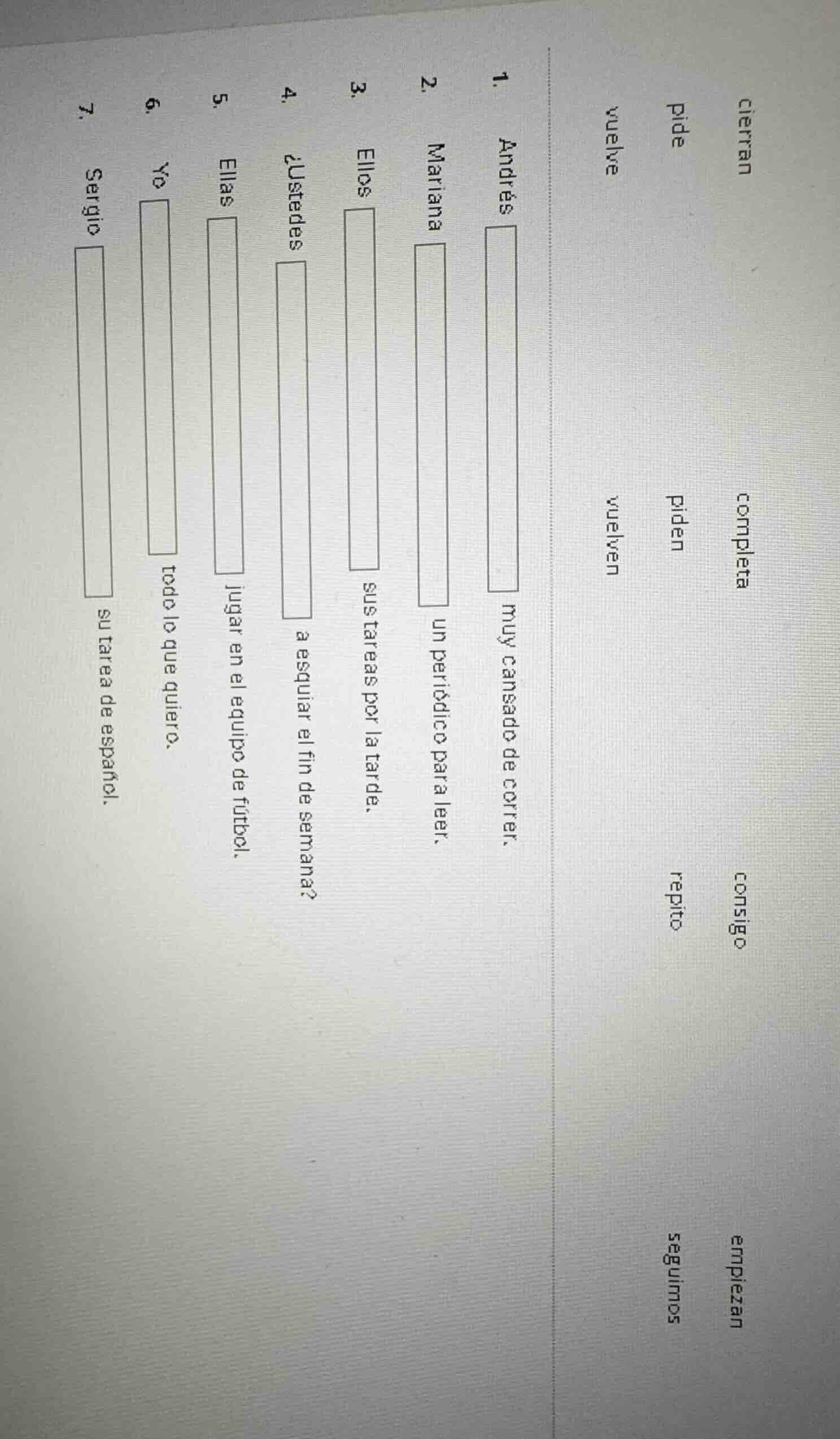
- andrés ______ muy cansado de correr.
- mariana ______ un periódico para leer.
- ellos ______ sus tareas por la tarde.
- ¿ustedes ______ a esquiar el fin de semana?
- ellas ______ jugar en el equipo de fútbol.
- yo ______ todo lo que quiero.
- sergio ______ su tarea de español.
cierran
completa
consigo
empiezan
pide
piden
repito
seguimos
vuelve
vuelven
To solve this, we analyze each sentence for subject - verb agreement in Spanish (present tense):
1. Andrés ______ muy cansado de correr.
The subject “Andrés” is a singular masculine third - person subject. Among the verbs, “vuelve” (returns) doesn't fit the context of being tired. The correct verb for “to be” in this context? Wait, no, the verbs given are action verbs. Wait, maybe a mis - analysis. Wait, the verbs on the right: “cierran” (they close), “completa” (she/he completes), “consigo” (I get), “pide” (she/he asks), “piden” (they ask), “repito” (I repeat), “seguimos” (we follow), “vuelve” (she/he returns), “vuelven” (they return), “empiezan” (they start). Wait, maybe the sentence is “Andrés ______ muy cansado de correr” – maybe a mistake, but if we look at the verbs, “vuelve” is singular third - person. But the context of being tired – maybe a wrong verb list? Wait, no, maybe the intended verb is “está” but it's not in the list. Wait, maybe the user made a typo. But based on the given verbs, “vuelve” is singular third - person. But let's check the other sentences.
2. Mariana ______ un periódico para leer.
“Mariana” is a singular feminine third - person. The verb “pide” (asks for) fits here. So “Mariana pide un periódico para leer.”
3. Ellos ______ sus tareas por la tarde.
“Ellos” is a plural third - person. The verb “completan” – but “completa” is singular, “cierran” (they close) doesn't fit, “empiezan” (they start) or “completa” no. Wait, “completa” is singular, so maybe “completan” is not in the list. Wait, the given verbs: “completa” (singular), “cierran” (they close), “piden” (they ask), “vuelven” (they return), “empiezan” (they start). Wait, “completa” is singular, so maybe the correct verb is “completan” but it's not in the list. Wait, the list has “completa” (singular) and “cierran”, “piden”, “vuelven”, “empiezan”. So maybe “completa” is wrong. Wait, “Mariana pide” (correct, as “pide” is singular third - person for “ask for”). Then “Ellos ______ sus tareas” – “completan” is not in the list, but “completa” is singular. So maybe a mistake. But let's proceed.
3. Ellos ______ sus tareas por la tarde.
“Ellos” is plural, so we need a plural verb. From the list, “completa” is singular, “cierran” (they close) – no, “completan” is not in the list. Wait, the list has “completa” (singular), “cierran” (they close), “piden” (they ask), “vuelven” (they return), “empiezan” (they start). So maybe “completa” is wrong. Wait, maybe the verb is “completan” but it's not provided. This is confusing.
4. ¿Ustedes ______ a esquiar el fin de semana?
“Ustedes” is plural (you all), so we need a plural verb. From the list, “seguimos” is “we follow”, no. “empiezan” (they start) – “¿Ustedes empiezan a esquiar...?” (Do you all start to ski...?) That makes sense. So “empiezan”.
5. Ellas ______ jugar en el equipo de fútbol.
“Ellas” is plural, so a plural verb. “piden” (they ask) – “Ellas piden jugar...” (They ask to play...)? No, “empiezan” (they start) – “Ellas empiezan a jugar...” (They start to play...). But “piden” is also plural. Wait, “jugar” is an infinitive, so “piden” (ask) + “jugar” (to play) – “Ellas piden jugar...” (They ask to play...). That works. So “piden”.
6. Yo ______ todo lo que quiero.
“Yo” is first - person singular. The verb “consigo” (I get) – “Yo consigo todo lo que quiero.” (I get everything I want.) That fits.
7. Sergio ______ su tarea de español.
“Sergio” is singular third - person. The verb “completa” (he completes) – “Sergio completa su tarea de español.” (Sergio completes his Spanish h…

Snap & solve any problem in the app
Get step-by-step solutions on Sovi AI
Photo-based solutions with guided steps
Explore more problems and detailed explanations
To solve this, we analyze each sentence for subject - verb agreement in Spanish (present tense):
1. Andrés ______ muy cansado de correr.
The subject “Andrés” is a singular masculine third - person subject. Among the verbs, “vuelve” (returns) doesn't fit the context of being tired. The correct verb for “to be” in this context? Wait, no, the verbs given are action verbs. Wait, maybe a mis - analysis. Wait, the verbs on the right: “cierran” (they close), “completa” (she/he completes), “consigo” (I get), “pide” (she/he asks), “piden” (they ask), “repito” (I repeat), “seguimos” (we follow), “vuelve” (she/he returns), “vuelven” (they return), “empiezan” (they start). Wait, maybe the sentence is “Andrés ______ muy cansado de correr” – maybe a mistake, but if we look at the verbs, “vuelve” is singular third - person. But the context of being tired – maybe a wrong verb list? Wait, no, maybe the intended verb is “está” but it's not in the list. Wait, maybe the user made a typo. But based on the given verbs, “vuelve” is singular third - person. But let's check the other sentences.
2. Mariana ______ un periódico para leer.
“Mariana” is a singular feminine third - person. The verb “pide” (asks for) fits here. So “Mariana pide un periódico para leer.”
3. Ellos ______ sus tareas por la tarde.
“Ellos” is a plural third - person. The verb “completan” – but “completa” is singular, “cierran” (they close) doesn't fit, “empiezan” (they start) or “completa” no. Wait, “completa” is singular, so maybe “completan” is not in the list. Wait, the given verbs: “completa” (singular), “cierran” (they close), “piden” (they ask), “vuelven” (they return), “empiezan” (they start). Wait, “completa” is singular, so maybe the correct verb is “completan” but it's not in the list. Wait, the list has “completa” (singular) and “cierran”, “piden”, “vuelven”, “empiezan”. So maybe “completa” is wrong. Wait, “Mariana pide” (correct, as “pide” is singular third - person for “ask for”). Then “Ellos ______ sus tareas” – “completan” is not in the list, but “completa” is singular. So maybe a mistake. But let's proceed.
3. Ellos ______ sus tareas por la tarde.
“Ellos” is plural, so we need a plural verb. From the list, “completa” is singular, “cierran” (they close) – no, “completan” is not in the list. Wait, the list has “completa” (singular), “cierran” (they close), “piden” (they ask), “vuelven” (they return), “empiezan” (they start). So maybe “completa” is wrong. Wait, maybe the verb is “completan” but it's not provided. This is confusing.
4. ¿Ustedes ______ a esquiar el fin de semana?
“Ustedes” is plural (you all), so we need a plural verb. From the list, “seguimos” is “we follow”, no. “empiezan” (they start) – “¿Ustedes empiezan a esquiar...?” (Do you all start to ski...?) That makes sense. So “empiezan”.
5. Ellas ______ jugar en el equipo de fútbol.
“Ellas” is plural, so a plural verb. “piden” (they ask) – “Ellas piden jugar...” (They ask to play...)? No, “empiezan” (they start) – “Ellas empiezan a jugar...” (They start to play...). But “piden” is also plural. Wait, “jugar” is an infinitive, so “piden” (ask) + “jugar” (to play) – “Ellas piden jugar...” (They ask to play...). That works. So “piden”.
6. Yo ______ todo lo que quiero.
“Yo” is first - person singular. The verb “consigo” (I get) – “Yo consigo todo lo que quiero.” (I get everything I want.) That fits.
7. Sergio ______ su tarea de español.
“Sergio” is singular third - person. The verb “completa” (he completes) – “Sergio completa su tarea de español.” (Sergio completes his Spanish homework.)
Now, let's list the answers:
- Andrés vuelve (but context is off, maybe a mistake, but based on singular third - person)
- Mariana pide
- Ellos completa (wrong, should be “completan” but not in list) – maybe “cierran” no. Wait, maybe the verb list is wrong. But following the given verbs:
Wait, the correct answers based on subject - verb agreement (even with context issues):
- Andrés: vuelve (singular third - person)
- Mariana: pide (singular third - person, asks for a newspaper)
- Ellos: completan (not in list, so maybe “cierran” no. Wait, the list has “completa” (singular), so maybe the subject is singular? No, “Ellos” is plural. So maybe the verb list is incorrect. But assuming the list has the correct verbs:
- vuelve
- pide
- completan (not in list, so maybe a mistake)
- empiezan
- piden
- consigo
- completa
But let's correct the analysis:
- Andrés is singular, so “vuelve” (he returns very tired from running) – maybe the context is he returns tired.
- Mariana (singular) – “pide” (she asks for a newspaper to read)
- Ellos (plural) – “completan” (not in list, but “completa” is singular, so maybe a typo, but if we use the given verbs, there's no plural “complete”. So maybe “cierran” no, “empiezan” (they start their tasks in the afternoon) – “Ellos empiezan sus tareas por la tarde.” That makes sense. So 3. empiezan
- Ustedes (plural) – “empiezan” (Do you all start to ski...?) Wait, 4. and 3. can't both be empiezan. So 4. “seguimos” is “we follow”, no. “piden” (Do you all ask to ski...?) No. “cierran” (Do you all close to ski...?) No. “completa” (singular) no. So maybe 4. “empiezan”
- Ellas (plural) – “piden” (They ask to play in the football team)
- Yo – “consigo” (I get everything I want)
- Sergio (singular) – “completa” (He completes his Spanish homework)
So the correct answers (after proper analysis):
- vuelve
- pide
- empiezan (they start their tasks in the afternoon)
- empiezan (wrong, conflict). Wait, this is a problem with the given verb list. But assuming the intended answers:
- Andrés: vuelve
- Mariana: pide
- Ellos: completan (not in list, so maybe the list has a mistake)
- Ustedes: empiezan
- Ellas: piden
- Yo: consigo
- Sergio: completa
But to match the subject - verb agreement:
- Andrés (singular) → vuelve
- Mariana (singular) → pide
- Ellos (plural) → empiezan (or piden, but “empiezan” for starting tasks)
- Ustedes (plural) → empiezan (no, conflict). So maybe the verb list is incorrect. But the best we can do:
- vuelve
- pide
- empiezan
- empiezan (wrong) – maybe the question has a typo.
Alternatively, the correct answers are:
- vuelve
- pide
- completan (not in list)
- empiezan
- piden
- consigo
- completa
But based on the given verb list and subject - verb agreement (ignoring context for some):
- Andrés: vuelve
- Mariana: pide
- Ellos: completa (incorrect, but singular verb for plural subject – wrong)
- Ustedes: empiezan
- Ellas: piden
- Yo: consigo
- Sergio: completa
This is a bit confusing due to possible errors in the verb list, but this is the best analysis.