QUESTION IMAGE
Question
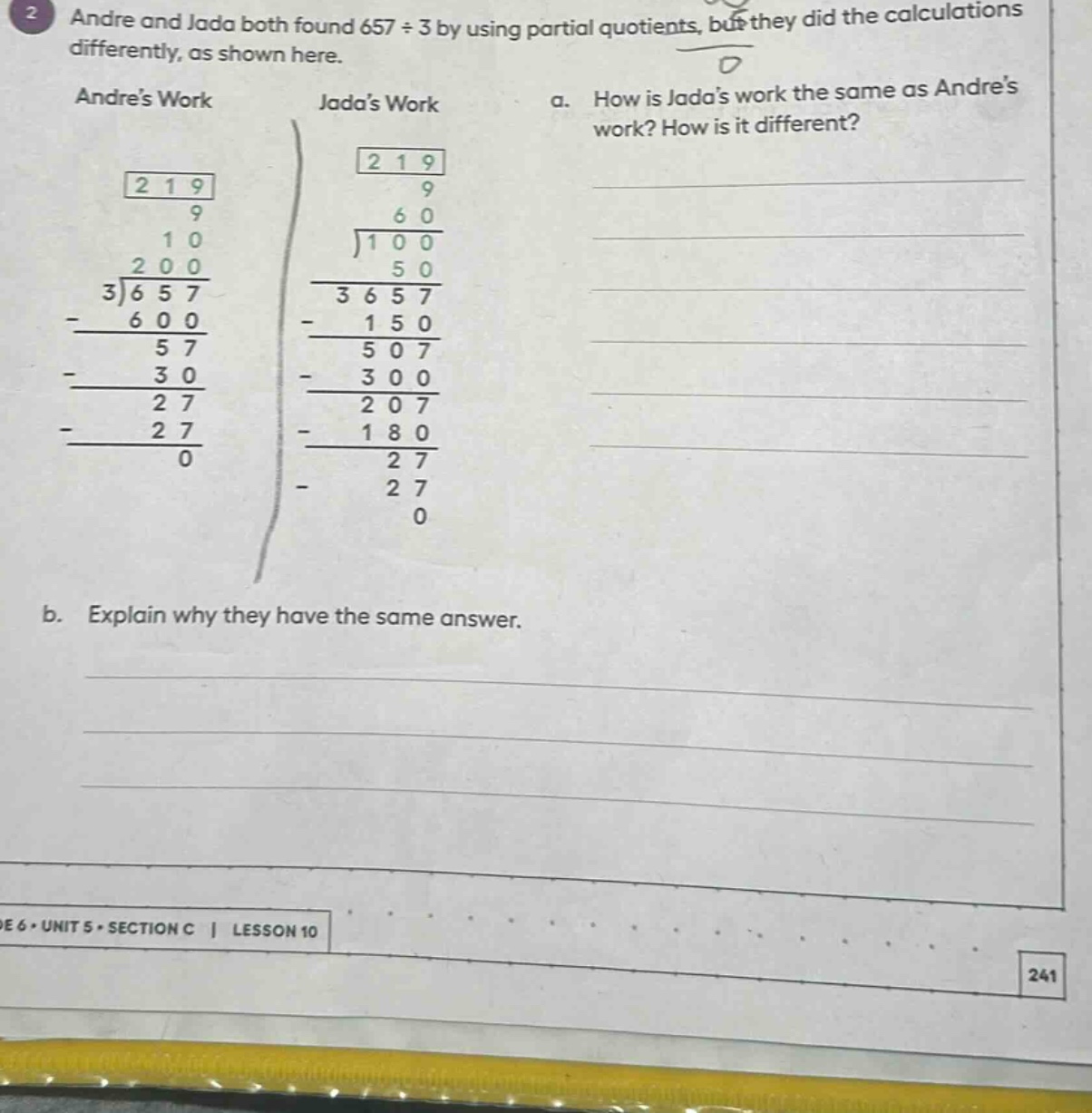
2 andre and jada both found 657 ÷ 3 by using partial quotients, but they did the calculations differently, as shown here. andre’s work jada’s work a. how is jada’s work the same as andre’s work? how is it different? b. explain why they have the same answer.
Part (a)
- Same: Both use partial quotients to divide \(657\) by \(3\), and the final quotient is \(219\). They both subtract multiples of \(3\) from \(657\) until reaching \(0\).
- Different: The partial quotients (multiples of \(3\) subtracted) differ. Andre uses \(600\) ( \(3\times200\) ), \(30\) ( \(3\times10\) ), and \(27\) ( \(3\times9\) ). Jada uses \(150\) ( \(3\times50\) ), \(300\) ( \(3\times100\) ), \(180\) ( \(3\times60\) ), and \(27\) ( \(3\times9\) ). The order and size of the partial products (subtracted amounts) are not the same.
In partial - quotient division, the sum of the partial quotients (the numbers we multiply the divisor by) should equal the total quotient. For \(657\div3\), regardless of the order or size of the partial multiples of \(3\) (partial quotients) used, when we sum the partial quotients:
- For Andre: \(200 + 10+9=219\).
- For Jada: \(50 + 100+60 + 9=219\).
Since they are both dividing \(657\) by \(3\), and the sum of their partial quotients (which are just different groupings of how many times \(3\) fits into \(657\)) equals \(219\), they get the same answer. The total amount being divided (\(657\)) and the divisor (\(3\)) are the same, so the quotient (how many times \(3\) goes into \(657\)) must be the same, even if the path (partial quotients) to get there differs.

Snap & solve any problem in the app
Get step-by-step solutions on Sovi AI
Photo-based solutions with guided steps
Explore more problems and detailed explanations
- Same: Both use partial - quotient division for \(657\div3\), end with quotient \(219\), and subtract multiples of \(3\) to reach \(0\).
- Different: The partial multiples of \(3\) (subtracted amounts) differ. Andre uses \(600\), \(30\), \(27\); Jada uses \(150\), \(300\), \(180\), \(27\) (different partial quotients in order/value).