QUESTION IMAGE
Question
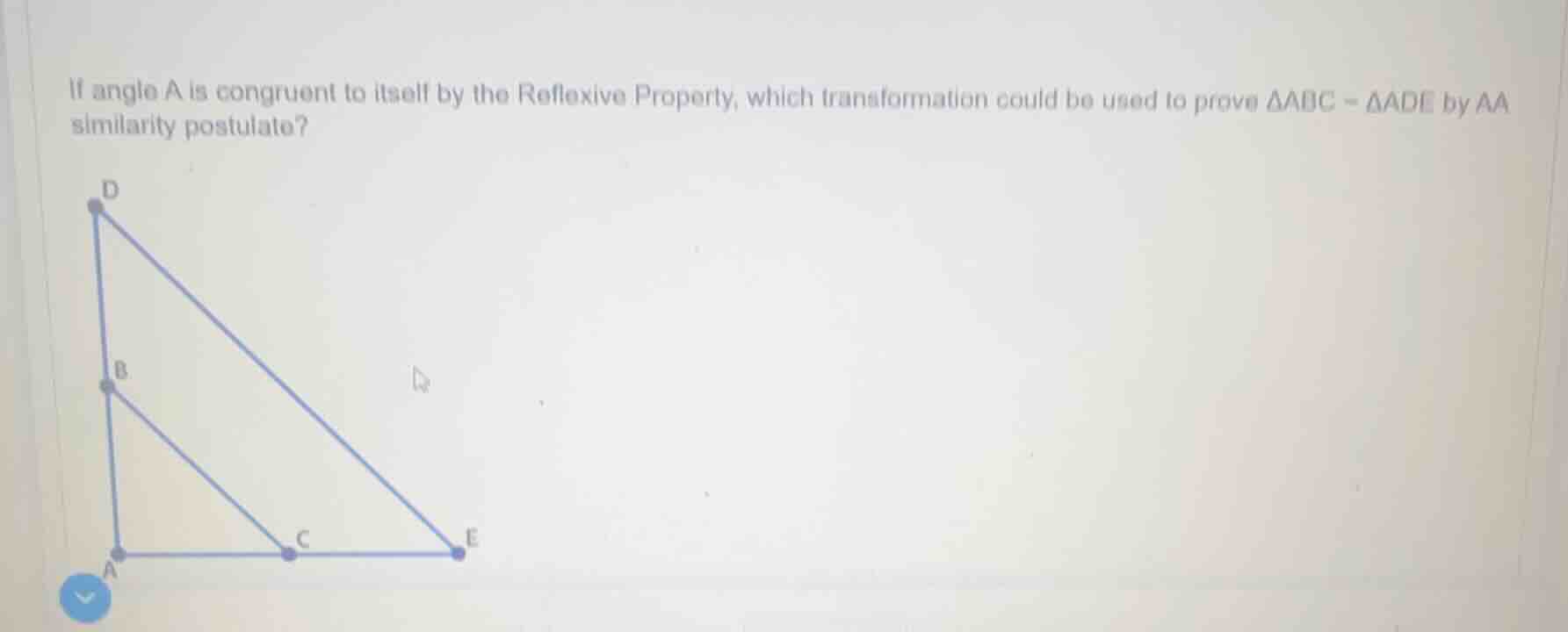
if angle a is congruent to itself by the reflexive property, which transformation could be used to prove $\triangle abc \sim \triangle ade$ by aa similarity postulate?
Step1: Recall AA Similarity
AA (Angle - Angle) similarity postulate states that if two angles of one triangle are congruent to two angles of another triangle, the triangles are similar. We know $\angle A\cong\angle A$ (reflexive property). We need another pair of congruent angles.
Step2: Analyze Transformations
To get another pair of congruent angles, a dilation (or a combination with other transformations like a translation, but mainly dilation here) centered at $A$ can be used. If we dilate $\triangle ABC$ with center $A$ such that the scale factor is chosen appropriately, the sides $AB$ and $AC$ will be mapped to $AD$ and $AE$ respectively (since $B$ is on $AD$ and $C$ is on $AE$). This dilation will preserve the angle measures. So, a dilation centered at $A$ (with a scale factor that maps $AB$ to $AD$ and $AC$ to $AE$) will make $\angle ABC\cong\angle ADE$ (corresponding angles after dilation) and $\angle ACB\cong\angle AED$ (corresponding angles after dilation), thus satisfying AA similarity. Also, a translation or rotation might not be as direct, but dilation (or a similarity transformation) is key here. Specifically, a dilation centered at vertex $A$ can be used to show that the angles at $B$ and $D$ (and $C$ and $E$) are congruent because dilation preserves angle measures and the lines $BC$ and $DE$ are parallel (implied by the position of the points, as $B$ is on $AD$ and $C$ is on $AE$) which gives corresponding angles congruent.

Snap & solve any problem in the app
Get step-by-step solutions on Sovi AI
Photo-based solutions with guided steps
Explore more problems and detailed explanations
A dilation centered at point \( A \) (or a similarity transformation including dilation) can be used to prove \( \triangle ABC \sim \triangle ADE \) by AA similarity, as it preserves angle measures and aligns the sides to show the second pair of congruent angles (e.g., \( \angle ABC \cong \angle ADE \) and \( \angle ACB \cong \angle AED \) due to the parallelism of \( BC \) and \( DE \) after dilation).