QUESTION IMAGE
Question
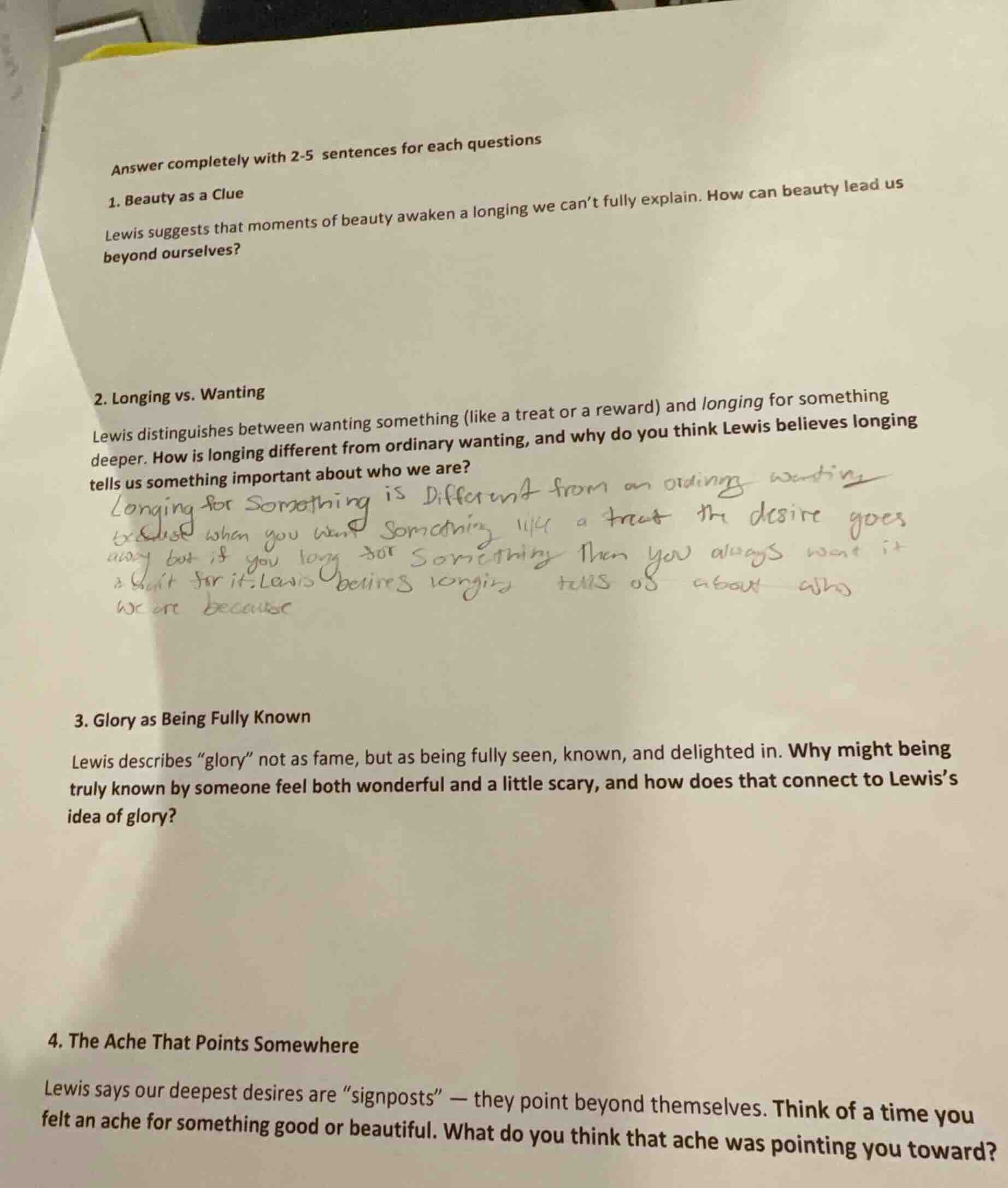
answer completely with 2-5 sentences for each questions
- beauty as a clue
lewis suggests that moments of beauty awaken a longing we cant fully explain. how can beauty lead us beyond ourselves?
- longing vs. wanting
lewis distinguishes between wanting something (like a treat or a reward) and longing for something deeper. how is longing different from ordinary wanting, and why do you think lewis believes longing tells us something important about who we are?
longing for something is different from an ording wanting
when you want something like a treat the desire goes
away but if you long for something then you always want it
a wait for it. lewis believes longing tells us about who
we are because
- glory as being fully known
lewis describes \glory\ not as fame, but as being fully seen, known, and delighted in. why might being truly known by someone feel both wonderful and a little scary, and how does that connect to lewiss idea of glory?
- the ache that points somewhere
lewis says our deepest desires are \signposts\ — they point beyond themselves. think of a time you felt an ache for something good or beautiful. what do you think that ache was pointing you toward?
- For Beauty as a Clue: Lewis frames beauty as a hint of a transcendent reality; when we encounter beauty (like a sunset or a poem), the unfulfillable longing it sparks pushes us to seek something beyond our mundane, finite lives, as the beauty itself is just a reflection of a greater, eternal goodness we intuitively crave. This longing draws us away from self-centered concerns to pursue meaning that lies outside our individual experience.
- For Longing vs. Wanting: Ordinary wanting is a finite, satiable desire for tangible, immediate things—once you get the treat or reward, the desire fades. Longing, by contrast, is an unquenchable, inward ache for something intangible and transcendent, like purpose or eternal beauty. Lewis sees this as key to our identity because it reveals we are not meant for only the temporary, physical world; our capacity for this deep longing proves we are wired for something beyond our current existence.
- For Glory as Being Fully Known: Being truly known feels wonderful because it brings profound acceptance—when someone sees our flaws, fears, and joys still delights in us, it fulfills our innate desire to be loved unconditionally. It feels scary because it requires vulnerability; we must let go of the masks we wear to be seen as "perfect," risking rejection. For Lewis, this ties to glory because glory is not about praise, but about being fully seen and cherished by the divine, which is both the ultimate fulfillment of our longing for connection and the ultimate act of vulnerability in opening ourselves to that perfect knowledge.
- For The Ache That Points Somewhere: When I felt an ache while listening to a piece of classical music that captured quiet joy and loss, that ache was pointing toward a longing for a world without grief, where joy is permanent. This aligns with Lewis's idea: the ache was not for the music itself, but for the transcendent, unbroken beauty and peace the music only hinted at—a sense of home or eternal goodness that lies beyond our imperfect, temporary lives.

Snap & solve any problem in the app
Get step-by-step solutions on Sovi AI
Photo-based solutions with guided steps
Explore more problems and detailed explanations
- Beauty sparks an unnameable longing that hints at a transcendent reality beyond our mundane lives. This ache draws us to move past self-focused concerns, pushing us to seek eternal, meaningful goodness that the beautiful thing only reflects, leading us beyond our limited individual experience.
- Ordinary wanting is a satiable desire for tangible, immediate rewards that fades once fulfilled, while longing is an unquenchable, inward ache for intangible, transcendent things like purpose or eternal beauty. Lewis believes this reveals our true identity: we are not made for only the temporary physical world, as this deep, unfulfillable longing proves we are wired for something beyond our current existence.
- Being truly known is wonderful because it brings unconditional acceptance, fulfilling our desire to be loved for our whole selves, but scary because it demands radical vulnerability, forcing us to let go of performative "perfection" and risk rejection. For Lewis, this mirrors his definition of glory: glory is not fame, but being fully seen, known, and delighted in by the divine—this is the ultimate fulfillment of our longing for connection, and the ultimate act of trusting in perfect, unconditionally loving knowledge.
- When I felt an ache while watching a documentary about a community living in deep, mutual care, that ache was pointing toward a longing for radical, unbroken connection and belonging that feels missing in my often isolated, individualistic daily life. This aligns with Lewis's signpost idea: the ache was not for that specific community, but for the transcendent, perfect version of love and belonging that the community only partially embodied, a state of being beyond our fragmented, temporary human relationships.