QUESTION IMAGE
Question
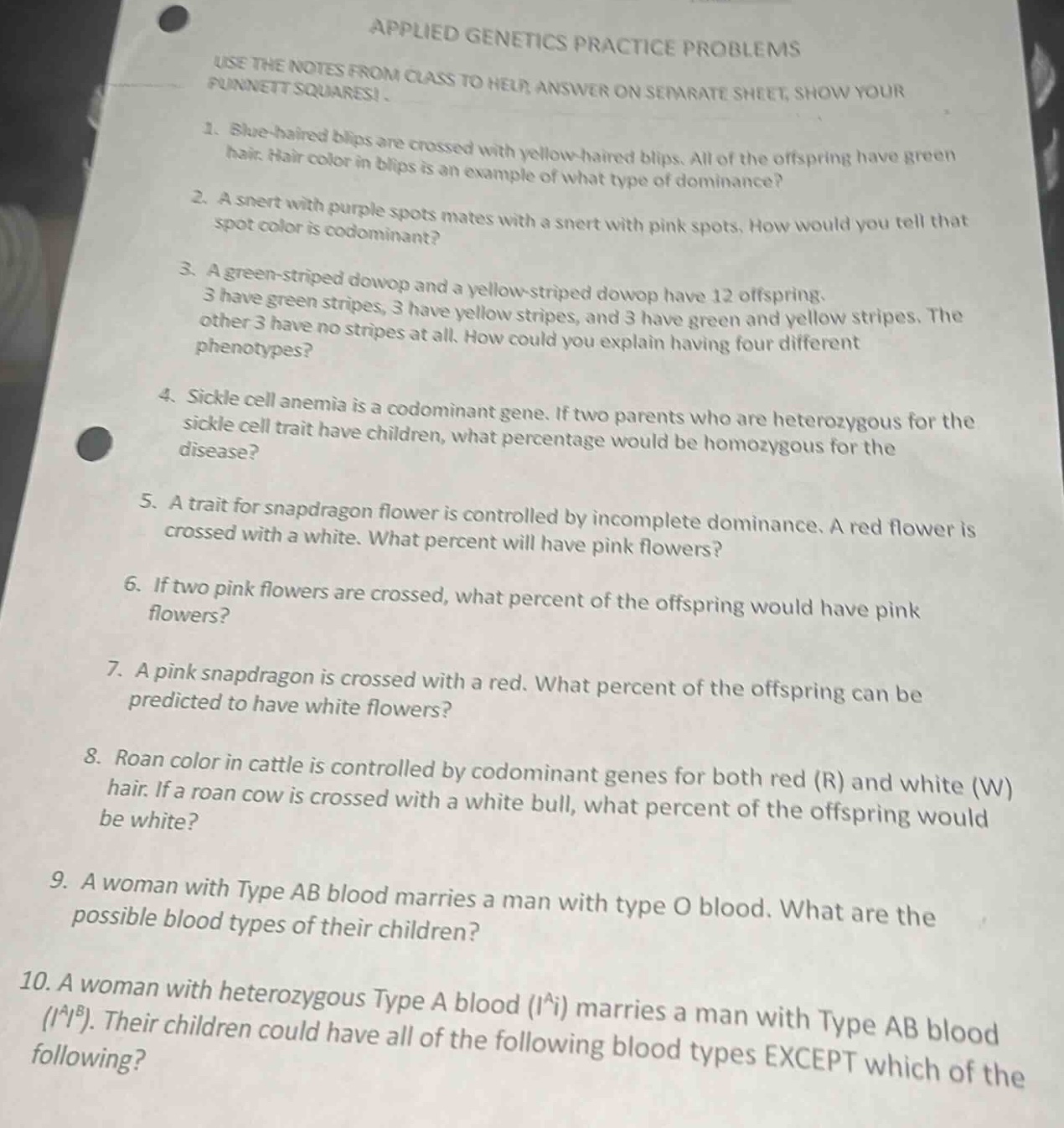
applied genetics practice problems
use the notes from class to help, answer on separate sheet, show your
punnett squares! .
- blue - haired blips are crossed with yellow - haired blips. all of the offspring have green
hair. hair color in blips is an example of what type of dominance?
- a snert with purple spots mates with a snert with pink spots. how would you tell that
spot color is codominant?
- a green - striped dowop and a yellow - striped dowop have 12 offspring.
3 have green stripes, 3 have yellow stripes, and 3 have green and yellow stripes. the
other 3 have no stripes at all. how could you explain having four different
phenotypes?
- sickle cell anemia is a codominant gene. if two parents who are heterozygous for the
sickle cell trait have children, what percentage would be homozygous for the
disease?
- a trait for snapdragon flower is controlled by incomplete dominance. a red flower is
crossed with a white. what percent will have pink flowers?
- if two pink flowers are crossed, what percent of the offspring would have pink
flowers?
- a pink snapdragon is crossed with a red. what percent of the offspring can be
predicted to have white flowers?
- roan color in cattle is controlled by codominant genes for both red (r) and white (w)
hair. if a roan cow is crossed with a white bull, what percent of the offspring would
be white?
- a woman with type ab blood marries a man with type o blood. what are the
possible blood types of their children?
- a woman with heterozygous type a blood (i^a i) marries a man with type ab blood
(i^a i^b). their children could have all of the following blood types except which of the
following?
Let's solve problem 4:
Step 1: Define the alleles
Let \( S \) represent the normal allele and \( s \) represent the sickle cell allele. Since it's codominant, heterozygous individuals have the genotype \( Ss \), showing both traits (some normal and some sickle - shaped red blood cells).
Step 2: Set up the Punnett square
The parents are both heterozygous (\( Ss \)). The Punnett square for a cross between two \( Ss \) individuals is:
| \( S \) | \( s \) | |
|---|---|---|
| \( s \) | \( Ss \) | \( ss \) |
Step 3: Determine the homozygous for the disease genotype
The genotype for homozygous with the sickle cell disease is \( ss \). From the Punnett square, out of 4 possible genotypes (\( SS \), \( Ss \), \( Ss \), \( ss \)), only 1 is \( ss \).
Step 4: Calculate the percentage
To find the percentage, we use the formula: \( \text{Percentage}=\frac{\text{Number of } ss \text{ genotypes}}{\text{Total number of genotypes}}\times100\% \)
Substituting the values, we get \( \frac{1}{4}\times 100\% = 25\% \)

Snap & solve any problem in the app
Get step-by-step solutions on Sovi AI
Photo-based solutions with guided steps
Explore more problems and detailed explanations
25%