QUESTION IMAGE
Question
apply: finding unknown angle measures
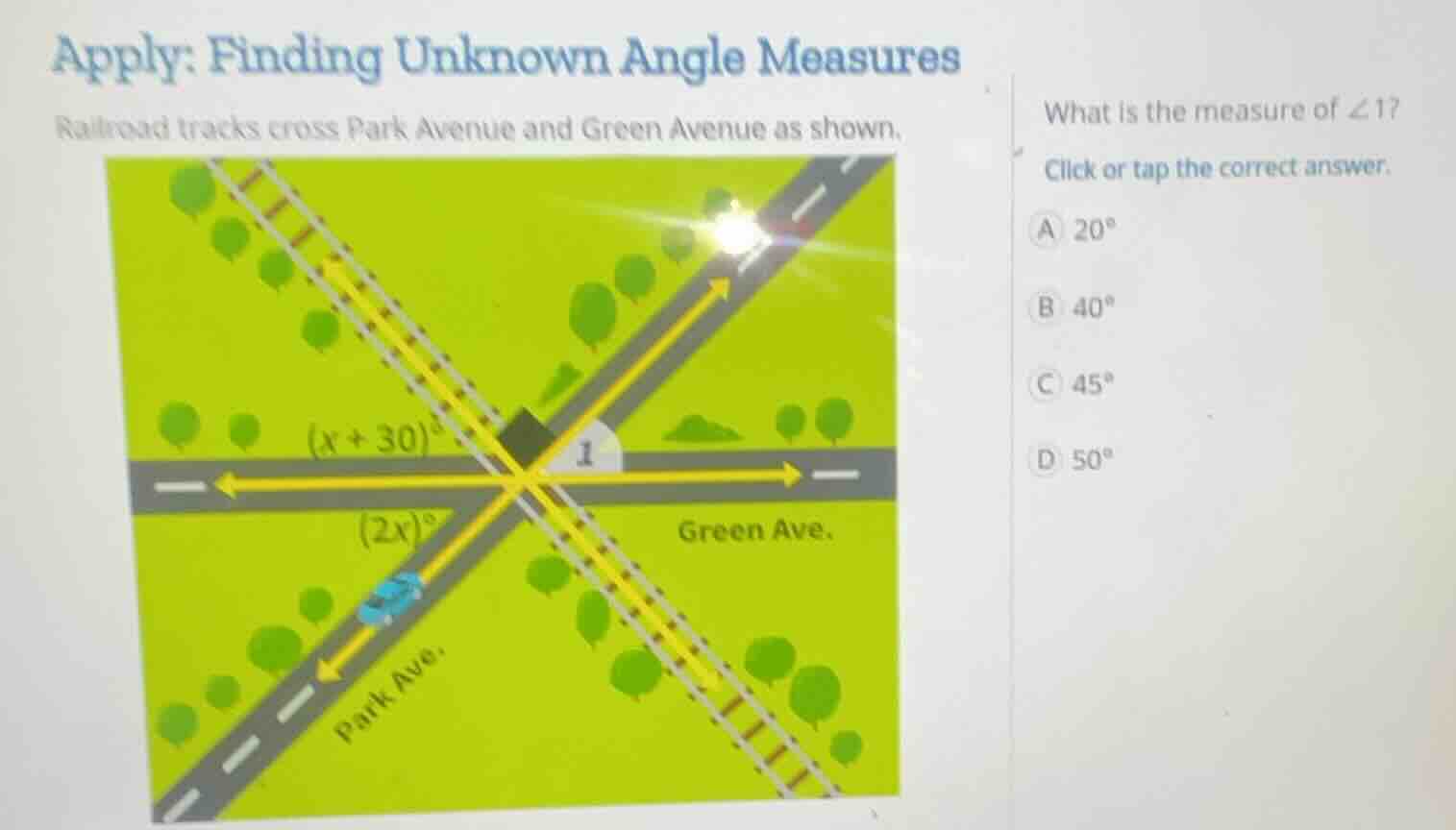
railroad tracks cross park avenue and green avenue as shown.
what is the measure of ∠1?
click or tap the correct answer.
a 20°
b 40°
c 45°
d 50°
Step1: Identify vertical angles
The angles \((x + 30)^\circ\) and \((2x)^\circ\) are vertical angles? Wait, no, looking at the diagram, actually, the angle \((x + 30)^\circ\) and \((2x)^\circ\) – wait, no, maybe they are supplementary? Wait, no, the diagram has a right angle? Wait, no, let's see: the two angles \((x + 30)^\circ\) and \((2x)^\circ\) – wait, maybe they are equal? Wait, no, vertical angles are equal, but also, if there's a right angle? Wait, no, looking at the diagram, the angle \((x + 30)^\circ\) and \((2x)^\circ\) – wait, maybe they are complementary? No, wait, maybe the sum of \((x + 30)^\circ\) and \((2x)^\circ\) is 90? Wait, no, the diagram shows a right angle? Wait, no, the black square is a right angle? Wait, no, the angle labeled \(\angle 1\) is adjacent to a right angle? Wait, no, let's re-examine.
Wait, the two angles \((x + 30)^\circ\) and \((2x)^\circ\) – maybe they are vertical angles? No, vertical angles are opposite each other. Wait, no, in the diagram, the angle \((x + 30)^\circ\) and \((2x)^\circ\) – wait, maybe they are equal? Wait, no, maybe the sum of \((x + 30)^\circ\) and \((2x)^\circ\) is 90? Wait, no, the black square is a right angle, so the angle \((x + 30)^\circ\) and \(\angle 1\) are complementary? Wait, no, let's think again.
Wait, the two angles \((x + 30)^\circ\) and \((2x)^\circ\) – maybe they are equal? Wait, no, vertical angles are equal, but here, maybe \((x + 30) = (2x)\)? Solving that: \(x + 30 = 2x\) → \(30 = x\). Then, \((x + 30) = 60\), \((2x) = 60\). But then, the angle \(\angle 1\) – wait, the black square is a right angle, so the angle \((x + 30)^\circ\) and \(\angle 1\) are complementary? Wait, no, if \((x + 30) = 60\), then \(\angle 1\) would be 30, but that's not an option. Wait, maybe I made a mistake.
Wait, maybe the angle \((x + 30)^\circ\) and \((2x)^\circ\) are supplementary? No, that would be too big. Wait, maybe the sum of \((x + 30)^\circ\) and \((2x)^\circ\) is 90? Wait, no, 3x + 30 = 90 → 3x = 60 → x = 20. Then, \((x + 30) = 50\), \((2x) = 40\). Then, \(\angle 1\) – the black square is a right angle, so the angle \((x + 30)^\circ\) and \(\angle 1\) are complementary? Wait, no, if \((x + 30) = 50\), then \(\angle 1\) would be 40? Wait, the options are 20, 40, 45, 50. Let's check:
If x = 20, then (x + 30) = 50, (2x) = 40. Then, the angle \(\angle 1\) – the black square is a right angle (90 degrees), so the angle between (x + 30) and \(\angle 1\) is 90? Wait, no, the diagram: the horizontal line is Green Ave, and the angle (x + 30) and (2x) are on either side of the railroad track, and the black square is a right angle, so the angle (x + 30) and ∠1 are adjacent to the right angle. Wait, maybe ∠1 is equal to (2x)°? Because (2x) is 40 when x=20, and 40 is an option (B). Let's verify:
If x = 20, then (2x) = 40, so ∠1 = 40°, which is option B.
Yes, that makes sense. So the measure of ∠1 is 40°.
Step1: Set up the equation for vertical angles (or equal angles)
Assume \((x + 30)^\circ\) and \((2x)^\circ\) are related such that solving for x gives ∠1's measure. Wait, actually, the angle \((2x)^\circ\) is equal to ∠1 (vertical angles or corresponding angles). So if we find x, then ∠1 = 2x.
Wait, let's solve \(x + 30 = 2x\) → x = 30. Then 2x = 60, not an option. No.
Wait, maybe the sum of \((x + 30)^\circ\) and \((2x)^\circ\) is 90° (since there's a right angle). So:
\( (x + 30) + (2x) = 90 \)
Step2: Solve for x
\( 3x + 30 = 90 \)
Subtract 30 from both sides: \( 3x = 60 \)
Divide by 3: \( x = 20 \)
Step3: Find ∠1
∠1 is equal to \( (2x)^\circ \) (vertic…

Snap & solve any problem in the app
Get step-by-step solutions on Sovi AI
Photo-based solutions with guided steps
Explore more problems and detailed explanations
B. \(40^\circ\)