QUESTION IMAGE
Question
applying the 45°-45°-90° triangle theorem
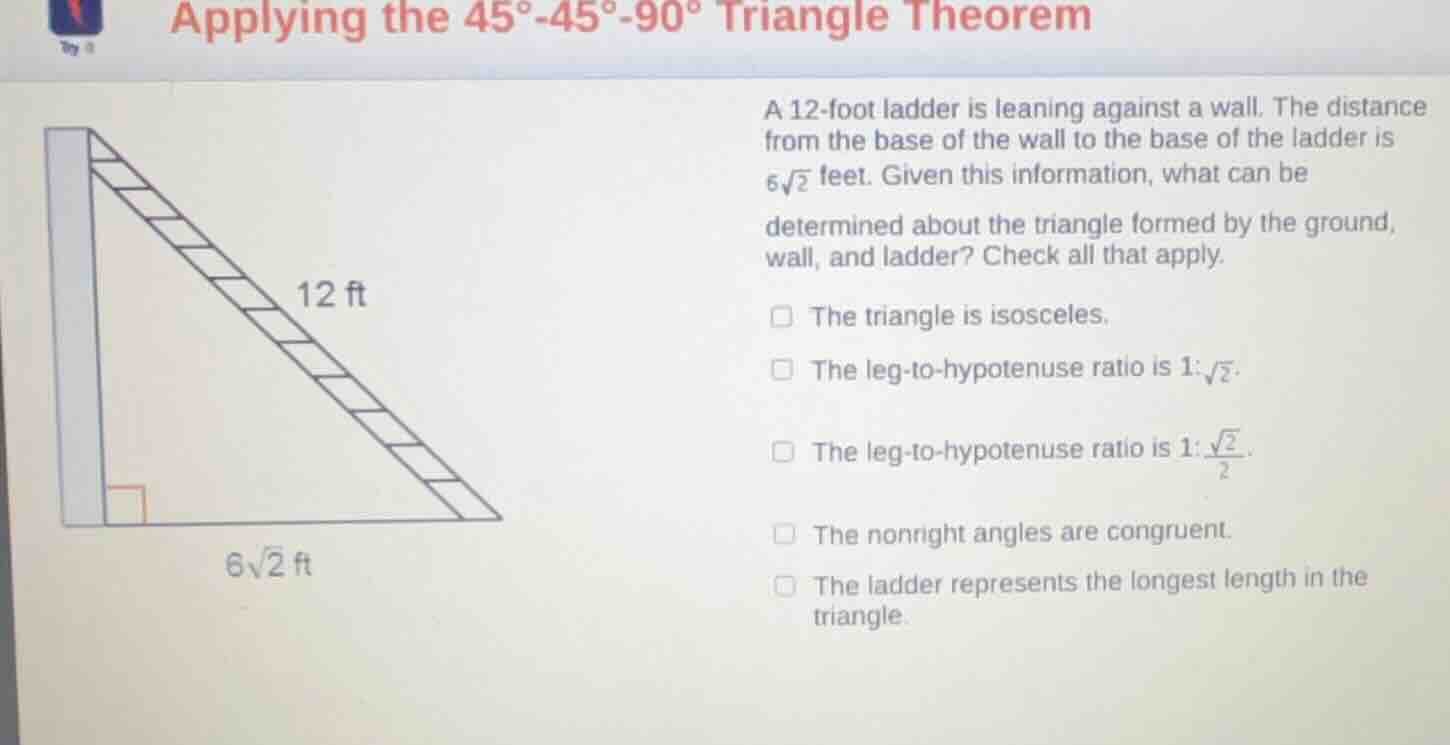
a 12-foot ladder is leaning against a wall. the distance from the base of the wall to the base of the ladder is $6\sqrt{2}$ feet. given this information, what can be determined about the triangle formed by the ground, wall, and ladder? check all that apply.
□ the triangle is isosceles.
□ the leg-to-hypotenuse ratio is $1:\sqrt{2}$.
□ the leg-to-hypotenuse ratio is $1:\frac{\sqrt{2}}{2}$.
□ the nonright angles are congruent.
□ the ladder represents the longest length in the triangle.
Step1: Calculate missing leg length
Use Pythagorean theorem: $a^2 + b^2 = c^2$. Let $a=6\sqrt{2}$, $c=12$, solve for $b$.
$$b = \sqrt{c^2 - a^2} = \sqrt{12^2 - (6\sqrt{2})^2} = \sqrt{144 - 72} = \sqrt{72} = 6\sqrt{2}$$
Step2: Verify triangle type
Both legs equal ($6\sqrt{2}=6\sqrt{2}$), so it is isosceles right triangle.
Step3: Check leg-hypotenuse ratio
Ratio of leg to hypotenuse: $\frac{6\sqrt{2}}{12} = \frac{\sqrt{2}}{2}$, so ratio is $1:\frac{\sqrt{2}}{2}$.
Step4: Check non-right angles
In isosceles right triangle, non-right angles are both $45^\circ$, so congruent.
Step5: Confirm longest side
Hypotenuse (ladder, 12 ft) is longest side in right triangle.

Snap & solve any problem in the app
Get step-by-step solutions on Sovi AI
Photo-based solutions with guided steps
Explore more problems and detailed explanations
- The triangle is isosceles.
- The leg-to-hypotenuse ratio is $1:\frac{\sqrt{2}}{2}$.
- The nonright angles are congruent.
- The ladder represents the longest length in the triangle.