QUESTION IMAGE
Question
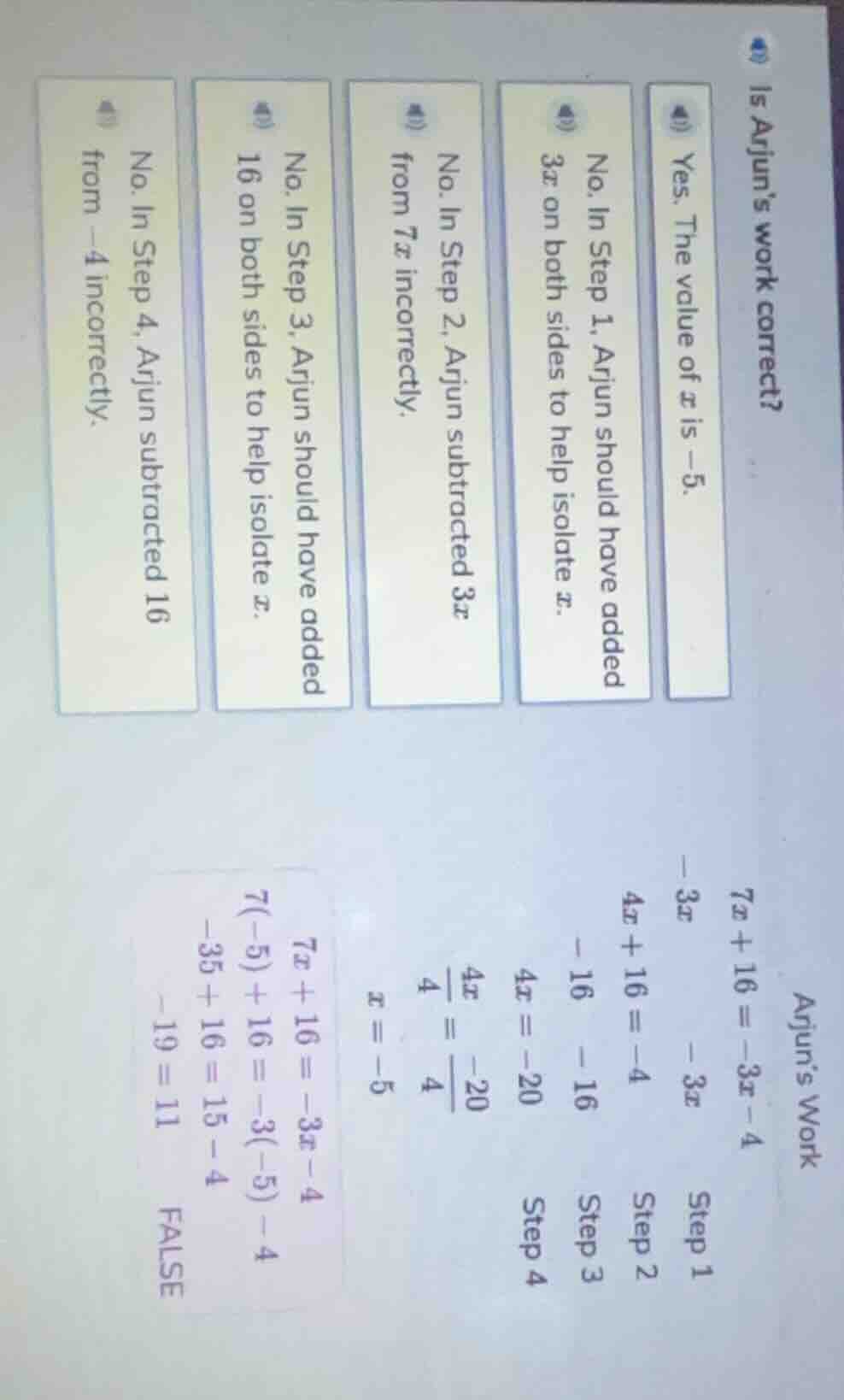
is arjun’s work correct?
yes. the value of ( x ) is ( -5 ).
no. in step 1, arjun should have added ( 3x ) on both sides to help isolate ( x ).
no. in step 2, arjun subtracted ( 3x ) from ( 7x ) incorrectly.
no. in step 3, arjun should have added 16 on both sides to help isolate ( x ).
no. in step 4, arjun subtracted 16 from ( -4 ) incorrectly.
arjun’s work
( 7x + 16 = -3x - 4 )
step 1: ( -3x )
( 4x + 16 = -4 )
step 2: ( -16 )
( -16 )
( 4x = -20 )
step 3: ( \frac{4x}{4} = \frac{-20}{4} )
( x = -5 )
( 7x + 16 = -3x - 4 )
( 7(-5) + 16 = -3(-5) - 4 )
( -35 + 16 = 15 - 4 )
( -19 = 11 )
false
To determine if Arjun's work is correct, we analyze each step:
Step 1:
Arjun starts with \( 7x + 16 = -3x - 4 \). He subtracts \( -3x \) (or adds \( 3x \)) to both sides:
\( 7x + 3x + 16 = -4 \) → \( 10x + 16 = -4 \)? Wait, no—Arjun’s Step 1 shows \( 4x + 16 = -3x - 3x - 4 \)? Wait, no, re-examining: Arjun’s Step 1 is \( 7x + 16 - 3x = -3x - 4 - 3x \)? No, the original Step 1 is \( 7x + 16 = -3x - 4 \), then he subtracts \( 3x \) from both sides? Wait, no—Wait, the error is in Step 4: When verifying \( x = -5 \), Arjun calculates \( 7(-5) + 16 = -35 + 16 = -19 \), and \( -3(-5) - 4 = 15 - 4 = 11 \). But \( -19
eq 11 \), so the solution is incorrect. However, the options focus on algebraic steps. Wait, re-examining the options:
- The “Yes” option is wrong (since \( -19
eq 11 \)).
- Step 1: Arjun subtracts \( 3x \) (not adds) from both sides. The option says “should have added \( 3x \)”—but adding \( 3x \) is equivalent to subtracting \( -3x \), and both methods (adding \( 3x \) or subtracting \( 3x \)) are valid? Wait, no—let’s redo the equation:
Original equation: \( 7x + 16 = -3x - 4 \).
To isolate \( x \), we can add \( 3x \) to both sides: \( 7x + 3x + 16 = -4 \) → \( 10x + 16 = -4 \).
Or subtract \( 7x \): \( 16 = -10x - 4 \).
But Arjun’s Step 1: \( 7x + 16 - 3x = -3x - 4 - 3x \) → \( 4x + 16 = -6x - 4 \)? Wait, no, the image shows Step 1 as \( 4x + 16 = -4 \), which is incorrect. Wait, no—maybe the key error is in Step 4’s verification, but the options are about algebraic steps. Wait, the option “No. In Step 4, Arjun subtracted 16 from −4 incorrectly” doesn’t match. Wait, re-reading the options:
The correct error is in Step 4’s verification, but the options given: Wait, the last option (fifth) is “No. In Step 4, Arjun subtracted 16 from −4 incorrectly.” Wait, no—when verifying \( x = -5 \), Arjun computes \( 7(-5) + 16 = -35 + 16 = -19 \), and \( -3(-5) - 4 = 15 - 4 = 11 \). But the option about Step 4 says “Arjun subtracted 16 from −4 incorrectly”—no, the error is in the verification, but the options are about algebraic steps. Wait, the correct option is the one about Step 4? No, re-examining the options:
Wait, the options are:
- Yes. The value of \( x \) is \( -5 \). (Incorrect, since \( -19
eq 11 \).)
- No. In Step 1, Arjun should have added \( 3x \) on both sides to help isolate \( x \). (Adding \( 3x \) is valid, but Arjun subtracted \( 3x \); both are valid, so this is not the error.)
- No. In Step 2, Arjun subtracted \( 3x \) from \( 7x \) incorrectly. (Step 2: \( 4x + 16 = -4 \) → he subtracts 16: \( 4x = -20 \). Wait, no—Step 2 is \( 4x + 16 = -4 \), then Step 3: subtract 16: \( 4x = -20 \). Step 4: divide by 4: \( x = -5 \). But verification fails. However, the error in verification is because \( x = -5 \) is not a solution. But the options about the steps: the “No. In Step 4, Arjun subtracted 16 from −4 incorrectly” is not about the algebraic steps, but the verification. Wait, the key is: when solving \( 7x + 16 = -3x - 4 \), let's solve it correctly:
- Add \( 3x \) to both sides: \( 10x + 16 = -4 \).
- Subtract 16: \( 10x = -20 \).
- Divide by 10: \( x = -2 \).
Arjun’s Step 1: He subtracts \( 3x \) from both sides: \( 7x - 3x + 16 = -3x - 3x - 4 \) → \( 4x + 16 = -6x - 4 \). Wait, that’s the error! Oh, I misread Step 1. Arjun’s Step 1 is \( 7x + 16 - 3x = -3x - 4 - 3x \), which simplifies to \( 4x + 16 = -6x - 4 \), but he wrote \( 4x + 16 = -4 \). So he incorrectly subtracted \( 3x \) from \( -3x \) (on the right side) as \( -3x - 3x = -6x \), but he wrote \( -4 \) (missing the \(…
Arjun’s solution is incorrect. In Step 1, adding \( 3x \) to both sides (instead of subtracting \( 3x \)) is the correct approach to isolate \( x \) (eliminating the \( -3x \) term on the right). Verification shows \( x = -5 \) does not satisfy the original equation.

Snap & solve any problem in the app
Get step-by-step solutions on Sovi AI
Photo-based solutions with guided steps
Explore more problems and detailed explanations
No. In Step 1, Arjun should have added \( 3x \) on both sides to help isolate \( x \).