QUESTION IMAGE
Question
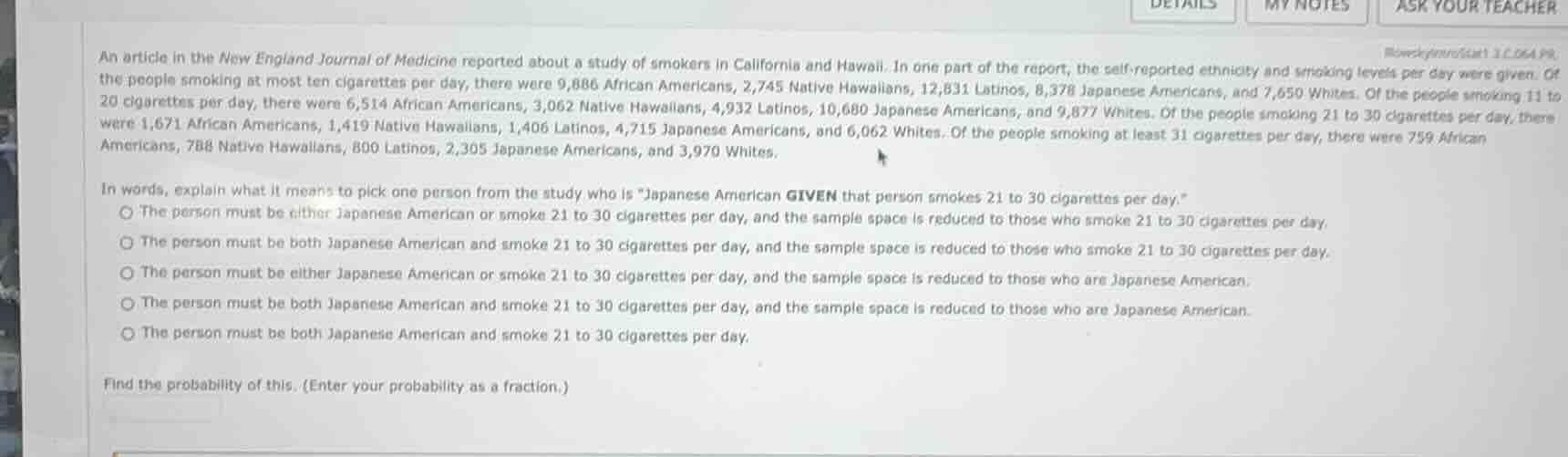
an article in the new england journal of medicine reported about a study of smokers in california and hawaii. in one part of the report, the self - reported ethnicity and smoking levels per day were given: of the people smoking at most ten cigarettes per day, there were 9,886 african americans, 2,745 native hawaiians, 12,831 latinos, 8,378 japanese americans, and 7,650 whites. of the people smoking 11 to 20 cigarettes per day, there were 6,514 african americans, 3,062 native hawaiians, 4,932 latinos, 10,680 japanese americans, and 9,877 whites. of the people smoking 21 to 30 cigarettes per day, there were 1,671 african americans, 1,419 native hawaiians, 1,406 latinos, 4,715 japanese americans, and 6,062 whites. of the people smoking at least 31 cigarettes per day, there were 759 african americans, 788 native hawaiians, 800 latinos, 2,305 japanese americans, and 3,970 whites.
in words, explain what it means to pick one person from the study who is “japanese american given that person smokes 21 to 30 cigarettes per day.”
○ the person must be either japanese american or smoke 21 to 30 cigarettes per day, and the sample space is reduced to those who smoke 21 to 30 cigarettes per day.
○ the person must be both japanese american and smoke 21 to 30 cigarettes per day, and the sample space is reduced to those who smoke 21 to 30 cigarettes per day.
○ the person must be either japanese american or smoke 21 to 30 cigarettes per day, and the sample space is reduced to those who are japanese american.
○ the person must be both japanese american and smoke 21 to 30 cigarettes per day, and the sample space is reduced to those who are japanese american.
○ the person must be both japanese american and smoke 21 to 30 cigarettes per day.
find the probability of this. (enter your probability as a fraction.)
Part 1: Interpreting the Conditional Probability
To interpret "Japanese American GIVEN that person smokes 21 to 30 cigarettes per day", we use the concept of conditional probability. The "given" condition (smokes 21 - 30 cigarettes per day) reduces the sample space to only those who smoke 21 - 30 cigarettes per day. We then look for individuals who are both Japanese American and in this reduced sample space (since we want Japanese Americans within the group of people who smoke 21 - 30 cigarettes per day).
- Option 1: Says "either...or", but conditional probability is about "and" within the reduced sample space. Eliminate.
- Option 2: Correctly states the person must be both Japanese American and smoke 21 - 30 cigarettes per day, with the sample space reduced to those who smoke 21 - 30 cigarettes per day.
- Option 3: Incorrect sample space (should be smokers of 21 - 30, not Japanese Americans) and "either...or" is wrong. Eliminate.
- Option 4: Incorrect sample space (should be smokers of 21 - 30, not Japanese Americans). Eliminate.
- Option 5: Does not mention the reduced sample space, which is a key part of conditional probability. Eliminate.
Step 1: Identify the relevant groups
We need the number of Japanese Americans who smoke 21 - 30 cigarettes per day and the total number of people who smoke 21 - 30 cigarettes per day.
From the data:
- Japanese Americans who smoke 21 - 30 cigarettes per day: \( 4,715 \)
- Total people who smoke 21 - 30 cigarettes per day: Sum of all ethnicities in the 21 - 30 category.
Step 2: Calculate the total for 21 - 30 cigarettes per day
\[
\]
Step 3: Calculate the probability
The probability \( P(\text{Japanese American} | \text{smokes 21 - 30}) = \frac{\text{Japanese Americans in 21 - 30}}{\text{Total in 21 - 30}} = \frac{4,715}{15,273} \)
We can check if this fraction can be simplified, but 4715 and 15273: Let's see GCD(4715, 15273). 15273 ÷ 4715 = 3 with remainder 15273 - 3×4715 = 15273 - 14145 = 1128. Then GCD(4715, 1128). 4715 ÷ 1128 = 4 with remainder 4715 - 4×1128 = 4715 - 4512 = 203. GCD(1128, 203). 1128 ÷ 203 = 5 with remainder 1128 - 5×203 = 1128 - 1015 = 113. GCD(203, 113). 203 ÷ 113 = 1 with remainder 90. GCD(113, 90). 113 ÷ 90 = 1 with remainder 23. GCD(90, 23). 90 ÷ 23 = 3 with remainder 21. GCD(23, 21). 23 ÷ 21 = 1 with remainder 2. GCD(21, 2). 21 ÷ 2 = 10 with remainder 1. GCD(2, 1) = 1. So the fraction is in simplest form.

Snap & solve any problem in the app
Get step-by-step solutions on Sovi AI
Photo-based solutions with guided steps
Explore more problems and detailed explanations
B. The person must be both Japanese American and smoke 21 to 30 cigarettes per day, and the sample space is reduced to those who smoke 21 to 30 cigarettes per day.