QUESTION IMAGE
Question
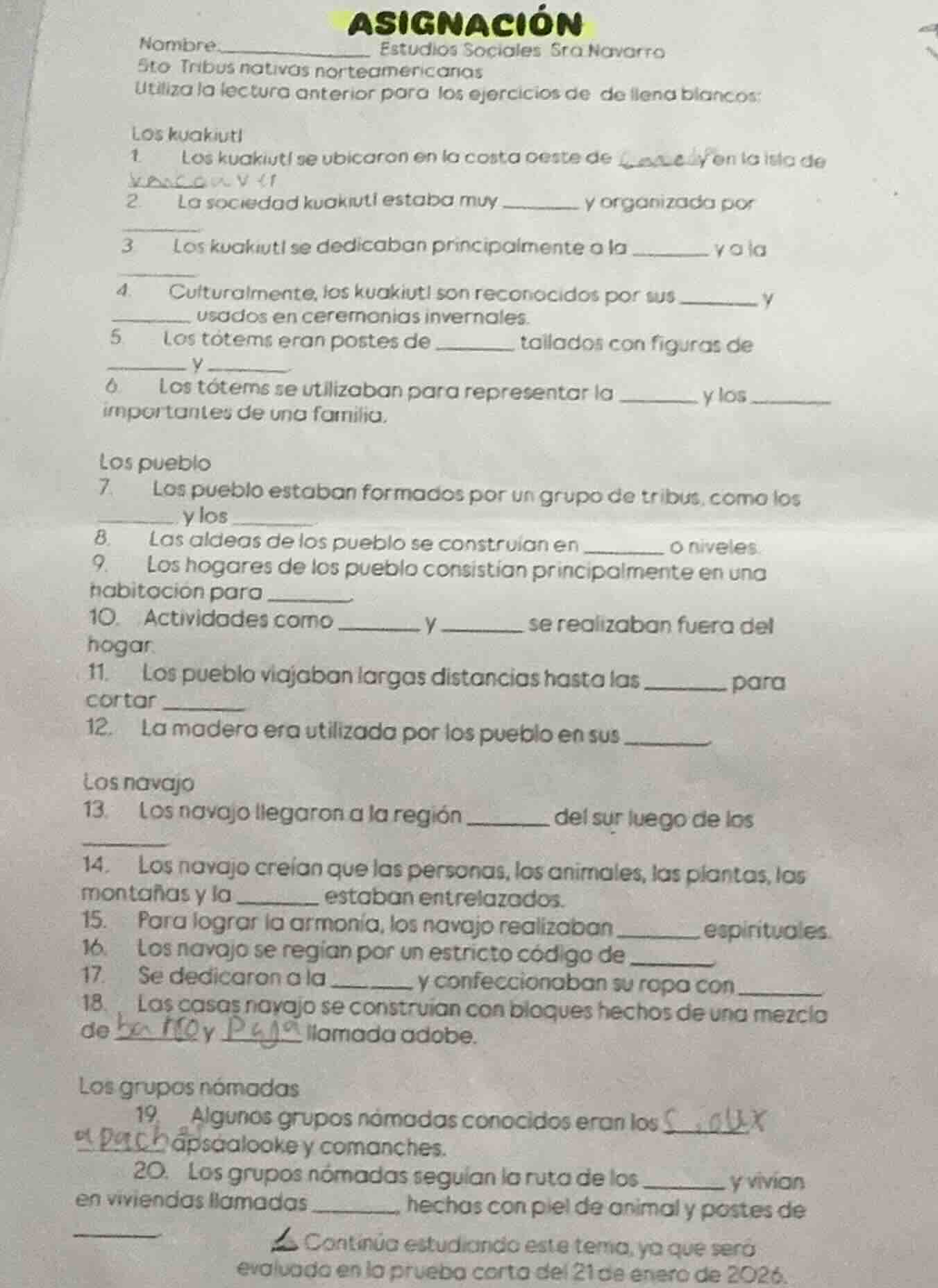
asignación
nombre__________ estudios sociales sra navarro
5to tribus nativas norteamericanas
utiliza la lectura anterior para los ejercicios de de llena blancos:
los kuakiutl
1 los kuakiutl se ubicaron en la costa oeste de ____ y en la isla de ____
2 la sociedad kuakiutl estaba muy ____ y organizada por ____
3 los kuakiutl se dedicaban principalmente a la ____ y a la ____
4 culturalmente, los kuakiutl son reconocidos por sus ____ y ____ usados en ceremonias invernales.
5 los tótems eran postes de ____ tallados con figuras de __ y ____
6 los tótems se utilizaban para representar la ____ y los ____ importantes de una familia.
los pueblo
7 los pueblo estaban formados por un grupo de tribus, como los ____ y los ____
8 los aldeas de los pueblo se construían en ______ o niveles.
9 los hogares de los pueblo consistían principalmente en una habitación para ______
10 actividades como ____ y ____ se realizaban fuera del hogar.
11 los pueblo viajaban largas distancias hasta las ____ para cortar ____
12 la madera era utilizada por los pueblo en sus ______
los navajo
13 los navajo llegaron a la región ____ del sur luego de los ____
14 los navajo creían que las personas, los animales, las plantas, las montañas y la ______ estaban entrelazados.
15 para lograr la armonía, los navajo realizaban ______ espirituales.
16 los navajo se regían por un estricto código de ______
17 se dedicaron a la ____ y confeccionaban su ropa con ____
18 las casas navajo se construían con bloques hechos de una mezcla de ____ y ____ llamada adobe.
los grupos nómadas
19 algunos grupos nómadas conocidos eran los ____ ____ apsaalooke y comanches.
20 los grupos nómadas seguían la ruta de los ____ y vivían en viviendas llamadas __, hechas con piel de animal y postes de ____
continúa estudiando este tema, ya que serás evaluado en la prueba carta del 21 de enero de 2026.
To solve these fill - in - the - blank questions about Native American tribes, we need to rely on knowledge of Native American history and culture (from the field of Social Science, specifically Anthropology or History sub - fields). Since the problem is in Spanish and related to the study of native North American tribes, we can use general knowledge about these tribes:
For “Los kuakiutl” section:
- Los kuakiutl se ubicaron en la costa oeste de Canadá y en la isla de Vancouver. (The Kwakiutl were located on the west coast of Canada and on Vancouver Island.)
- La sociedad kuakiutl estaba muy jerarquizada y organizada por clanes (The Kwakiutl society was very hierarchical and organized by clans).
- Los kuakiutl se dedicaban principalmente a la pesca y a la caza (The Kwakiutl were mainly engaged in fishing and hunting).
- Culturalmente, los kuakiutl son reconocidos por sus máscaras y totems usados en ceremonias invernales. (Culturally, the Kwakiutl are known for their masks and totems used in winter ceremonies.)
- Los tótems eran postes de madera tallados con figuras de animales y ancestros (Totems were wooden posts carved with figures of animals and ancestors).
- Los tótems se utilizaban para representar la herencia y los orígenes importantes de una familia. (Totems were used to represent the heritage and important origins of a family.)
For “Los pueblo” section:
- Los pueblo estaban formados por un grupo de tribus, como los Hopi y los Zuni (The Pueblo were made up of a group of tribes, such as the Hopi and the Zuni).
- Las aldeas de los pueblo se construían en mesetas o niveles. (Pueblo villages were built on mesas or levels.)
- Los hogares de los pueblo consistían principalmente en una habitación para toda la familia (Pueblo homes mainly consisted of one room for the whole family).
- Actividades como la agricultura y la artesanía se realizaban fuera del hogar. (Activities such as agriculture and handicrafts were carried out outside the home.)
- Los pueblo viajaban largas distancias hasta las montañas para cortar madera (The Pueblo traveled long distances to the mountains to cut wood).
- La madera era utilizada por los pueblo en sus construcciones (Wood was used by the Pueblo in their constructions).
For “Los navajo” section:
- Los navajo llegaron a la región sudoeste del sur luego de los anos (The Navajo arrived in the southwestern region after many years) (Note: A more accurate statement could be “Los navajo llegaron a la región sudoeste de los Estados Unidos luego de migraciones” - The Navajo arrived in the southwestern region of the United States after migrations).
- Los navajo creían que las personas, los animales, las plantas, las montañas y la tierra estaban entrelazados. (The Navajo believed that people, animals, plants, mountains, and the earth were intertwined.)
- Para lograr la armonía, los navajo realizaban rituales espirituales. (To achieve harmony, the Navajo performed spiritual rituals.)
- Los navajo se regían por un estricto código de conducta (The Navajo were governed by a strict code of conduct).
- Se dedicaron a la ganadería y confeccionaban su ropa con lana (They devoted themselves to livestock raising and made their clothes with wool).
- Las casas navajo se construían con bloques hechos de una mezcla de barro y paja llamada adobe. (Navajo houses were built with blocks made of a mixture of mud and straw called adobe.)
For “Los grupos nómadas” secti…

Snap & solve any problem in the app
Get step-by-step solutions on Sovi AI
Photo-based solutions with guided steps
Explore more problems and detailed explanations
To solve these fill - in - the - blank questions about Native American tribes, we need to rely on knowledge of Native American history and culture (from the field of Social Science, specifically Anthropology or History sub - fields). Since the problem is in Spanish and related to the study of native North American tribes, we can use general knowledge about these tribes:
For “Los kuakiutl” section:
- Los kuakiutl se ubicaron en la costa oeste de Canadá y en la isla de Vancouver. (The Kwakiutl were located on the west coast of Canada and on Vancouver Island.)
- La sociedad kuakiutl estaba muy jerarquizada y organizada por clanes (The Kwakiutl society was very hierarchical and organized by clans).
- Los kuakiutl se dedicaban principalmente a la pesca y a la caza (The Kwakiutl were mainly engaged in fishing and hunting).
- Culturalmente, los kuakiutl son reconocidos por sus máscaras y totems usados en ceremonias invernales. (Culturally, the Kwakiutl are known for their masks and totems used in winter ceremonies.)
- Los tótems eran postes de madera tallados con figuras de animales y ancestros (Totems were wooden posts carved with figures of animals and ancestors).
- Los tótems se utilizaban para representar la herencia y los orígenes importantes de una familia. (Totems were used to represent the heritage and important origins of a family.)
For “Los pueblo” section:
- Los pueblo estaban formados por un grupo de tribus, como los Hopi y los Zuni (The Pueblo were made up of a group of tribes, such as the Hopi and the Zuni).
- Las aldeas de los pueblo se construían en mesetas o niveles. (Pueblo villages were built on mesas or levels.)
- Los hogares de los pueblo consistían principalmente en una habitación para toda la familia (Pueblo homes mainly consisted of one room for the whole family).
- Actividades como la agricultura y la artesanía se realizaban fuera del hogar. (Activities such as agriculture and handicrafts were carried out outside the home.)
- Los pueblo viajaban largas distancias hasta las montañas para cortar madera (The Pueblo traveled long distances to the mountains to cut wood).
- La madera era utilizada por los pueblo en sus construcciones (Wood was used by the Pueblo in their constructions).
For “Los navajo” section:
- Los navajo llegaron a la región sudoeste del sur luego de los anos (The Navajo arrived in the southwestern region after many years) (Note: A more accurate statement could be “Los navajo llegaron a la región sudoeste de los Estados Unidos luego de migraciones” - The Navajo arrived in the southwestern region of the United States after migrations).
- Los navajo creían que las personas, los animales, las plantas, las montañas y la tierra estaban entrelazados. (The Navajo believed that people, animals, plants, mountains, and the earth were intertwined.)
- Para lograr la armonía, los navajo realizaban rituales espirituales. (To achieve harmony, the Navajo performed spiritual rituals.)
- Los navajo se regían por un estricto código de conducta (The Navajo were governed by a strict code of conduct).
- Se dedicaron a la ganadería y confeccionaban su ropa con lana (They devoted themselves to livestock raising and made their clothes with wool).
- Las casas navajo se construían con bloques hechos de una mezcla de barro y paja llamada adobe. (Navajo houses were built with blocks made of a mixture of mud and straw called adobe.)
For “Los grupos nómadas” section:
- Algunos grupos nómadas conocidos eran los Sioux, Cheyenne, apsaalooke y comanches. (Some well - known nomadic groups were the Sioux, Cheyenne, Apsaalooke, and Comanches.)
- Los grupos nómadas seguían la ruta de los bueyes salvajes y vivían en viviendas llamadas tiendas de campaña (tipis), hechas con piel de animal y postes de madera (Nomadic groups followed the route of the bison and lived in dwellings called tipis, made with animal skin and wooden posts).
Since this is a set of questions related to the study of human societies (Native American tribes), the discipline is Social Science, and the sub - field can be considered as Anthropology (for the cultural and social aspects of the tribes) or History (for the historical location and development of the tribes).
If we were to present the answers in a more concise way for each blank:
- Canadá; Vancouver
- jerarquizada; clanes
- pesca; caza
- máscaras; totems
- madera; animales; ancestros
- herencia; orígenes
- Hopi; Zuni (or other Pueblo - related tribes)
- mesetas
- toda la familia
- agricultura; artesanía (or other appropriate activities)
- montañas; madera
- construcciones
- sudoeste; migraciones (or other appropriate terms)
- tierra
- rituales
- conducta
- ganadería; lana
- barro; paja
- Sioux; Cheyenne (or other nomadic tribes)
- bueyes salvajes; tiendas de campaña (tipis); madera
It should be noted that some of the answers may vary slightly depending on the specific educational material used to study these Native American tribes.