QUESTION IMAGE
Question
assignment
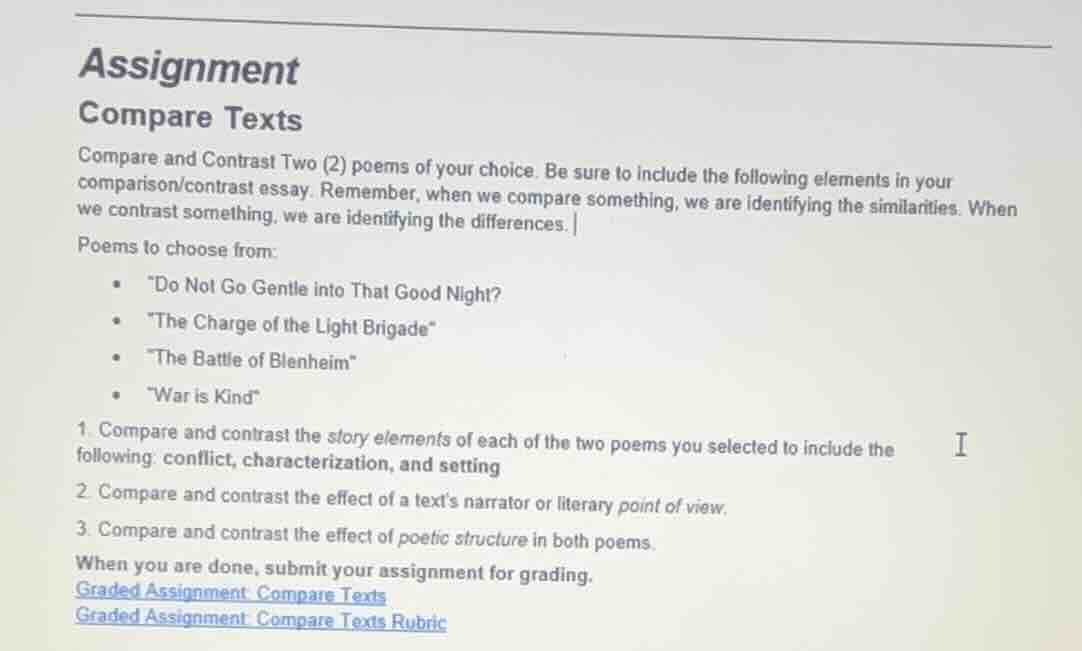
compare texts
compare and contrast two (2) poems of your choice. be sure to include the following elements in your comparison/contrast essay. remember, when we compare something, we are identifying the similarities. when we contrast something, we are identifying the differences.
poems to choose from:
- \do not go gentle into that good night?
- \the charge of the light brigade\
- \the battle of blenheim\
- \war is kind\
- compare and contrast the story elements of each of the two poems you selected to include the following: conflict, characterization, and setting
- compare and contrast the effect of a text’s narrator or literary point of view.
- compare and contrast the effect of poetic structure in both poems.
when you are done, submit your assignment for grading.
graded assignment: compare texts
graded assignment: compare texts rubric
This is an assignment instruction rather than a question with a specific problem to solve. If you need help with writing the compare - contrast essay for the poems, here are some general steps:
Step 1: Select Two Poems
For example, let's choose "Do Not Go Gentle into That Good Night" and "War is Kind".
Step 2: Analyze Story Elements
- Conflict:
- In "Do Not Go Gentle into That Good Night", the conflict is between the speaker (and the father he addresses) and death. The speaker urges his father to fight against the approach of death ("Do not go gentle into that good night, / Old age should burn and rave at close of day; / Rage, rage against the dying of the light").
- In "War is Kind", the conflict is between the reality of war (its brutality, senselessness) and the false glorification of war. The poem repeatedly says "War is kind" in an ironic way, while depicting the horrors of war (e.g., "Mother whose heart hung humble as a button / On the bright splendid shroud of your son," showing the grief of a mother who lost her son in war).
- Characterization:
- In "Do Not Go Gentle into That Good Night", the main "characters" are the speaker (a son) and his father. The son is characterized as someone who is desperate for his father to fight against death, showing love and urgency. The father is a figure approaching death, and the speaker's description of different types of men (wise men, good men, wild men, grave men) can also be seen as a way of characterizing different responses to death, which may be related to how the father should respond.
- In "War is Kind", the characters are the soldiers who die in war, their mothers, sweethearts, and fathers. The soldiers are depicted as victims of war, the mothers as grief - stricken, the sweethearts as left alone, and the fathers as having lost their sons. The poem uses these characters to show the impact of war on different people.
- Setting:
- "Do Not Go Gentle into That Good Night" has a more internal and personal setting, focused on the relationship between the son and his father, and the approach of death (which is a more abstract setting in terms of physical location, but very personal in terms of emotional and familial context).
- "War is Kind" is set in the context of war. It has scenes of battle ("Hoarse, booming drums of the regiment, / Little souls who thirst for fight, / These men were born to drill and die") and also the homes of the loved ones of the soldiers (e.g., the mother's home, the sweetheart's home), showing both the battlefield and the domestic sphere affected by war.
Step 3: Analyze Narrator/Literary Point of View
- "Do Not Go Gentle into That Good Night":
- The poem is written from the point of view of a son addressing his father. It is a first - person point of view (or at least a very personal, direct address) which makes the plea to the father very intimate and emotionally charged. The narrator's point of view is that of someone who deeply cares about his father and is desperate to have him resist death.
- "War is Kind":
- The narrator's point of view is more detached in a way, but also ironic. The narrator seems to be an outside voice that is commenting on war. The repeated use of "War is kind" is ironic, and the narrator's point of view is one that exposes the falsehood of the glorification of war. The narrator addresses different people (mothers, sweethearts, fathers) and describes the impact of war on them, so the point of view is a kind of omniscient or at least a broad - ranging view that can see…

Snap & solve any problem in the app
Get step-by-step solutions on Sovi AI
Photo-based solutions with guided steps
Explore more problems and detailed explanations
This is an assignment instruction rather than a question with a specific problem to solve. If you need help with writing the compare - contrast essay for the poems, here are some general steps:
Step 1: Select Two Poems
For example, let's choose "Do Not Go Gentle into That Good Night" and "War is Kind".
Step 2: Analyze Story Elements
- Conflict:
- In "Do Not Go Gentle into That Good Night", the conflict is between the speaker (and the father he addresses) and death. The speaker urges his father to fight against the approach of death ("Do not go gentle into that good night, / Old age should burn and rave at close of day; / Rage, rage against the dying of the light").
- In "War is Kind", the conflict is between the reality of war (its brutality, senselessness) and the false glorification of war. The poem repeatedly says "War is kind" in an ironic way, while depicting the horrors of war (e.g., "Mother whose heart hung humble as a button / On the bright splendid shroud of your son," showing the grief of a mother who lost her son in war).
- Characterization:
- In "Do Not Go Gentle into That Good Night", the main "characters" are the speaker (a son) and his father. The son is characterized as someone who is desperate for his father to fight against death, showing love and urgency. The father is a figure approaching death, and the speaker's description of different types of men (wise men, good men, wild men, grave men) can also be seen as a way of characterizing different responses to death, which may be related to how the father should respond.
- In "War is Kind", the characters are the soldiers who die in war, their mothers, sweethearts, and fathers. The soldiers are depicted as victims of war, the mothers as grief - stricken, the sweethearts as left alone, and the fathers as having lost their sons. The poem uses these characters to show the impact of war on different people.
- Setting:
- "Do Not Go Gentle into That Good Night" has a more internal and personal setting, focused on the relationship between the son and his father, and the approach of death (which is a more abstract setting in terms of physical location, but very personal in terms of emotional and familial context).
- "War is Kind" is set in the context of war. It has scenes of battle ("Hoarse, booming drums of the regiment, / Little souls who thirst for fight, / These men were born to drill and die") and also the homes of the loved ones of the soldiers (e.g., the mother's home, the sweetheart's home), showing both the battlefield and the domestic sphere affected by war.
Step 3: Analyze Narrator/Literary Point of View
- "Do Not Go Gentle into That Good Night":
- The poem is written from the point of view of a son addressing his father. It is a first - person point of view (or at least a very personal, direct address) which makes the plea to the father very intimate and emotionally charged. The narrator's point of view is that of someone who deeply cares about his father and is desperate to have him resist death.
- "War is Kind":
- The narrator's point of view is more detached in a way, but also ironic. The narrator seems to be an outside voice that is commenting on war. The repeated use of "War is kind" is ironic, and the narrator's point of view is one that exposes the falsehood of the glorification of war. The narrator addresses different people (mothers, sweethearts, fathers) and describes the impact of war on them, so the point of view is a kind of omniscient or at least a broad - ranging view that can see the effects of war on different individuals and groups.
Step 4: Analyze Poetic Structure
- "Do Not Go Gentle into That Good Night":
- It is a villanelle. It has a strict structure: five tercets (three - line stanzas) followed by a quatrain (four - line stanza). The rhyme scheme is aba aba aba aba aba abaa. The first and third lines of the first tercet are repeated alternately in the following tercets and then together in the final quatrain. This structure creates a sense of urgency and repetition, which reinforces the speaker's plea to his father to fight against death. The repetition of the lines "Do not go gentle into that good night" and "Rage, rage against the dying of the light" builds up the emotional intensity.
- "War is Kind":
- The poem has a more irregular structure. It has stanzas of different lengths (some stanzas have 5 lines, some have 4 lines, etc.). The rhyme scheme is also more irregular, although there are some repeated rhymes. The structure, with its repeated ironic refrain "War is kind", creates a sense of irony and also a kind of chant - like quality, which emphasizes the contrast between the false claim that "War is kind" and the true horrors of war that are described in the rest of the stanzas.
If you want to continue with writing the essay, you can organize these analyses into a coherent compare - contrast essay, making sure to clearly identify similarities and differences in each of the required areas.
If you have a specific question about this assignment (e.g., how to start the essay, how to find more details about a particular poem's structure), please let me know and I can provide more targeted help.