QUESTION IMAGE
Question
assignment
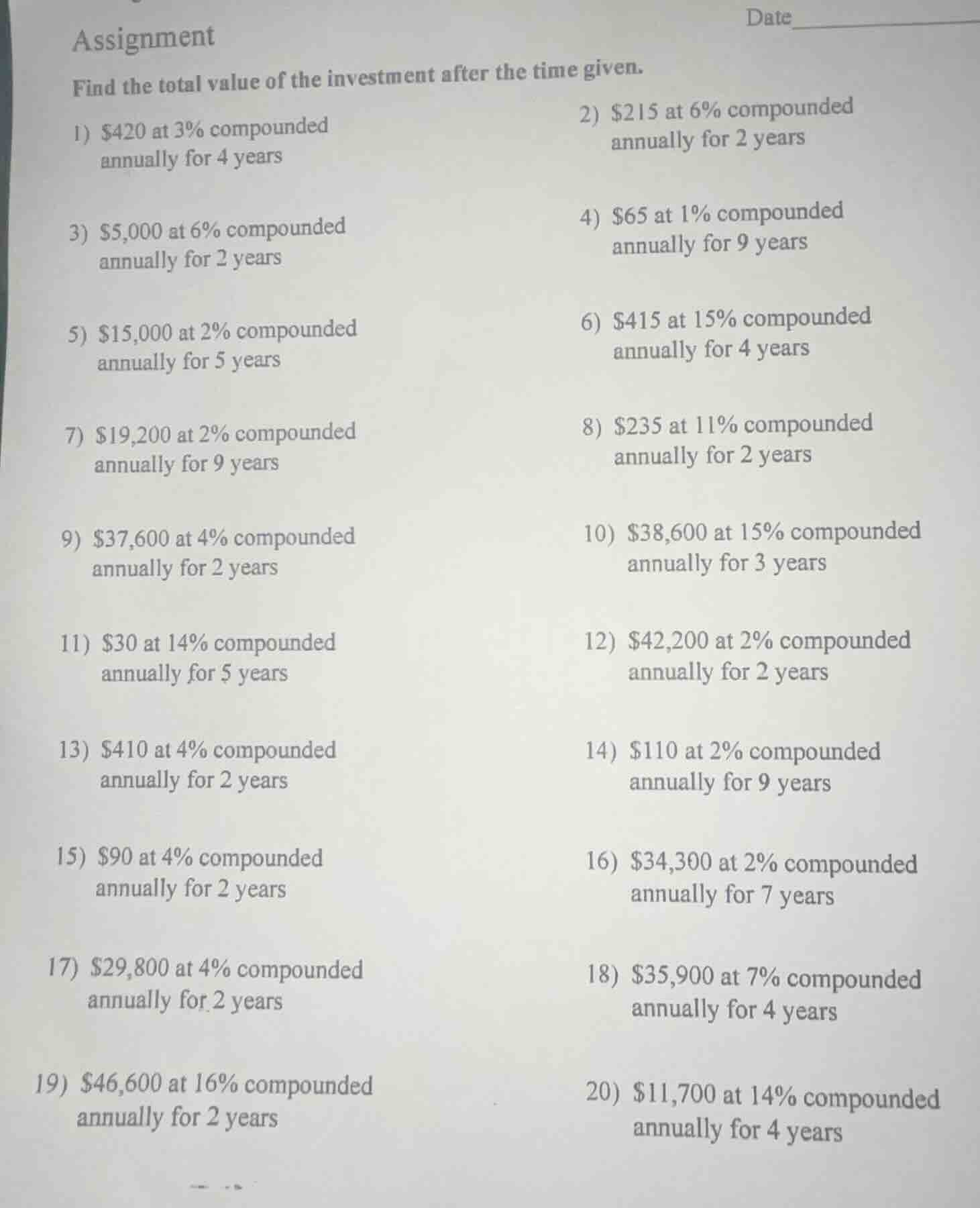
find the total value of the investment after the time given.
- $420 at 3% compounded annually for 4 years
- $215 at 6% compounded annually for 2 years
- $5,000 at 6% compounded annually for 2 years
- $65 at 1% compounded annually for 9 years
- $15,000 at 2% compounded annually for 5 years
- $415 at 15% compounded annually for 4 years
- $19,200 at 2% compounded annually for 9 years
- $235 at 11% compounded annually for 2 years
- $37,600 at 4% compounded annually for 2 years
- $38,600 at 15% compounded annually for 3 years
- $30 at 14% compounded annually for 5 years
- $42,200 at 2% compounded annually for 2 years
- $410 at 4% compounded annually for 2 years
- $110 at 2% compounded annually for 9 years
- $90 at 4% compounded annually for 2 years
- $34,300 at 2% compounded annually for 7 years
- $29,800 at 4% compounded annually for 2 years
- $35,900 at 7% compounded annually for 4 years
- $46,600 at 16% compounded annually for 2 years
- $11,700 at 14% compounded annually for 4 years
Let's solve the first problem (1) as an example, and you can follow the same method for the others. The formula for compound interest is $A = P(1 + r)^t$, where:
- $A$ is the amount of money accumulated after $n$ years, including interest.
- $P$ is the principal amount (the initial amount of money).
- $r$ is the annual interest rate (decimal).
- $t$ is the time the money is invested for in years.
Problem 1: $420 at 3% compounded annually for 4 years
Step 1: Identify the values
$P = 420$, $r = 3\% = 0.03$, $t = 4$
Step 2: Apply the compound interest formula
$A = 420(1 + 0.03)^4$
First, calculate $(1 + 0.03)^4$:
$(1.03)^4 \approx 1.12550881$
Then, multiply by the principal:
$A = 420 \times 1.12550881 \approx 472.71$
Step 1: Identify the values
$P = 215$, $r = 6\% = 0.06$, $t = 2$
Step 2: Apply the compound interest formula
$A = 215(1 + 0.06)^2$
First, calculate $(1 + 0.06)^2$:
$(1.06)^2 = 1.1236$
Then, multiply by the principal:
$A = 215 \times 1.1236 = 241.574$
Step 1: Identify the values
$P = 5000$, $r = 6\% = 0.06$, $t = 2$
Step 2: Apply the compound interest formula
$A = 5000(1 + 0.06)^2$
First, calculate $(1 + 0.06)^2$:
$(1.06)^2 = 1.1236$
Then, multiply by the principal:
$A = 5000 \times 1.1236 = 5618$

Snap & solve any problem in the app
Get step-by-step solutions on Sovi AI
Photo-based solutions with guided steps
Explore more problems and detailed explanations
The total value of the investment is approximately $\$472.71$.