QUESTION IMAGE
Question
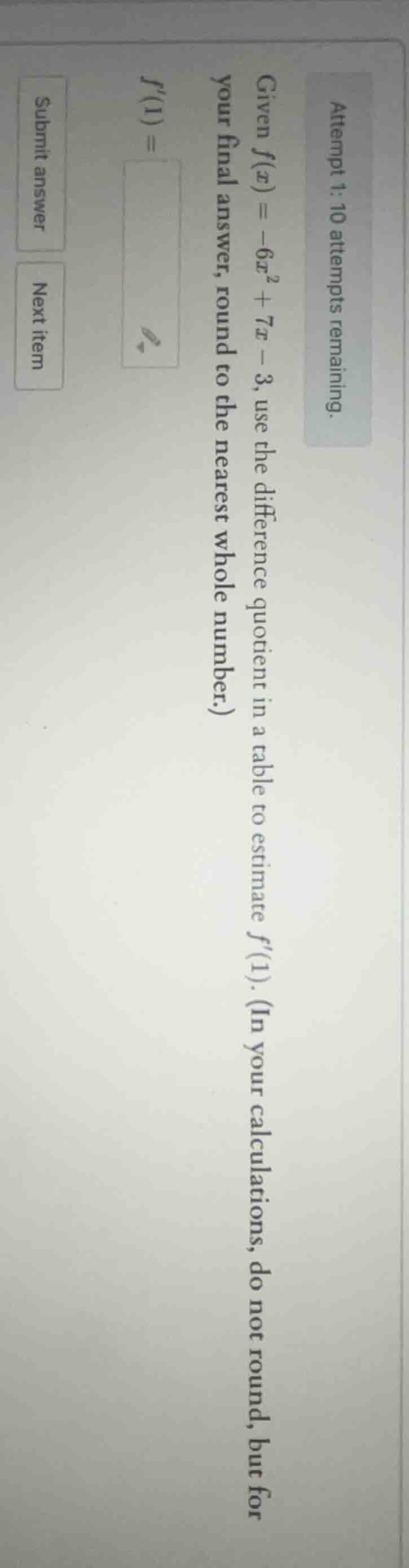
attempt 1: 10 attempts remaining. given ( f(x) = -6x^2 + 7x - 3 ), use the difference quotient in a table to estimate ( f(1) ). (in your calculations, do not round, but for your final answer, round to the nearest whole number.) ( f(1) = ) submit answer next item
Step1: Recall the difference quotient formula
The difference quotient to estimate the derivative \( f^{\prime}(a) \) is \( f^{\prime}(a)\approx\frac{f(a + h)-f(a)}{h} \) as \( h \) approaches 0. We can use small values of \( h \) (e.g., \( h = 0.1, 0.01, - 0.1, - 0.01 \)) to approximate \( f^{\prime}(1) \). First, find \( f(1) \) and \( f(1 + h) \) for a function \( f(x)=-6x^{2}+7x - 3 \).
First, calculate \( f(1) \):
\( f(1)=-6(1)^{2}+7(1)-3=-6 + 7-3=-2 \)
Step2: Calculate \( f(1 + h) \) for \( h = 0.1 \)
\( 1+h=1.1 \)
\( f(1.1)=-6(1.1)^{2}+7(1.1)-3=-6\times1.21 + 7.7-3=-7.26+7.7 - 3=-2.56 \)
Then the difference quotient for \( h = 0.1 \) is \( \frac{f(1.1)-f(1)}{0.1}=\frac{-2.56-(-2)}{0.1}=\frac{-0.56}{0.1}=-5.6 \)
Step3: Calculate \( f(1 + h) \) for \( h = 0.01 \)
\( 1 + h=1.01 \)
\( f(1.01)=-6(1.01)^{2}+7(1.01)-3=-6\times1.0201+7.07 - 3=-6.1206 + 7.07-3=-2.0506 \)
The difference quotient for \( h = 0.01 \) is \( \frac{f(1.01)-f(1)}{0.01}=\frac{-2.0506-(-2)}{0.01}=\frac{-0.0506}{0.01}=-5.06 \)
Step4: Calculate \( f(1 + h) \) for \( h=- 0.1 \)
\( 1+h = 0.9 \)
\( f(0.9)=-6(0.9)^{2}+7(0.9)-3=-6\times0.81+6.3 - 3=-4.86+6.3 - 3=-1.56 \)
The difference quotient for \( h=-0.1 \) is \( \frac{f(0.9)-f(1)}{-0.1}=\frac{-1.56-(-2)}{-0.1}=\frac{0.44}{-0.1}=-4.4 \)
Step5: Calculate \( f(1 + h) \) for \( h=-0.01 \)
\( 1+h = 0.99 \)
\( f(0.99)=-6(0.99)^{2}+7(0.99)-3=-6\times0.9801+6.93 - 3=-5.8806+6.93 - 3=-1.9506 \)
The difference quotient for \( h = - 0.01 \) is \( \frac{f(0.99)-f(1)}{-0.01}=\frac{-1.9506-(-2)}{-0.01}=\frac{0.0494}{-0.01}=-4.94 \)
Step6: Average the results (optional, but to get a better approximation)
We can take the average of the values from positive and negative \( h \). For \( h = 0.01 \) and \( h=-0.01 \), the average is \( \frac{-5.06+(-4.94)}{2}=\frac{-10}{2}=-5 \). As \( h \) gets smaller, the approximation gets better. Also, we can recall that the exact derivative of \( f(x)=-6x^{2}+7x - 3 \) using the power rule is \( f^{\prime}(x)=-12x + 7 \). Let's check the exact value: \( f^{\prime}(1)=-12(1)+7=-5 \). So the estimated value using the difference quotient (and confirmed by the power rule) is - 5.

Snap & solve any problem in the app
Get step-by-step solutions on Sovi AI
Photo-based solutions with guided steps
Explore more problems and detailed explanations
\(-5\)