QUESTION IMAGE
Question
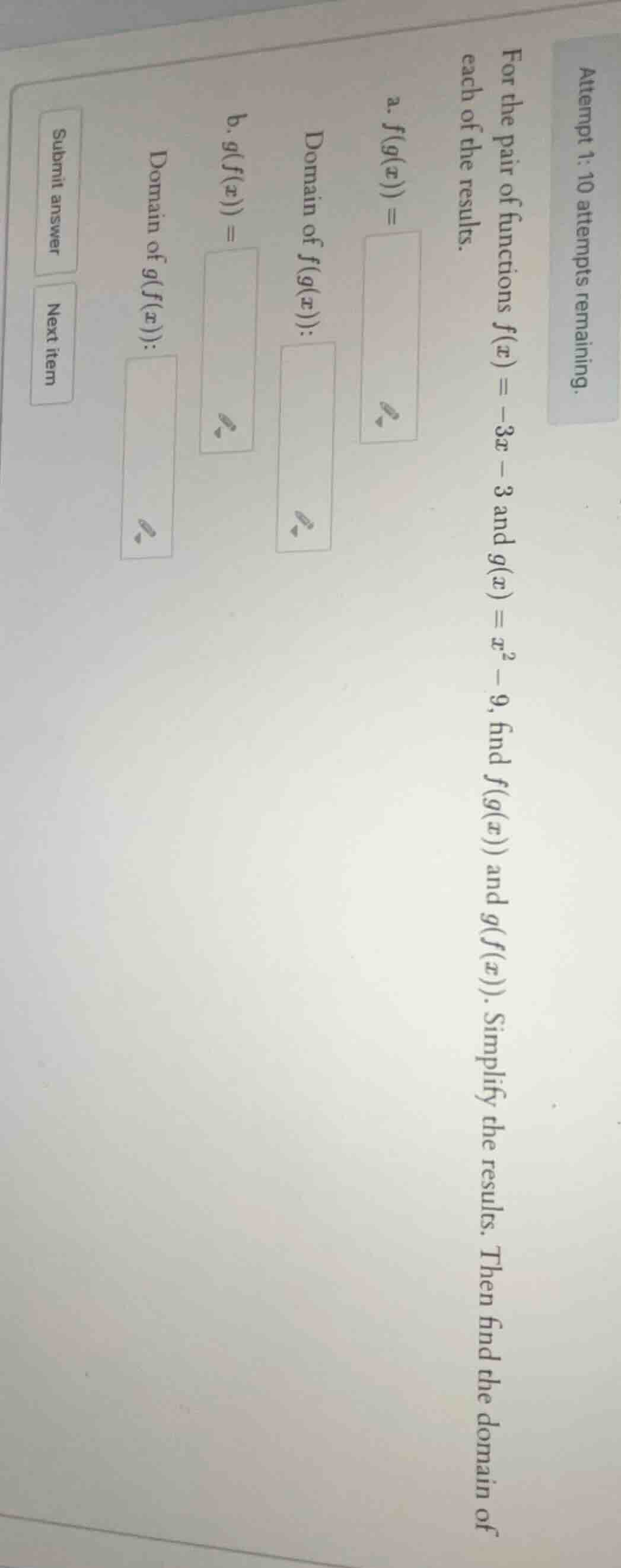
attempt 1: 10 attempts remaining. for the pair of functions ( f(x) = -3x - 3 ) and ( g(x) = x^2 - 9 ), find ( f(g(x)) ) and ( g(f(x)) ). simplify the results. then find the domain of each of the results.
a. ( f(g(x)) = )
domain of ( f(g(x)) ):
b. ( g(f(x)) = )
domain of ( g(f(x)) ):
submit answer
next item
Part a: Find \( f(g(x)) \) and its domain
Step 1: Substitute \( g(x) \) into \( f(x) \)
We know that \( f(x) = -3x - 3 \) and \( g(x) = x^2 - 9 \). To find \( f(g(x)) \), we substitute \( g(x) \) (which is \( x^2 - 9 \)) in place of \( x \) in the function \( f(x) \).
So, \( f(g(x)) = f(x^2 - 9) \)
Now, substitute \( x = x^2 - 9 \) into \( f(x) = -3x - 3 \):
\( f(x^2 - 9) = -3(x^2 - 9) - 3 \)
Step 2: Simplify the expression
First, distribute the -3 in \( -3(x^2 - 9) \):
\( -3(x^2 - 9) = -3x^2 + 27 \)
Then, subtract 3:
\( -3x^2 + 27 - 3 = -3x^2 + 24 \)
So, \( f(g(x)) = -3x^2 + 24 \)
Step 3: Find the domain of \( f(g(x)) \)
The function \( f(g(x)) = -3x^2 + 24 \) is a polynomial function. Polynomial functions (like quadratic functions, linear functions, cubic functions, etc.) are defined for all real numbers. That is, there are no restrictions on the value of \( x \) (no division by zero, no square roots of negative numbers, etc.) that would make the function undefined. So the domain of \( f(g(x)) \) is all real numbers, which in interval notation is \( (-\infty, \infty) \)
Part b: Find \( g(f(x)) \) and its domain
Step 1: Substitute \( f(x) \) into \( g(x) \)
We know that \( g(x) = x^2 - 9 \) and \( f(x) = -3x - 3 \). To find \( g(f(x)) \), we substitute \( f(x) \) (which is \( -3x - 3 \)) in place of \( x \) in the function \( g(x) \).
So, \( g(f(x)) = g(-3x - 3) \)
Now, substitute \( x = -3x - 3 \) into \( g(x) = x^2 - 9 \):
\( g(-3x - 3) = (-3x - 3)^2 - 9 \)
Step 2: Simplify the expression
First, expand \( (-3x - 3)^2 \). Using the formula \( (a + b)^2 = a^2 + 2ab + b^2 \), where \( a = -3x \) and \( b = -3 \):
\( (-3x - 3)^2 = (-3x)^2 + 2(-3x)(-3) + (-3)^2 \)
Calculate each term:
\( (-3x)^2 = 9x^2 \)
\( 2(-3x)(-3) = 18x \)
\( (-3)^2 = 9 \)
So, \( (-3x - 3)^2 = 9x^2 + 18x + 9 \)
Now, subtract 9:
\( 9x^2 + 18x + 9 - 9 = 9x^2 + 18x \)
We can factor out a 9x (optional, but it simplifies the expression):
\( 9x^2 + 18x = 9x(x + 2) \)
So, \( g(f(x)) = 9x^2 + 18x \) (or \( 9x(x + 2) \))
Step 3: Find the domain of \( g(f(x)) \)
The function \( g(f(x)) = 9x^2 + 18x \) is also a polynomial function (a quadratic function, since the highest power of \( x \) is 2). As with all polynomial functions, there are no restrictions on the value of \( x \); it is defined for all real numbers. So the domain of \( g(f(x)) \) is all real numbers, which in interval notation is \( (-\infty, \infty) \)
Final Answers
Part a:
\( f(g(x)) = \boldsymbol{-3x^2 + 24} \)
Domain of \( f(g(x)) \): \( \boldsymbol{(-\infty, \infty)} \) (or all real numbers)
Part b:
\( g(f(x)) = \boldsymbol{9x^2 + 18x} \) (or \( \boldsymbol{9x(x + 2)} \))
Domain of \( g(f(x)) \): \( \boldsymbol{(-\infty, \infty)} \) (or all real numbers)

Snap & solve any problem in the app
Get step-by-step solutions on Sovi AI
Photo-based solutions with guided steps
Explore more problems and detailed explanations
Part a: Find \( f(g(x)) \) and its domain
Step 1: Substitute \( g(x) \) into \( f(x) \)
We know that \( f(x) = -3x - 3 \) and \( g(x) = x^2 - 9 \). To find \( f(g(x)) \), we substitute \( g(x) \) (which is \( x^2 - 9 \)) in place of \( x \) in the function \( f(x) \).
So, \( f(g(x)) = f(x^2 - 9) \)
Now, substitute \( x = x^2 - 9 \) into \( f(x) = -3x - 3 \):
\( f(x^2 - 9) = -3(x^2 - 9) - 3 \)
Step 2: Simplify the expression
First, distribute the -3 in \( -3(x^2 - 9) \):
\( -3(x^2 - 9) = -3x^2 + 27 \)
Then, subtract 3:
\( -3x^2 + 27 - 3 = -3x^2 + 24 \)
So, \( f(g(x)) = -3x^2 + 24 \)
Step 3: Find the domain of \( f(g(x)) \)
The function \( f(g(x)) = -3x^2 + 24 \) is a polynomial function. Polynomial functions (like quadratic functions, linear functions, cubic functions, etc.) are defined for all real numbers. That is, there are no restrictions on the value of \( x \) (no division by zero, no square roots of negative numbers, etc.) that would make the function undefined. So the domain of \( f(g(x)) \) is all real numbers, which in interval notation is \( (-\infty, \infty) \)
Part b: Find \( g(f(x)) \) and its domain
Step 1: Substitute \( f(x) \) into \( g(x) \)
We know that \( g(x) = x^2 - 9 \) and \( f(x) = -3x - 3 \). To find \( g(f(x)) \), we substitute \( f(x) \) (which is \( -3x - 3 \)) in place of \( x \) in the function \( g(x) \).
So, \( g(f(x)) = g(-3x - 3) \)
Now, substitute \( x = -3x - 3 \) into \( g(x) = x^2 - 9 \):
\( g(-3x - 3) = (-3x - 3)^2 - 9 \)
Step 2: Simplify the expression
First, expand \( (-3x - 3)^2 \). Using the formula \( (a + b)^2 = a^2 + 2ab + b^2 \), where \( a = -3x \) and \( b = -3 \):
\( (-3x - 3)^2 = (-3x)^2 + 2(-3x)(-3) + (-3)^2 \)
Calculate each term:
\( (-3x)^2 = 9x^2 \)
\( 2(-3x)(-3) = 18x \)
\( (-3)^2 = 9 \)
So, \( (-3x - 3)^2 = 9x^2 + 18x + 9 \)
Now, subtract 9:
\( 9x^2 + 18x + 9 - 9 = 9x^2 + 18x \)
We can factor out a 9x (optional, but it simplifies the expression):
\( 9x^2 + 18x = 9x(x + 2) \)
So, \( g(f(x)) = 9x^2 + 18x \) (or \( 9x(x + 2) \))
Step 3: Find the domain of \( g(f(x)) \)
The function \( g(f(x)) = 9x^2 + 18x \) is also a polynomial function (a quadratic function, since the highest power of \( x \) is 2). As with all polynomial functions, there are no restrictions on the value of \( x \); it is defined for all real numbers. So the domain of \( g(f(x)) \) is all real numbers, which in interval notation is \( (-\infty, \infty) \)
Final Answers
Part a:
\( f(g(x)) = \boldsymbol{-3x^2 + 24} \)
Domain of \( f(g(x)) \): \( \boldsymbol{(-\infty, \infty)} \) (or all real numbers)
Part b:
\( g(f(x)) = \boldsymbol{9x^2 + 18x} \) (or \( \boldsymbol{9x(x + 2)} \))
Domain of \( g(f(x)) \): \( \boldsymbol{(-\infty, \infty)} \) (or all real numbers)