QUESTION IMAGE
Question
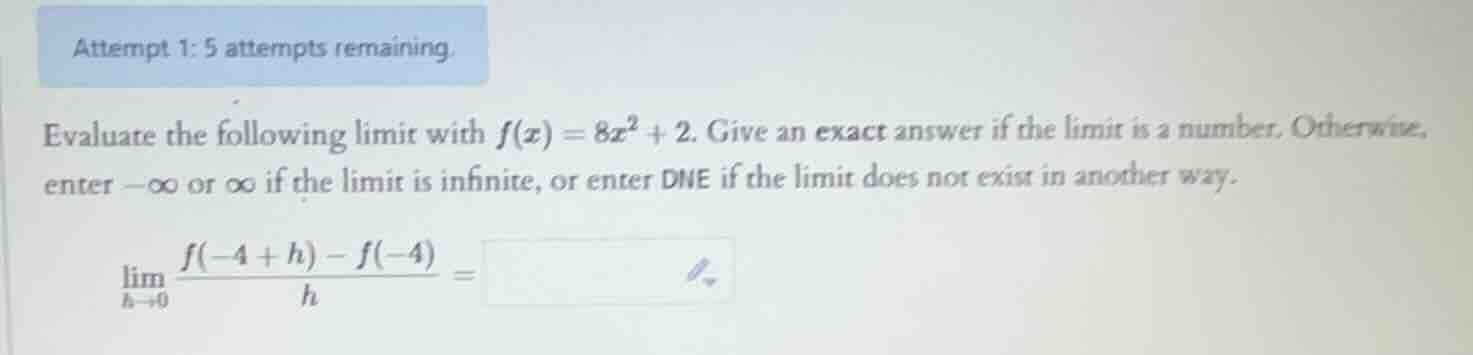
attempt 1: 5 attempts remaining. evaluate the following limit with $f(x) = 8x^2 + 2$. give an exact answer if the limit is a number. otherwise, enter $-infty$ or $infty$ if the limit is infinite, or enter dne if the limit does not exist in another way. $limlimits_{h \to 0} \frac{f(-4 + h) - f(-4)}{h} = $
Step1: Compute $f(-4+h)$
Substitute $x=-4+h$ into $f(x)=8x^2+2$:
$$\begin{align*}
f(-4+h)&=8(-4+h)^2+2\\
&=8(16-8h+h^2)+2\\
&=128-64h+8h^2+2\\
&=8h^2-64h+130
\end{align*}$$
Step2: Compute $f(-4)$
Substitute $x=-4$ into $f(x)=8x^2+2$:
$$
f(-4)=8(-4)^2+2=8\times16+2=128+2=130
$$
Step3: Calculate $f(-4+h)-f(-4)$
Subtract the results from Step1 and Step2:
$$
f(-4+h)-f(-4)=(8h^2-64h+130)-130=8h^2-64h
$$
Step4: Simplify the difference quotient
Divide the result by $h$ (where $h
eq0$):
$$
\frac{f(-4+h)-f(-4)}{h}=\frac{8h^2-64h}{h}=8h-64
$$
Step5: Evaluate the limit as $h\to0$
Substitute $h=0$ into the simplified expression:
$$
\lim_{h\to0}(8h-64)=8\times0-64=-64
$$

Snap & solve any problem in the app
Get step-by-step solutions on Sovi AI
Photo-based solutions with guided steps
Explore more problems and detailed explanations
$-64$