QUESTION IMAGE
Question
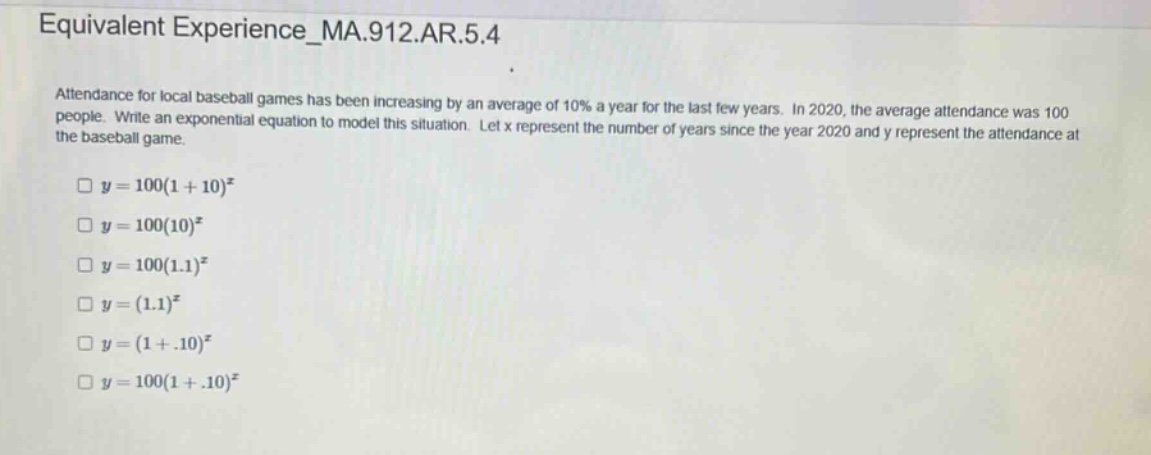
attendance for local baseball games has been increasing by an average of 10% a year for the last few years. in 2020, the average attendance was 100 people. write an exponential equation to model this situation. let x represent the number of years since the year 2020 and y represent the attendance at the baseball game.
\\(\square\\ y = 100(1 + 10)^x\\)
\\(\square\\ y = 100(10)^x\\)
\\(\square\\ y = 100(1.1)^x\\)
\\(\square\\ y = (1.1)^x\\)
\\(\square\\ y = (1 +.10)^x\\)
\\(\square\\ y = 100(1 +.10)^x\\)
Step1: Recall exponential growth formula
The general formula for exponential growth is \( y = a(1 + r)^x \), where \( a \) is the initial amount, \( r \) is the growth rate (in decimal), and \( x \) is the number of time periods.
Step2: Identify values for \( a \) and \( r \)
Here, the initial attendance (in 2020) \( a = 100 \). The growth rate is 10% per year, so \( r = 0.10 \) (since 10% = 0.10 in decimal).
Step3: Substitute into the formula
Substituting \( a = 100 \) and \( r = 0.10 \) into the exponential growth formula \( y = a(1 + r)^x \), we get \( y = 100(1 + 0.10)^x \), which simplifies to \( y = 100(1.1)^x \) or \( y = 100(1 +.10)^x \) (since \( 1 + 0.10 = 1.1 \) and \( 0.10 =.10 \)).
Let's check the options:
- \( y = 100(1 + 10)^x \): Incorrect, because 10 is not the decimal form of the growth rate (it should be 0.10, not 10).
- \( y = 100(10)^x \): Incorrect, this is not a 10% growth rate model (10 is not related to 10% growth).
- \( y = 100(1.1)^x \): Correct, as \( 1 + 0.10 = 1.1 \).
- \( y = (1.1)^x \): Incorrect, missing the initial amount \( a = 100 \).
- \( y = (1 +.10)^x \): Incorrect, missing the initial amount \( a = 100 \).
- \( y = 100(1 +.10)^x \): Correct, same as \( y = 100(1.1)^x \) since \( 1 + 0.10 = 1.1 \).

Snap & solve any problem in the app
Get step-by-step solutions on Sovi AI
Photo-based solutions with guided steps
Explore more problems and detailed explanations
C. \( y = 100(1.1)^x \), F. \( y = 100(1 +.10)^x \) (both are equivalent as \( 1 + 0.10 = 1.1 \))