QUESTION IMAGE
Question
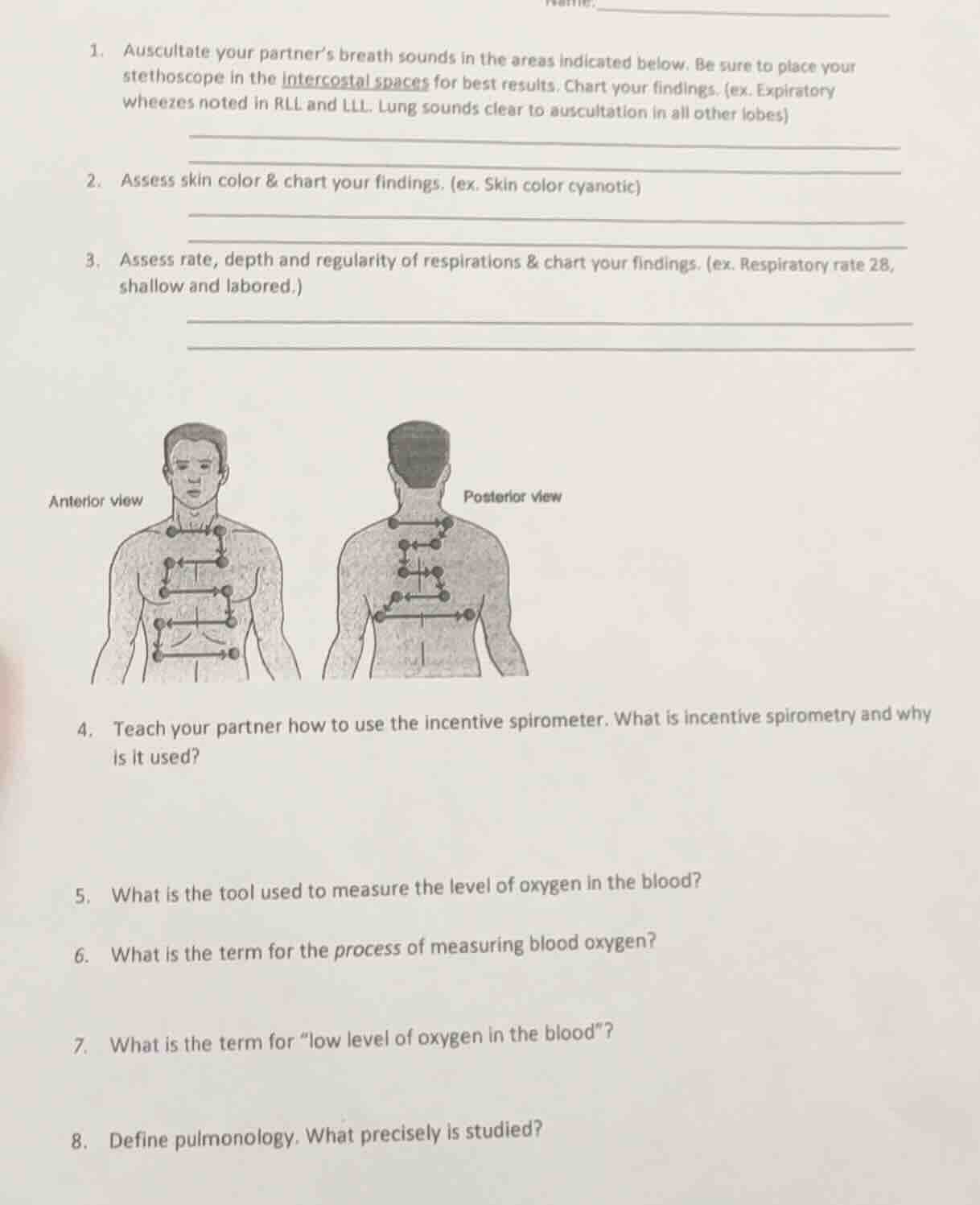
- auscultate your partners breath sounds in the areas indicated below. be sure to place your stethoscope in the intercostal spaces for best results. chart your findings. (ex. expiratory wheezes noted in rll and lll. lung sounds clear to auscultation in all other lobes)2. assess skin color & chart your findings. (ex. skin color cyanotic)3. assess rate, depth and regularity of respirations & chart your findings. (ex. respiratory rate 28, shallow and labored.)4. teach your partner how to use the incentive spirometer. what is incentive spirometry and why is it used?5. what is the tool used to measure the level of oxygen in the blood?6. what is the term for the process of measuring blood oxygen?7. what is the term for \low level of oxygen in the blood\?8. define pulmonology. what precisely is studied?
Brief Explanations
- For the assessment tasks (1-3), these are clinical observations; example normal findings are provided as a reference.
- Questions 4-8 are standard respiratory/medical terminology and tool knowledge.

Snap & solve any problem in the app
Get step-by-step solutions on Sovi AI
Photo-based solutions with guided steps
Explore more problems and detailed explanations
- Lung sounds clear to auscultation in all anterior and posterior intercostal spaces (normal finding example)
- Skin color pink, warm, and dry (normal finding example)
- Respiratory rate 16 breaths per minute, deep and regular (normal finding example)
- Incentive spirometry is a breathing exercise using a device (incentive spirometer) that helps patients take slow, deep breaths. It is used to prevent lung complications (like atelectasis) after surgery or in patients with lung disease by expanding the lungs, improving oxygenation, and clearing mucus.
- Pulse oximeter (arterial blood gas analyzer is also used for more precise measurement, but pulse oximeter is the common non-invasive tool)
- Oximetry (arterial blood gas analysis is an invasive alternative)
- Hypoxemia
- Pulmonology is a medical specialty that focuses on the study, diagnosis, and treatment of diseases and disorders of the respiratory system, including the lungs, trachea, bronchi, pleura, and the respiratory muscles and processes involved in breathing.