QUESTION IMAGE
Question
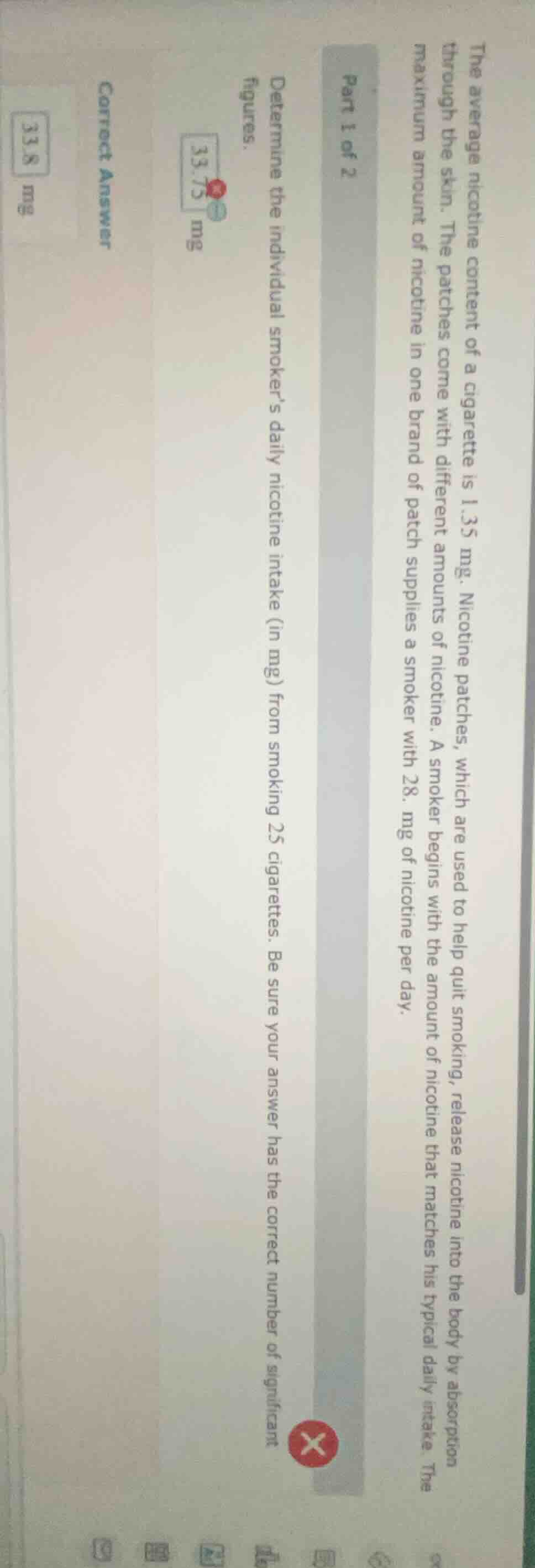
the average nicotine content of a cigarette is 1.35 mg. nicotine patches, which are used to help quit smoking, release nicotine into the body by absorption through the skin. the patches come with different amounts of nicotine. a smoker begins with the amount of nicotine that matches his typical daily intake. the maximum amount of nicotine in one brand of patch supplies a smoker with 28. mg of nicotine per day.
part 1 of 2
determine the individual smoker’s daily nicotine intake (in mg) from smoking 25 cigarettes. be sure your answer has the correct number of significant figures.
33.75 mg
correct answer
33.8 mg
Step1: Identify the amount per cigarette
The average nicotine content per cigarette is \( 1.35 \) mg.
Step2: Calculate total intake from 25 cigarettes
To find the total nicotine intake from smoking 25 cigarettes, we multiply the amount per cigarette by the number of cigarettes. So, we calculate \( 1.35 \times 25 \).
\[
1.35\times25 = (1 + 0.35)\times25 = 1\times25 + 0.35\times25 = 25 + 8.75 = 33.75
\]
But we need to consider significant figures. The value \( 1.35 \) has three significant figures and \( 25 \) has two. When multiplying, the result should have two significant figures? Wait, no, \( 25 \) here is an exact count (number of cigarettes), so we consider the significant figures from \( 1.35 \). Wait, the problem says "Be sure your answer has the correct number of significant figures". The average nicotine content is \( 1.35 \) mg (three significant figures) and the number of cigarettes is 25 (exact, so no limit on significant figures from it). So the product should have three significant figures. Wait, \( 1.35\times25 = 33.75 \), and with three significant figures, it is \( 33.8 \) (since the fourth digit is 5, we round up the third digit: \( 33.75 \approx 33.8 \) when considering three significant figures). Wait, but let's check again. Wait, maybe the initial calculation: \( 1.35\times25 \). Let's do the multiplication: \( 1.35\times25 = 33.75 \). Now, the average nicotine content per cigarette is \( 1.35 \) (three significant figures), and the number of cigarettes is 25 (which is a whole number, maybe considered as having infinite significant figures, or maybe two? Wait, the problem says "the correct number of significant figures". Let's see, \( 1.35 \) has three, 25 has two. When multiplying, the result should have the least number of significant figures, which is two? But the correct answer shown is \( 33.8 \) mg, which is three significant figures. Wait, maybe 25 is considered as exact (like 25.0), so we take three significant figures from \( 1.35 \). So \( 1.35\times25 = 33.75 \), and rounding to three significant figures gives \( 33.8 \).
Wait, maybe I made a mistake earlier. Let's recalculate: \( 1.35 \times 25 \). \( 1.35 \times 25 = 33.75 \). Now, the average nicotine per cigarette is \( 1.35 \) (three significant figures), and the number of cigarettes is 25 (which is a count, so maybe it's exact, so we can keep three significant figures. So \( 33.75 \) rounded to three significant figures is \( 33.8 \) (because the fourth digit is 5, so we round the third digit 7 up to 8: \( 33.75 \approx 33.8 \) when rounding to three significant figures).

Snap & solve any problem in the app
Get step-by-step solutions on Sovi AI
Photo-based solutions with guided steps
Explore more problems and detailed explanations
\( 33.8 \) mg