QUESTION IMAGE
Question
azalea botanical gardens is adding new tropical greenhouses. the gardeners will split t tropical plants evenly among the 3 new greenhouses. they will put 20 tropical plants in each greenhouse.
which diagram models the story?
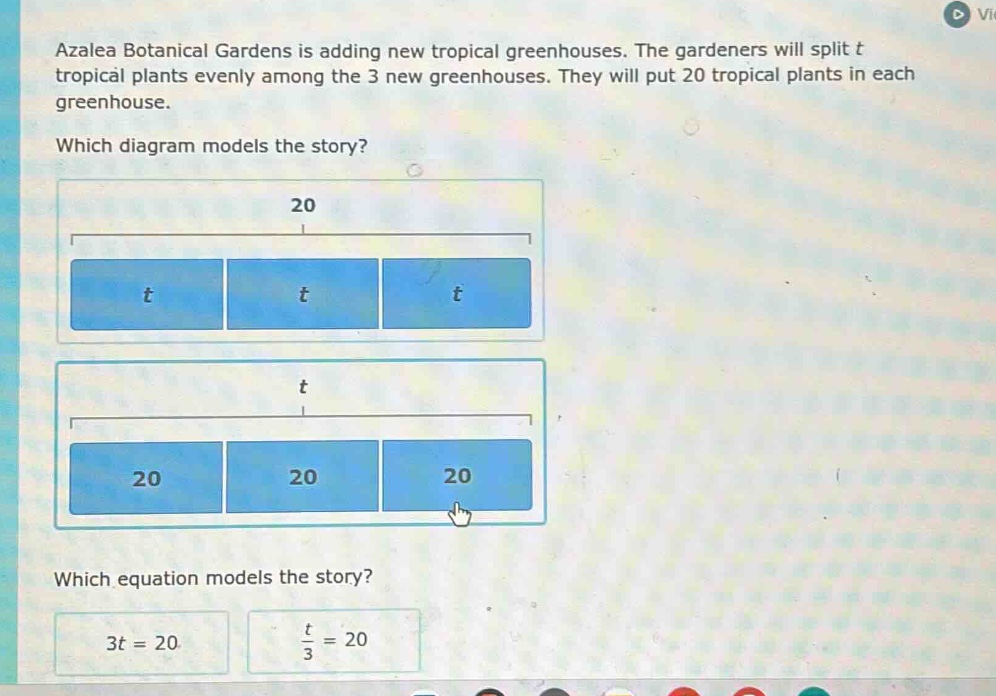
diagram 1: a rectangle labeled 20 at the top, divided into three blue sections each labeled t
diagram 2: a rectangle labeled t at the top, divided into three blue sections each labeled 20
which equation models the story?
options: 3t = 20, \\(\frac{t}{3} = 20\\)
Diagram Question
The story is about splitting \( t \) tropical plants evenly among 3 greenhouses, with 20 plants in each. So the total number of plants \( t \) is split into 3 equal parts, each being 20. The second diagram has a total of \( t \) and three parts each labeled 20, which matches the scenario (3 greenhouses, 20 each, total \( t \)). The first diagram has three parts labeled \( t \), which doesn't match as we need three parts of 20 summing to \( t \).
Step1: Analyze the problem
We have \( t \) plants split evenly into 3 greenhouses, and each greenhouse has 20 plants. So the number of plants per greenhouse is \( \frac{t}{3} \), and this equals 20.
Step2: Form the equation
From the analysis, the equation is \( \frac{t}{3}=20 \). The other equation \( 3t = 20 \) would imply 3 times the total plants is 20, which doesn't match the problem.

Snap & solve any problem in the app
Get step-by-step solutions on Sovi AI
Photo-based solutions with guided steps
Explore more problems and detailed explanations
The second diagram (the one with total \( t \) and three blue boxes each labeled 20)