QUESTION IMAGE
Question
the balkan powder keg explodes
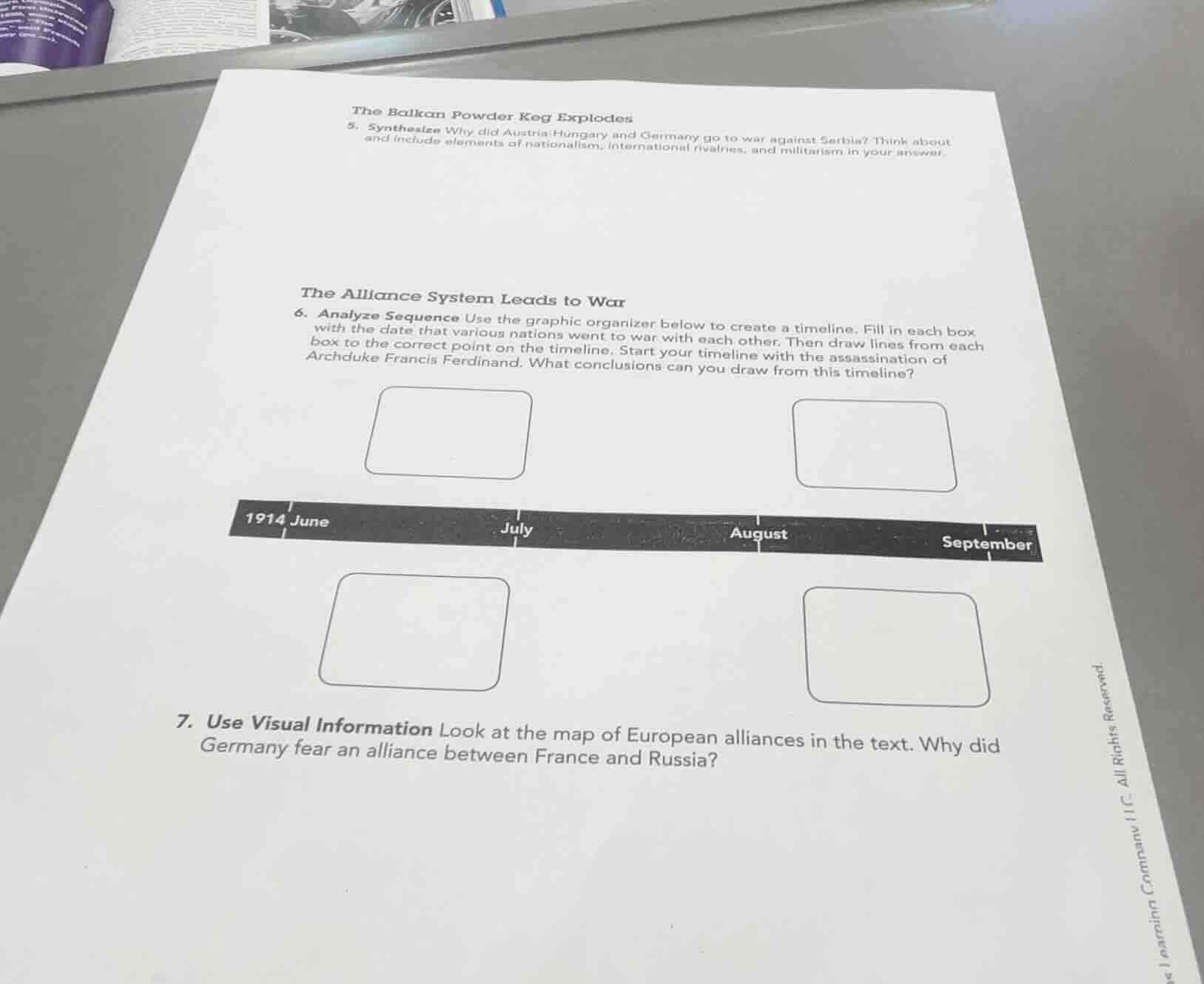
- synthesize why did austria-hungary and germany go to war against serbia? think about and include elements of nationalism, international rivalries, and militarism in your answer.
the alliance system leads to war
- analyze sequence use the graphic organizer below to create a timeline. fill in each box with the date that various nations went to war with each other. then draw lines from each box to the correct point on the timeline. start your timeline with the assassination of archduke francis ferdinand. what conclusions can you draw from this timeline?
1914 june july august september
- use visual information look at the map of european alliances in the text. why did germany fear an alliance between france and russia?
Brief Explanations
For Question 5:
- Nationalism: Pan-Slavism in Serbia threatened Austria-Hungary's multi-ethnic empire, as Serbian nationalists sought to unite Slavic peoples under Serbia, including those within Austria-Hungary. The assassination of Archduke Franz Ferdinand by a Serbian nationalist group (the Black Hand) was the immediate trigger, driven by nationalist sentiment.
- International Rivalries: Austria-Hungary had long-standing territorial and political tensions with Serbia, which was backed by Russia. Germany, as Austria-Hungary's ally, saw Serbia as a proxy for Russian influence in the Balkans, and wanted to assert its dominance over regional rivals.
- Militarism: Both powers had built up large, mobilized militaries and had war plans ready. Germany's Schlieffen Plan relied on quick, aggressive action, and Austria-Hungary's military leadership pushed for a punitive war against Serbia, confident in German military support.
For Question 6:
- Timeline Events:
- June 28, 1914: Assassination of Archduke Franz Ferdinand in Sarajevo.
- July 28, 1914: Austria-Hungary declares war on Serbia.
- August 1, 1914: Germany declares war on Russia.
- August 3, 1914: Germany declares war on France.
- Conclusion: The alliance system and pre-planned military mobilizations caused a localized conflict between Austria-Hungary and Serbia to escalate into a full-scale European war in just over a month.
For Question 7:
Germany feared the Franco-Russian Alliance because it created the threat of a two-front war. Germany shared a border with both France (to the west) and Russia (to the east). If war broke out, Germany would be forced to split its military forces to fight on two separate fronts, which would stretch its military resources thin and undermine its ability to win a quick, decisive victory (a core goal of its Schlieffen Plan).

Snap & solve any problem in the app
Get step-by-step solutions on Sovi AI
Photo-based solutions with guided steps
Explore more problems and detailed explanations
- Question 5: Austria-Hungary and Germany went to war against Serbia for three key reasons:
- Nationalism: Serbian Pan-Slavism threatened Austria-Hungary's multi-ethnic state, and the nationalist Black Hand's assassination of Archduke Franz Ferdinand provided a direct casus belli.
- International Rivalries: Austria-Hungary sought to crush Serbian (and by extension Russian) influence in the Balkans, while Germany aimed to assert its regional dominance and support its ally against Russian-backed Serbia.
- Militarism: Both powers had prepped militaries and war plans; Austria-Hungary pushed for punitive action, and Germany relied on aggressive, quick mobilization via the Schlieffen Plan.
- Question 6:
- Timeline mappings:
- June 28, 1914: Assassination of Archduke Francis Ferdinand
- July 28, 1914: Austria-Hungary declares war on Serbia
- August 1, 1914: Germany declares war on Russia
- August 3, 1914: Germany declares war on France
- Conclusion: The combination of alliances and pre-planned military mobilizations turned a regional dispute into a continent-wide war in less than 6 weeks.
- Question 7: Germany feared the Franco-Russian Alliance because it meant Germany faced the risk of a two-front war, which would force it to split its military between fighting France in the west and Russia in the east, undermining its ability to achieve a quick, decisive victory.