QUESTION IMAGE
Question
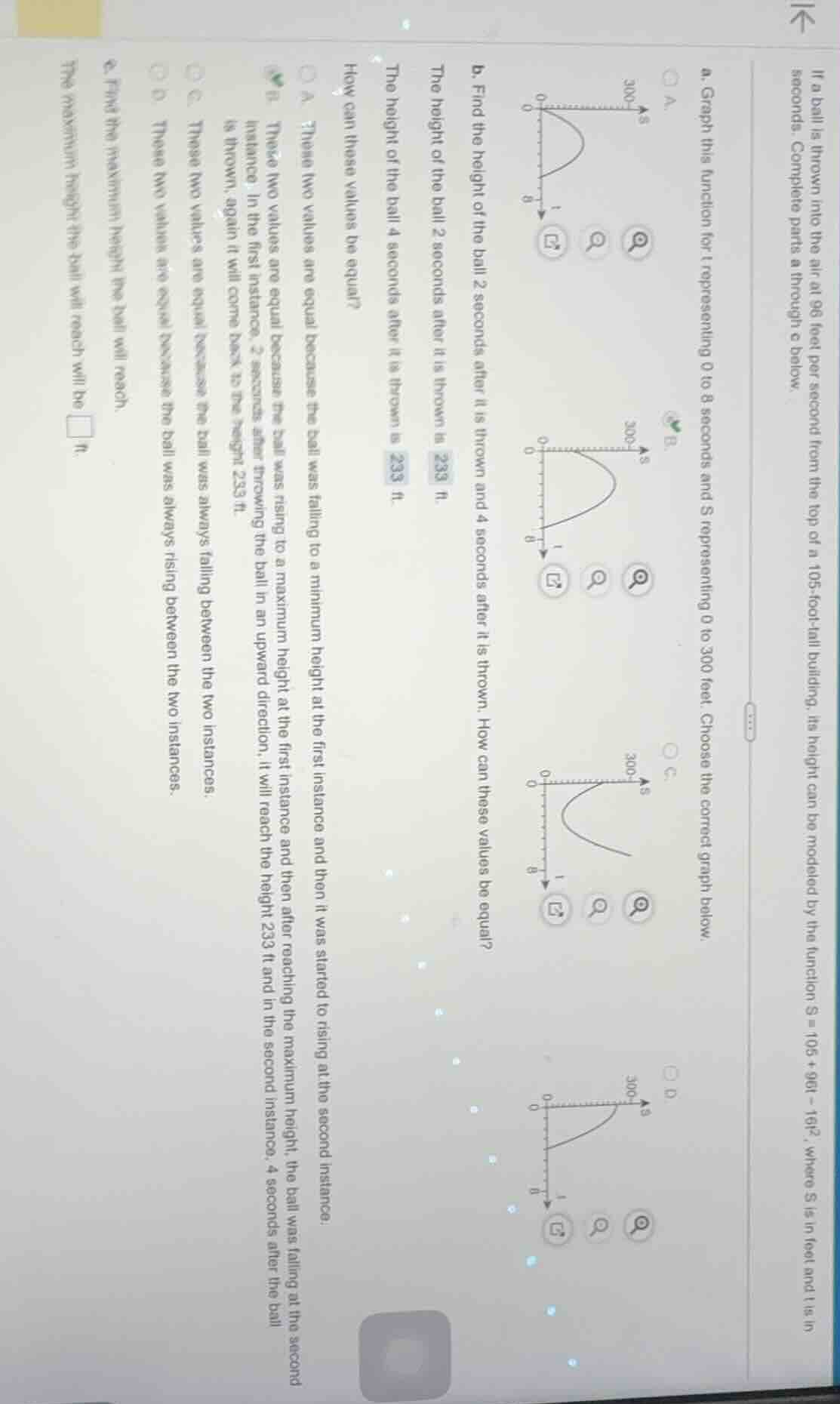
if a ball is thrown into the air at 96 feet per second from the top of a 105 - foot - tall building, its height can be modeled by the function $s = 105+96t - 16t^{2}$, where $s$ is in feet and $t$ is in seconds. complete parts a through c below.
a. graph this function for $t$ representing 0 to 8 seconds and $s$ representing 0 to 300 feet. choose the correct graph below.
there are four graph options (a, b, c, d) with axes labeled $t$ (0 - 8) and $s$ (0 - 300).
b. find the height of the ball 2 seconds after it is thrown and 4 seconds after it is thrown. how can these values be equal?
the height of the ball 2 seconds after it is thrown is 233 ft.
the height of the ball 4 seconds after it is thrown is 233 ft.
how can these values be equal?
a. these two values are equal because the ball was falling to a minimum height at the first instance and then it was started to rising at the second instance.
b. these two values are equal because the ball was rising to a maximum height at the first instance and then after reaching the maximum height, the ball was falling at the second instance. in the first instance, 2 seconds after throwing the ball in an upward direction, it will reach the height 233 ft and in the second instance, 4 seconds after the ball is thrown, again it will come back to the height 233 ft.
c. these two values are equal because the ball was always falling between the two instances.
d. these two values are equal because the ball was always rising between the two instances.
c. find the maximum height the ball will reach.
the maximum height the ball will reach is \\(\square\\) ft.
Step1: Identify height function
The height function is $S(t) = 105 + 96t - 16t^2$, a downward-opening parabola.
Step2: Match to correct graph
At $t=0$, $S(0)=105$ ft. The parabola peaks then falls, matching option B.
Step3: Calculate height at t=2
Substitute $t=2$ into $S(t)$:
$S(2)=105 + 96(2) - 16(2)^2 = 105 + 192 - 64 = 233$ ft
Step4: Calculate height at t=4
Substitute $t=4$ into $S(t)$:
$S(4)=105 + 96(4) - 16(4)^2 = 105 + 384 - 256 = 233$ ft
Step5: Explain equal heights
The ball rises to max height, then falls back to the same height.
Step6: Find vertex of parabola
For $at^2+bt+c$, vertex time $t=-\frac{b}{2a}$. Here $a=-16, b=96$:
$t=-\frac{96}{2(-16)} = 3$ seconds
Step7: Compute max height
Substitute $t=3$ into $S(t)$:
$S(3)=105 + 96(3) - 16(3)^2 = 105 + 288 - 144 = 249$ ft

Snap & solve any problem in the app
Get step-by-step solutions on Sovi AI
Photo-based solutions with guided steps
Explore more problems and detailed explanations
a. B. (The graph starting at 105 ft, peaking, then falling to near 0 at t=8)
b.
- Height at 2 seconds: 233 ft; Height at 4 seconds: 233 ft
- Correct explanation: B. These two values are equal because the ball was rising to a maximum height at the first instance and then after reaching the maximum height, the ball was falling at the second instance. In the first instance, 2 seconds after throwing the ball in an upward direction, it will reach the height 233 ft and in the second instance, 4 seconds after the ball is thrown, again it will come back to the height 233 ft.
c. 249