QUESTION IMAGE
Question
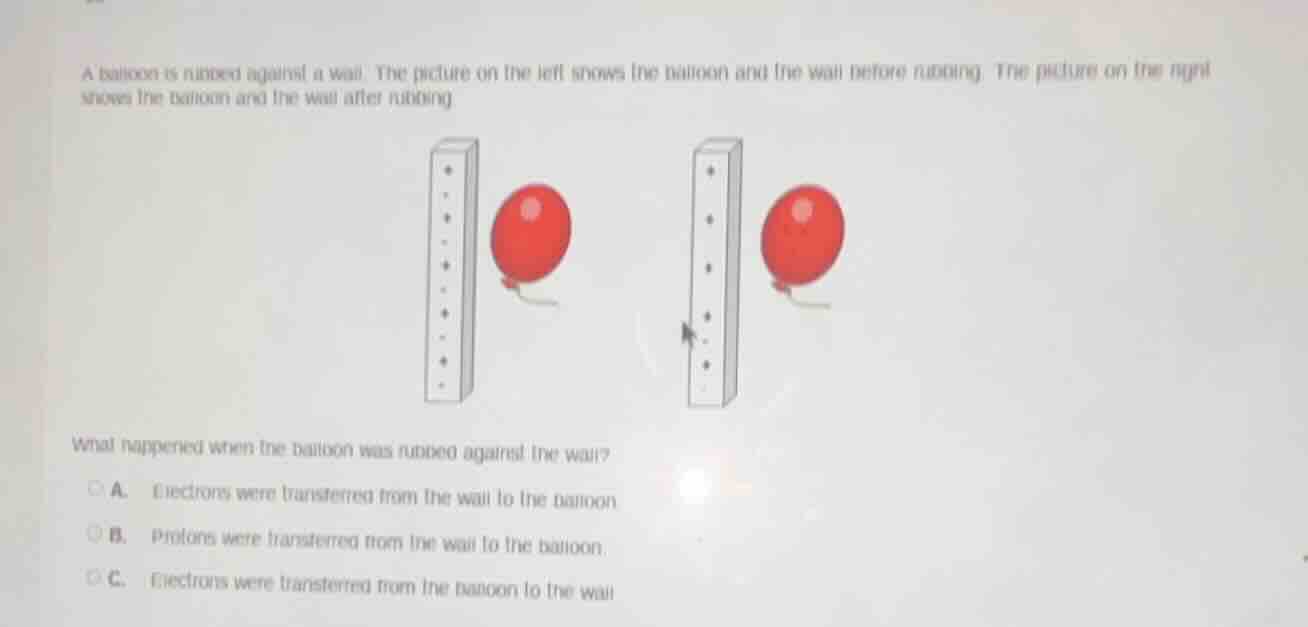
a balloon is rubbed against a wall. the picture on the left shows the balloon and the wall before rubbing. the picture on the right shows the balloon and the wall after rubbing. what happened when the balloon was rubbed against the wall? a. electrons were transferred from the wall to the balloon b. protons were transferred from the wall to the balloon c. electrons were transferred from the balloon to the wall
When a balloon is rubbed against a wall, static electricity is involved. In static charging by friction, electrons (which are mobile) can be transferred. Protons are in the nucleus and not transferred easily. Looking at the charges: before rubbing, the wall has some charges, after rubbing, the wall's charge distribution changes. If the balloon becomes charged, and considering the options, electrons transfer (protons don't move). Option C says electrons move from balloon to wall? Wait, no—wait, when you rub a balloon on a wall, usually the balloon gains electrons (becomes negative) and the wall loses electrons (becomes positive), but wait the options: A: electrons from wall to balloon (so balloon gains electrons, wall loses). B: protons transfer (impossible). C: electrons from balloon to wall (balloon loses electrons, wall gains). Wait, maybe the diagram: before rubbing, wall has more positive? Wait, no, let's think about charging. When you rub, the material that has a higher affinity for electrons gains them. If the balloon is rubbed on the wall, and after rubbing, the wall has more negative charges? Wait, maybe I got it wrong. Wait, the key is: protons are in the nucleus, so they don't transfer. So B is out. Now, between A and C. When you rub a balloon on a wall, typically the balloon becomes negatively charged (gains electrons) and the wall becomes positively charged (loses electrons). So electrons move from wall to balloon? No, wait: if the balloon gains electrons, that means electrons move from wall to balloon (so wall loses electrons, balloon gains). But wait, maybe the other way. Wait, no—let's check the options. Option C: electrons from balloon to wall (balloon loses electrons, wall gains). Wait, maybe the diagram shows that after rubbing, the wall has more negative charges? Wait, maybe I messed up. Wait, the correct concept: in charging by friction, electrons transfer. Protons don't. So B is wrong. Now, if the balloon is rubbed on the wall, and the balloon becomes charged, the transfer is of electrons. So if the answer is C? Wait, no—wait, maybe the wall is made of a material where the balloon loses electrons to the wall. Wait, maybe the correct answer is C? Wait, no, let's re-express: when you rub a balloon on a wall, sometimes the balloon can lose electrons (become positive) and the wall gains electrons (become negative). Or vice versa. But the key is protons don't move. So B is out. Now, between A and C. If the balloon is rubbed and then sticks, but here the question is about electron transfer. So the correct answer is C? Wait, no—wait, maybe I made a mistake. Wait, the options: A: electrons from wall to balloon (balloon gains e⁻, wall loses e⁻). C: electrons from balloon to wall (balloon loses e⁻, wall gains e⁻). So which is correct? Let's think about the materials. Rubber (balloon) and wall (maybe a different material). The triboelectric series: if the wall has a lower affinity for electrons than the balloon, then the balloon gains electrons (so electrons from wall to balloon, A). But if the wall has higher affinity, balloon loses electrons (C). Wait, but the standard example: rubbing a balloon on hair, balloon gains electrons (hair loses). But on a wall, maybe similar. Wait, but the options: A says electrons from wall to balloon (balloon gains), C says from balloon to wall (balloon loses). Wait, maybe the diagram: before rubbing, the wall has some charges, after rubbing, the wall has more negative? No, maybe the answer is C? Wait, no, I think I confused. Wait, the key is protons don't transfer, so B is wrong. Now, elect…

Snap & solve any problem in the app
Get step-by-step solutions on Sovi AI
Photo-based solutions with guided steps
Explore more problems and detailed explanations
C. Electrons were transferred from the balloon to the wall