QUESTION IMAGE
Question
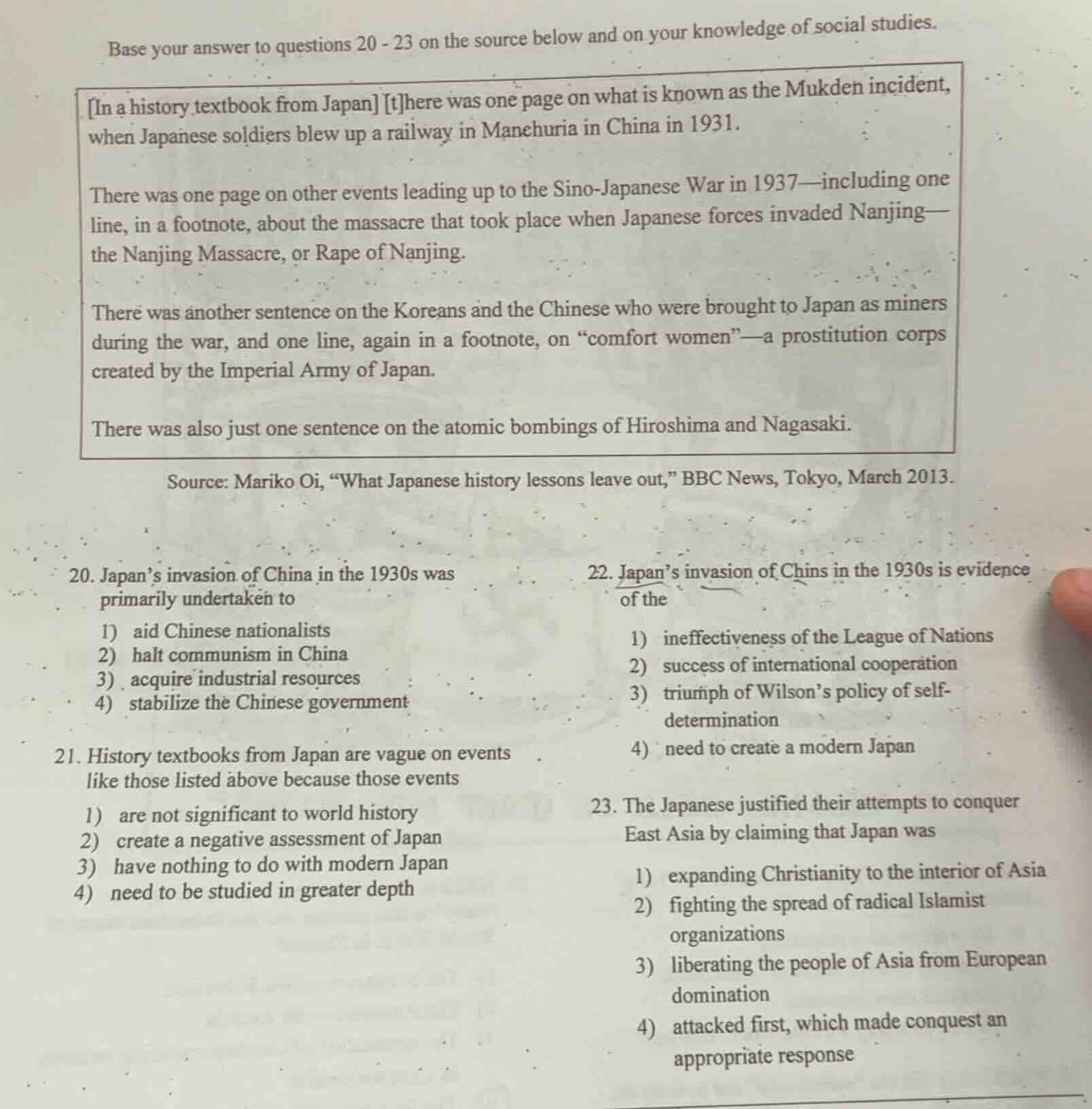
base your answer to questions 20 - 23 on the source below and on your knowledge of social studies.
in a history textbook from japan there was one page on what is known as the mukden incident, when japanese soldiers blew up a railway in manchuria in china in 1931.
there was one page on other events leading up to the sino - japanese war in 1937—including one line, in a footnote, about the massacre that took place when japanese forces invaded nanjing—the nanjing massacre, or rape of nanjing.
there was another sentence on the koreans and the chinese who were brought to japan as miners during the war, and one line, again in a footnote, on “comfort women”—a prostitution corps created by the imperial army of japan.
there was also just one sentence on the atomic bombings of hiroshima and nagasaki.
source: mariko oi, “what japanese history lessons leave out,” bbc news, tokyo, march 2013.
- japan’s invasion of china in the 1930s was primarily undertaken to
- aid chinese nationalists
- halt communism in china
- acquire industrial resources
- stabilize the chinese government
- history textbooks from japan are vague on events like those listed above because those events
- are not significant to world history
- create a negative assessment of japan
- have nothing to do with modern japan
- need to be studied in greater depth
- japan’s invasion of china in the 1930s is evidence of the
- ineffectiveness of the league of nations
- success of international cooperation
- triumph of wilson’s policy of self - determination
- need to create a modern japan
- the japanese justified their attempts to conquer east asia by claiming that japan was
- expanding christianity to the interior of asia
- fighting the spread of radical islamist organizations
- liberating the people of asia from european domination
- attacked first, which made conquest an appropriate response
Question 20
Japan invaded China in the 1930s mainly to acquire industrial resources (like those from Manchuria) to fuel its industrial and military growth. Option 1 is incorrect as Japan aimed to exploit, not aid. Option 2 is more about the later Cold War context or other conflicts, not the primary reason for 1930s invasion. Option 4 is wrong as Japan sought to dominate, not stabilize China.
Japanese textbooks are vague on these events (like Nanjing Massacre, comfort women) because these events portray Japan negatively (war crimes, exploitation). Option 1 is wrong as these events are significant in world history. Option 3 is incorrect as they are related to modern Japan's history. Option 4 is not the reason for vagueness; the issue is negative portrayal, not depth of study.
Japan's invasion of China in the 1930s showed the League of Nations was ineffective (it failed to stop Japan's aggression). Option 2 is wrong as international cooperation failed here. Option 3: Wilson's self - determination was about post - WWI Europe, not relevant. Option 4: Japan's invasion was for expansion, not modernization.

Snap & solve any problem in the app
Get step-by-step solutions on Sovi AI
Photo-based solutions with guided steps
Explore more problems and detailed explanations
- acquire industrial resources