QUESTION IMAGE
Question
base your answers to questions 9 and 10 on the final excerpt below and on your knowledge of social studies.
... we think the enforced separation of the races, as applied to the internal commerce of the state, neither abridges the privileges or immunities of the colored man, deprives him of his property without due process of law, nor denies him the equal protection of the laws, within the meaning of the fourteenth amendment.
9 which phrase is most clearly associated with the issue expressed in this excerpt?
(1) \separate but equal\
(2) \clear and present danger\
(3) \all men are created equal\
(4)
ecessary and proper\
10 what was an effect of the supreme court decision in plessy v. ferguson?
(1) the decision in brown v. board of education was reinforced.
(2) the underground railroad was formed.
(3) the practice of segregation was permitted.
(4) voting rights were extended to emancipated slaves.
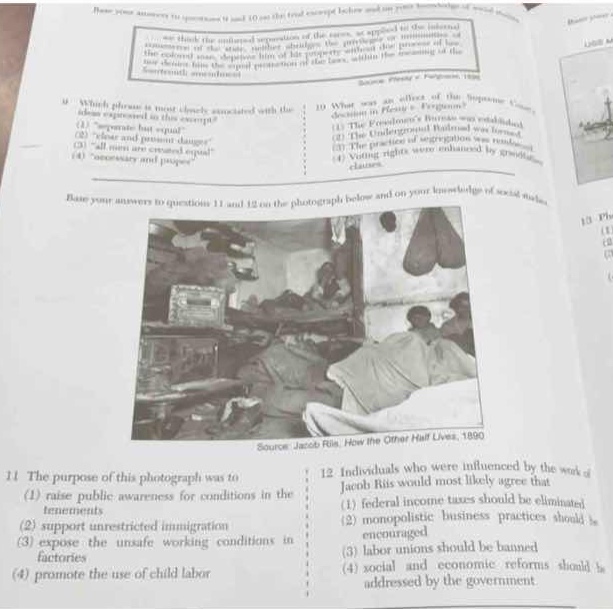
base your answers to questions 11 and 12 on the photograph below and on your knowledge of social studies.
photograph: jacob riis, how the other half lives, 1890
11 the purpose of this photograph was to
(1) raise public awareness for conditions in the tenements
(2) support unrestricted immigration
(3) expose the unsafe working conditions in factories
(4) promote the use of child labor
12 individuals who were influenced by the work of jacob riis would most likely agree that
(1) federal income taxes should be eliminated
(2) monopolistic business practices should be encouraged
(3) labor unions should be banned
(4) social and economic reforms should be addressed by the government.
Question 9 (Assuming it's about the "separate but equal" doctrine, likely related to US history/civil rights, subfield History in Social Science)
The phrase "separate but equal" was associated with the idea of racial segregation (like in Plessy v. Ferguson), and "separate but equal" aligns with the concept of allowing segregation as long as facilities were "equal" (though they weren't). The other phrases like "states' rights" or "necessary and proper" don't relate as closely. The key here is recognizing the historical context of segregation laws.
Jacob Riis' work (How the Other Half Lives) exposed tenement poverty. The Progressive Era responses included government addressing social/economic reforms. Option (4) about social and economic reforms addressed by government matches, as Riis' work spurred reform efforts. Other options: (1) - NAACP was later, (2) Underground Railroad was pre - Civil War, (3) Segregation by race wasn't the main focus of Riis (he focused on poverty).
Jacob Riis' "How the Other Half Lives" used photography to show the squalid conditions in tenements (urban slums) to raise public awareness. Option (1) says "raise public awareness for conditions in the tenements" which matches. Option (2) - he didn't support unrestricted immigration, (3) - his focus was tenements, not factory working conditions, (4) - he opposed child labor, not promoted.

Snap & solve any problem in the app
Get step-by-step solutions on Sovi AI
Photo-based solutions with guided steps
Explore more problems and detailed explanations
(Assuming the options are labeled, e.g., if the option with "separate but equal" is, say, option (1), then: 1. "separate but equal" (exact option text depends on original, but typically this phrase is linked to segregation doctrine))