QUESTION IMAGE
Question
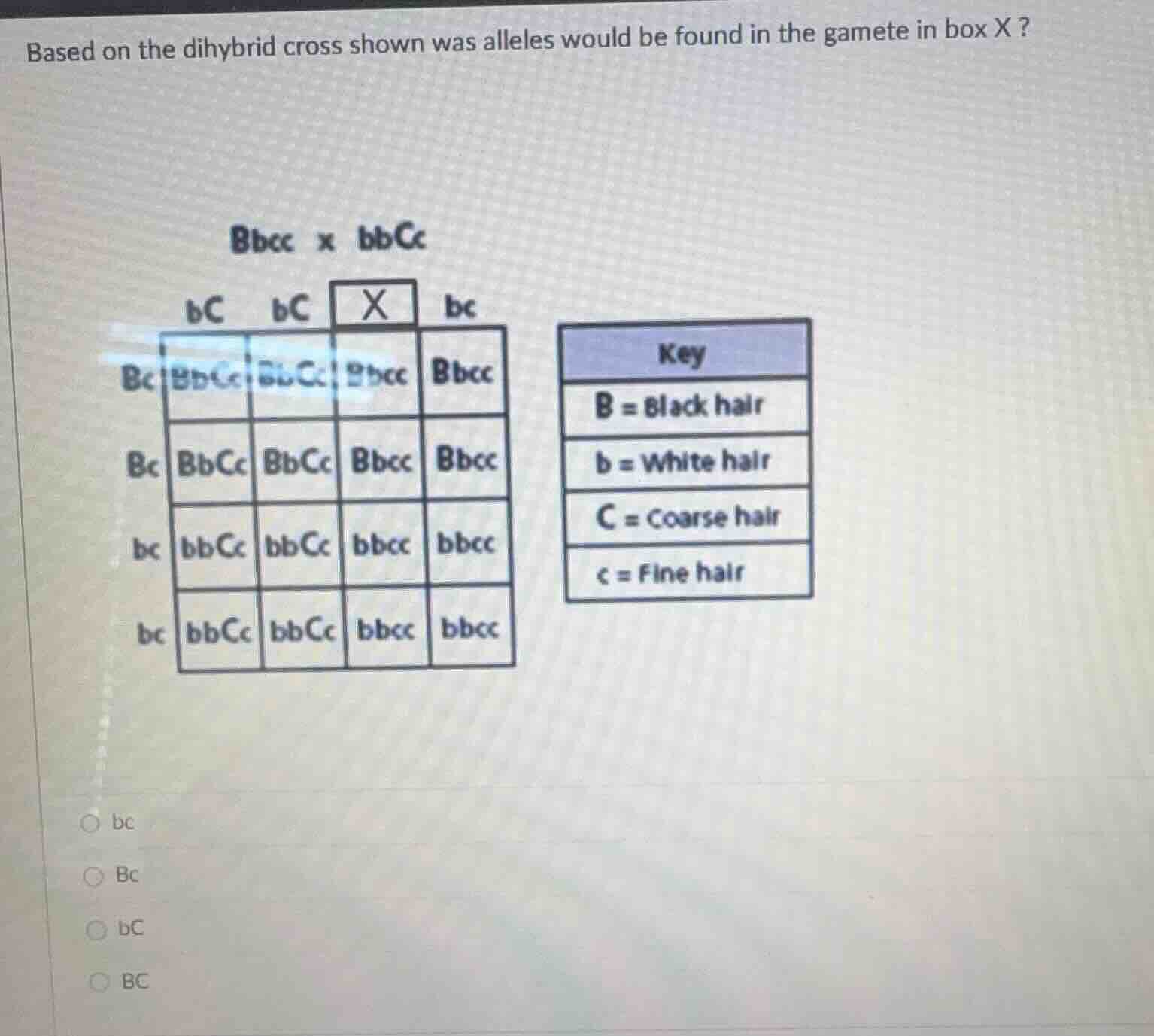
based on the dihybrid cross shown was alleles would be found in the gamete in box x ? bbcc × bbcc key b = black hair b = white hair c = coarse hair c = fine hair bc bc bc bc
Step1: Analyze the parents' genotypes
The cross is between \( Bbcc \) and \( bbCc \). For the parent \( Bbcc \), the possible gametes are formed by independent assortment of alleles. The alleles for the first gene (B/b) and second gene (C/c) assort independently. So from \( Bbcc \), the gametes are formed by taking one allele from each gene: \( B \) or \( b \) (from \( Bb \)) and \( c \) (since it's \( cc \), only \( c \) is possible). So the gametes from \( Bbcc \) are \( Bc \) and \( bc \) (wait, no: \( Bbcc \) has \( Bb \) for the first trait and \( cc \) for the second. So the possible gametes are \( Bc \) (B from Bb, c from cc) and \( bc \) (b from Bb, c from cc). Wait, but looking at the Punnett square, the rows are labeled \( Bc \), \( Bc \), \( bc \), \( bc \). So that's the gametes from \( Bbcc \).
Now the columns are from the other parent \( bbCc \). The genotype \( bbCc \) has \( bb \) (so only \( b \) for the first gene) and \( Cc \) (so \( C \) or \( c \) for the second gene). So the possible gametes from \( bbCc \) should be \( bC \) (b from bb, C from Cc) and \( bc \) (b from bb, c from Cc). Wait, but in the Punnett square, the columns are labeled \( bC \), \( bC \), \( X \), \( bc \). Wait, no, the first two columns are \( bC \), then \( X \), then \( bc \). Wait, maybe I made a mistake. Wait, the parent \( bbCc \): alleles for first gene are \( bb \) (so only \( b \)), alleles for second gene are \( Cc \) (so \( C \) or \( c \)). So the possible gametes are \( bC \) (b and C) and \( bc \) (b and c). But in the Punnett square, there are four columns? Wait, no, the Punnett square has four columns? Wait, the image shows columns: \( bC \), \( bC \), \( X \), \( bc \). Wait, maybe the parent \( bbCc \) is producing four gametes? No, that can't be. Wait, no, \( bbCc \) is heterozygous for C/c, so it should produce two types of gametes: \( bC \) and \( bc \), each in two copies? Wait, maybe the Punnett square is set up with the rows from \( Bbcc \) (gametes \( Bc \), \( Bc \), \( bc \), \( bc \)) and columns from \( bbCc \) (gametes \( bC \), \( bC \), \( X \), \( bc \)). Wait, but the third column (X) should be a gamete from \( bbCc \). Wait, looking at the cells in the third column (X column) and first row (Bc row): the cell is \( Bbcc \). Let's check the genotype of that cell. The row is \( Bc \) (from \( Bbcc \): B and c) and the column is X (gamete from \( bbCc \): let's call it \( g \)). So the cell's genotype is \( Bc \times g \). The cell is \( Bbcc \). So \( Bc \) (B, c) times \( g \) (let's say \( g \) has alleles \( x \) and \( y \)) gives \( Bx \) (for first gene) and \( cy \) (for second gene). The cell is \( Bbcc \), so first gene: \( Bx = Bb \) ⇒ \( x = b \). Second gene: \( cy = cc \) ⇒ \( y = c \). So \( g \) (the gamete in X) must be \( bc \)? Wait, no. Wait, the cell is \( Bbcc \). So the row is \( Bc \) (B, c) and the column is \( g \) (let's say \( g \) is \( (b, c) \)? Wait, no. Wait, the row is \( Bc \) (B from Bb, c from cc) and the column is \( g \) (from bbCc: which has b for first gene, and either C or c for second). Wait, the cell is \( Bbcc \). So the first allele of the cell is B (from row) and b (from column) ⇒ column's first allele is b. The second allele of the cell is c (from row) and c (from column) ⇒ column's second allele is c. So the gamete in column X is \( bc \)? Wait, but the other columns are \( bC \) (b, C) and \( bc \) (b, c). Wait, the first two columns are \( bC \), then X, then \( bc \). Wait, maybe the parent \( bbCc \) is producing four gametes? No, \( bbCc \) is \( bb \)…

Snap & solve any problem in the app
Get step-by-step solutions on Sovi AI
Photo-based solutions with guided steps
Explore more problems and detailed explanations
The alleles in the gamete in box X are \( bc \), so the correct option is the one labeled "bc" (the first option, assuming the options are: bc, Bc, bC, BC; so the answer is the option with "bc").