QUESTION IMAGE
Question
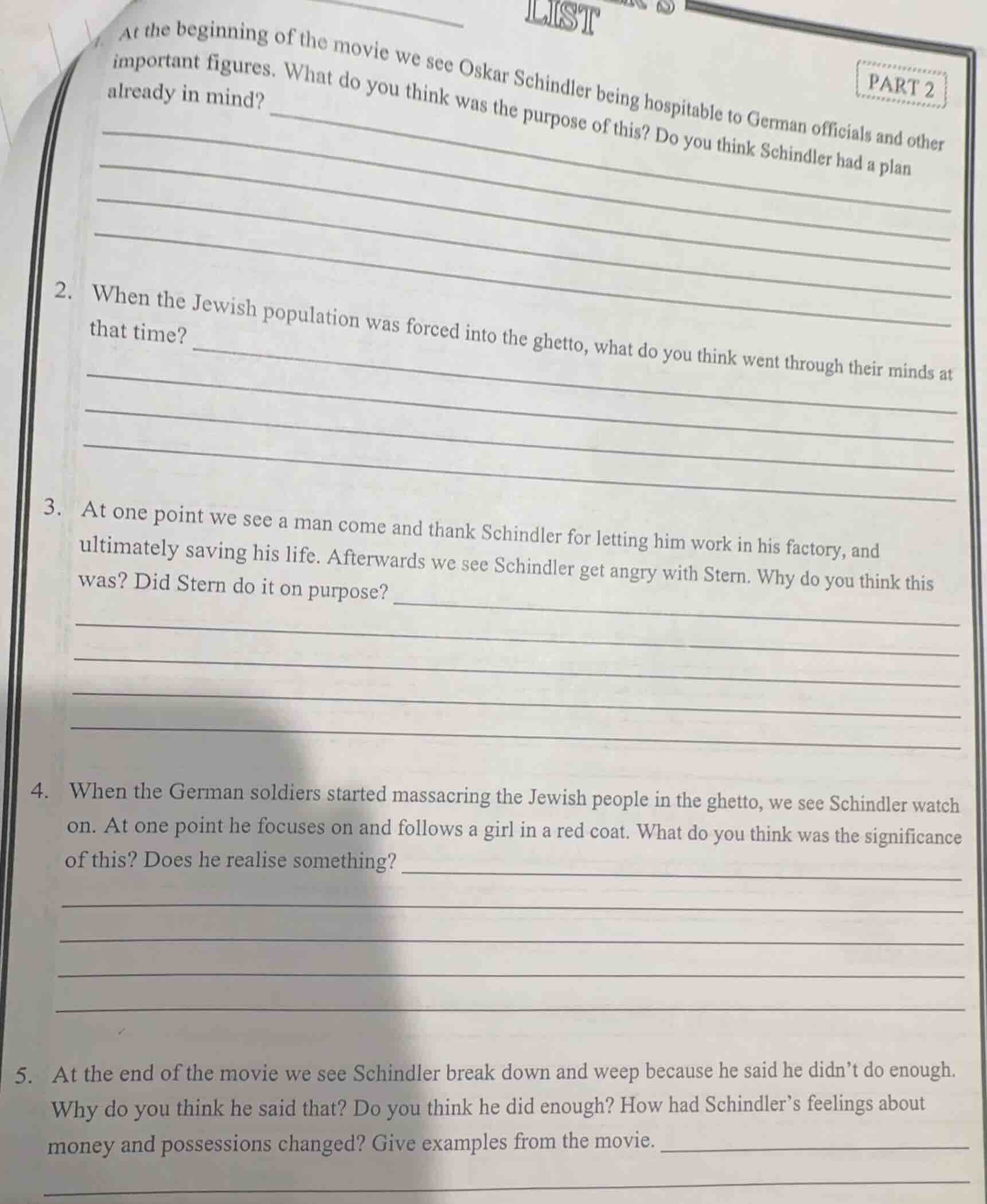
- at the beginning of the movie we see oskar schindler being hospitable to german officials and other important figures. what do you think was the purpose of this? do you think schindler had a plan already in mind?
- when the jewish population was forced into the ghetto, what do you think went through their minds at that time?
- at one point we see a man come and thank schindler for letting him work in his factory, and ultimately saving his life. afterwards we see schindler get angry with stern. why do you think this was? did stern do it on purpose?
- when the german soldiers started massacring the jewish people in the ghetto, we see schindler watch on. at one point he focuses on and follows a girl in a red coat. what do you think was the significance of this? does he realise something?
- at the end of the movie we see schindler break down and weep because he said he didn’t do enough. why do you think he said that? do you think he did enough? how had schindler’s feelings about money and possessions changed? give examples from the movie.
Question 1
Oskar Schindler's hospitality to German officials was likely to build connections and gain access to resources/opportunities, especially for his business (running a factory). Given the context of Nazi - era Poland, networking with officials was crucial for business operations, like getting permits, access to labor (Jewish workers in the ghetto), and avoiding scrutiny. It's probable he had a plan related to business expansion or security in the volatile environment, though his later moral evolution shows the plan might have evolved to include saving lives.
When Jews were forced into ghettos, they would likely feel fear (of the unknown, Nazi brutality), loss (of homes, businesses, normal life), and uncertainty about their future. They might also feel anger at the injustice and a sense of community as they were all in the same dire situation, knowing they were targeted for their identity.
Schindler got angry because the man's gratitude could draw attention to Schindler's role in saving Jews, which was dangerous under Nazi rule (helping Jews was illegal). Stern probably didn't do it on purpose; the man was grateful and acted out of emotion, not realizing the risk to Schindler. Schindler feared Nazi retribution if his actions were exposed.

Snap & solve any problem in the app
Get step-by-step solutions on Sovi AI
Photo-based solutions with guided steps
Explore more problems and detailed explanations
Schindler's hospitality aimed to build connections with German officials for business advantages (e.g., factory operations, access to labor). He likely had a plan related to business security/expansion, though it later grew to include saving lives.