QUESTION IMAGE
Question
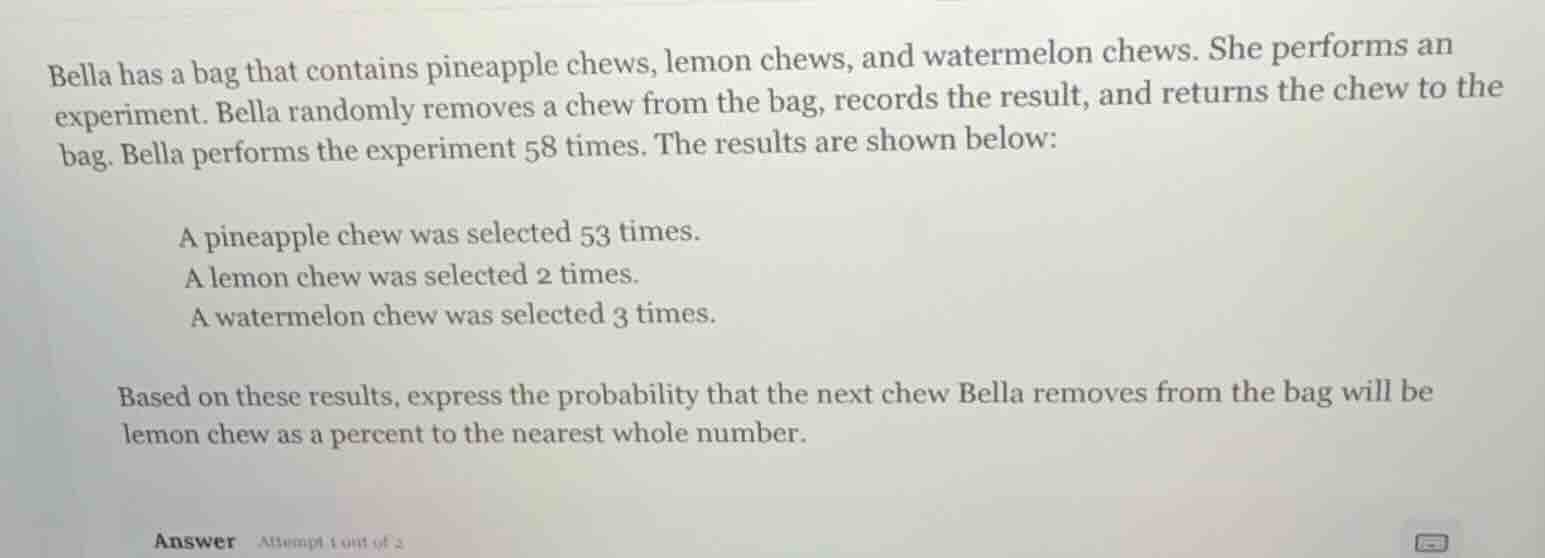
bella has a bag that contains pineapple chews, lemon chews, and watermelon chews. she performs an experiment. bella randomly removes a chew from the bag, records the result, and returns the chew to the bag. bella performs the experiment 58 times. the results are shown below:
a pineapple chew was selected 53 times.
a lemon chew was selected 2 times.
a watermelon chew was selected 3 times.
based on these results, express the probability that the next chew bella removes from the bag will be lemon chew as a percent to the nearest whole number.
Step1: Recall probability formula
The experimental probability of an event is the number of times the event occurs divided by the total number of trials. So, for the lemon chew, the formula is $P(\text{lemon})=\frac{\text{Number of lemon chews selected}}{\text{Total number of trials}}$.
Step2: Identify values
Number of lemon chews selected is 2, and total number of trials is 58.
Step3: Calculate probability
Substitute the values into the formula: $P(\text{lemon})=\frac{2}{58}$.
Step4: Convert to percentage
To convert to a percentage, multiply by 100: $\frac{2}{58}\times100\approx3.45\%$. Rounding to the nearest whole number gives 3%.

Snap & solve any problem in the app
Get step-by-step solutions on Sovi AI
Photo-based solutions with guided steps
Explore more problems and detailed explanations
3%