QUESTION IMAGE
Question
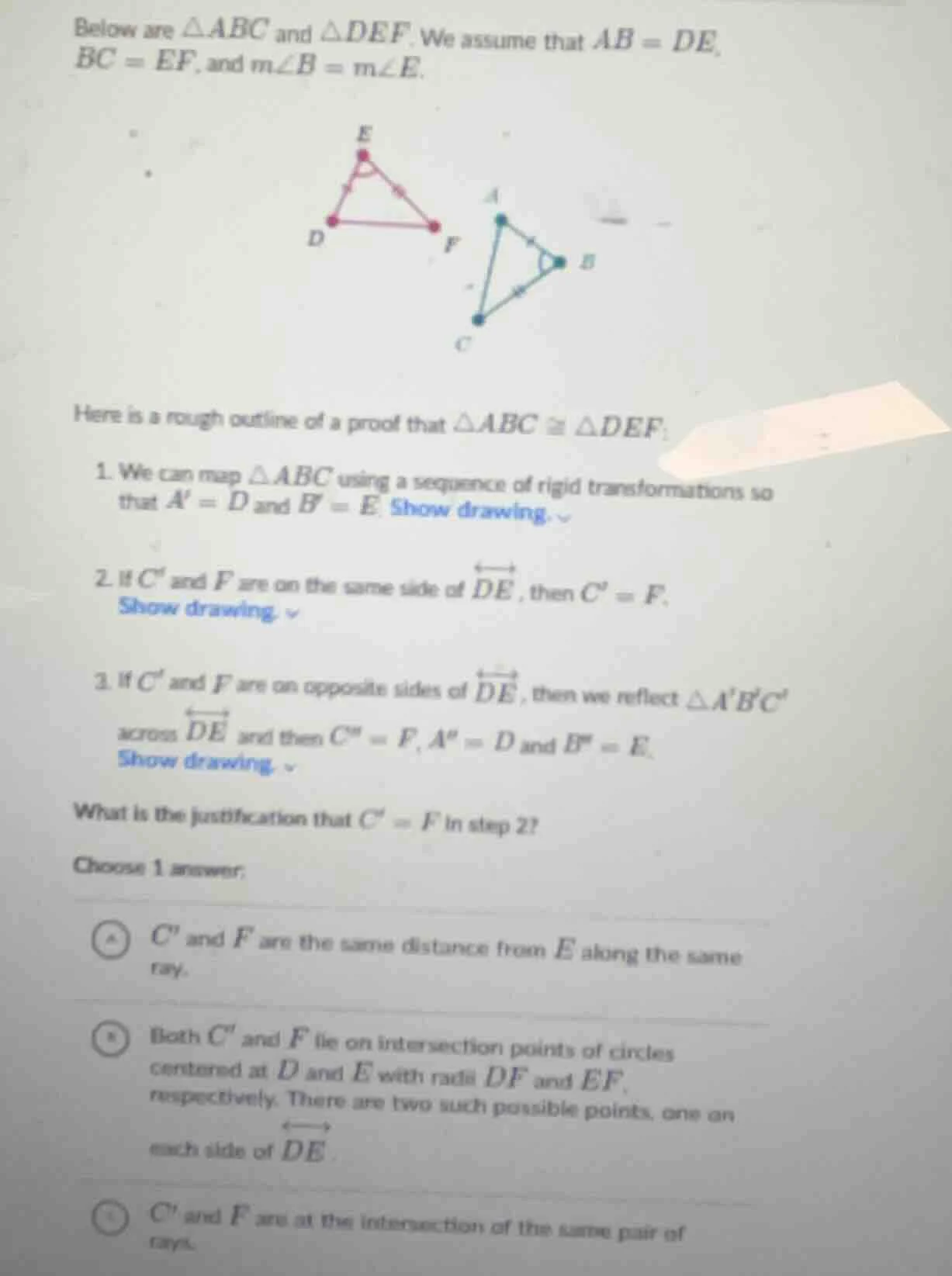
below are △abc and △def. we assume that ab = de, bc = ef, and m∠b = m∠e. here is a rough outline of a proof that △abc ≅ △def: 1. we can map △abc using a sequence of rigid transformations so that a = d and b = e. 2. if c and f are on the same side of de, then c = f. 3. if c and f are on opposite sides of de, then we reflect △abc across de and then c = f, a = d and e = e. what is the justification that c = f in step 2? choose 1 answer: a. c and f are the same distance from e along the same ray. b. both c and f lie on intersection points of circles centered at d and e with radii df and ef, respectively. there are two such possible points, one on each side of de. c. c and f are at the intersection of the same pair of rays.
To determine the justification for \( C' = F \) in step 2, we analyze the given information and the properties of rigid transformations. We know \( AB = DE \), \( BC = EF \), and \( m\angle B = m\angle E \). After mapping \( \triangle ABC \) to \( \triangle A'B'C' \) (where \( A' = D \) and \( B' = E \)) using rigid transformations, we consider the position of \( C' \) and \( F \) relative to \( \overleftrightarrow{DE} \).
- Option A: Since \( BC = EF \) (given) and \( B' = E \), \( C' \) and \( F \) must be the same distance from \( E \) along the same ray (because the angle \( \angle B \) and \( \angle E \) are equal, so the direction from \( E \) to \( F \) and from \( B' \) (which is \( E \)) to \( C' \) is the same). This means \( C' \) and \( F \) coincide because they are on the same side of \( \overleftrightarrow{DE} \) and at the same distance from \( E \) along the same ray.
- Option B: This option describes the general case of two intersection points of circles (one on each side of \( \overleftrightarrow{DE} \)), but step 2 specifically considers the case where \( C' \) and \( F \) are on the same side of \( \overleftrightarrow{DE} \), so this is not the justification for \( C' = F \) in that specific case.
- Option C: While \( C' \) and \( F \) might lie on the intersection of some circles, the key justification here is the distance and direction (same ray) from \( E \), not just the intersection of circles in general.
So the correct justification is that \( C' \) and \( F \) are the same distance from \( E \) along the same ray.

Snap & solve any problem in the app
Get step-by-step solutions on Sovi AI
Photo-based solutions with guided steps
Explore more problems and detailed explanations
A. \( C' \) and \( F \) are the same distance from \( E \) along the same ray.