QUESTION IMAGE
Question
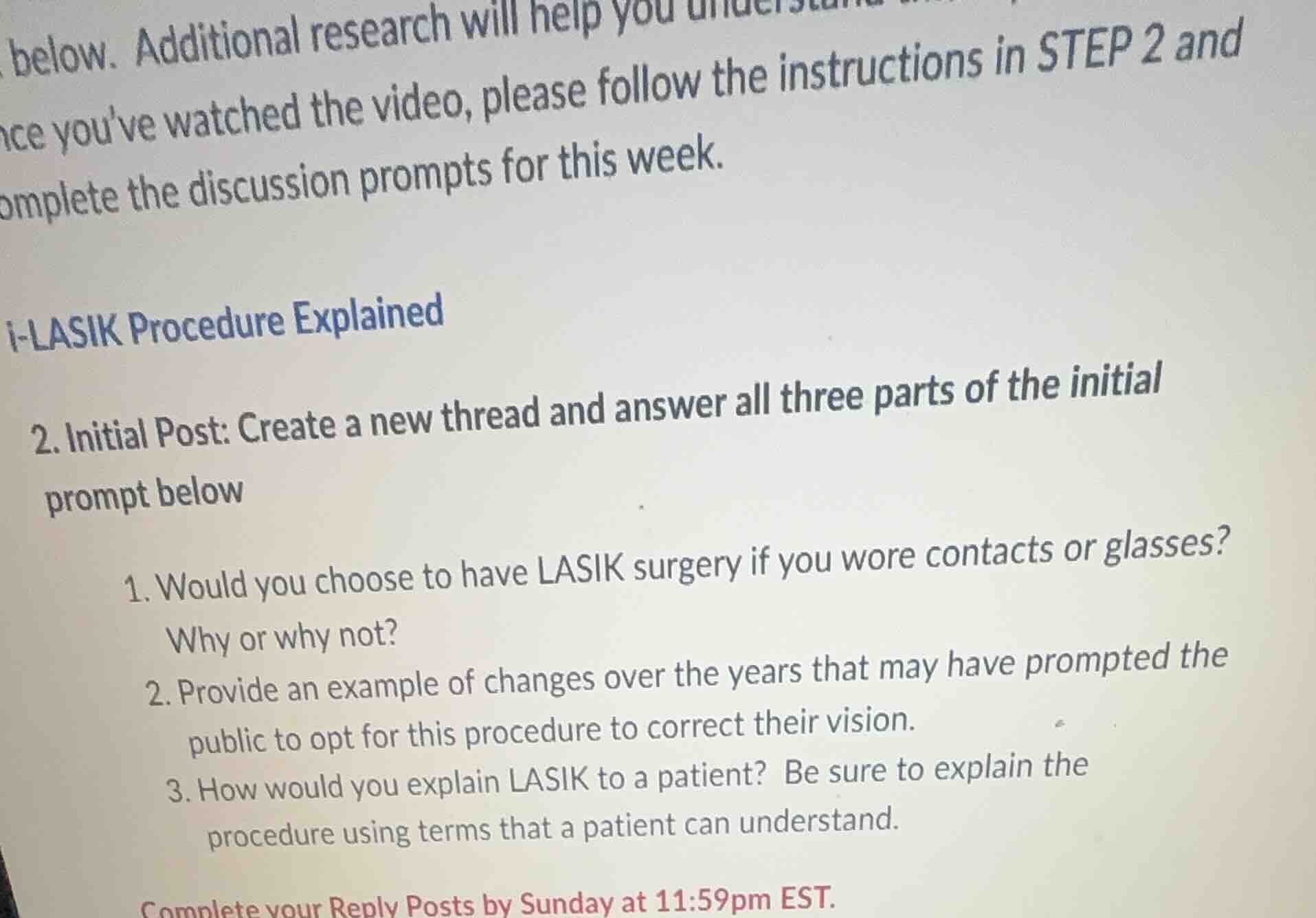
below. additional research will help you nce youve watched the video, please follow the instructions in step 2 and omplete the discussion prompts for this week. i-lasik procedure explained 2. initial post: create a new thread and answer all three parts of the initial prompt below 1. would you choose to have lasik surgery if you wore contacts or glasses? why or why not? 2. provide an example of changes over the years that may have prompted the public to opt for this procedure to correct their vision. 3. how would you explain lasik to a patient? be sure to explain the procedure using terms that a patient can understand. complete your reply posts by sunday at 11:59pm est.
- For the first question, the response balances personal preference with practical considerations of risks and benefits.
- The second question addresses a key technological advancement that improved safety and accessibility of LASIK.
- The third question uses simple, non-technical language to break down the LASIK procedure clearly for a patient.

Snap & solve any problem in the app
Get step-by-step solutions on Sovi AI
Photo-based solutions with guided steps
Explore more problems and detailed explanations
- I would consider LASIK surgery after thorough consultation. I would choose it if my vision prescription is stable, I meet all eligibility criteria, and the risks (like dry eyes or mild vision fluctuations) are low for my case. It would eliminate the hassle of daily contact lens care and the cost of replacing glasses/contacts over time. However, I would decline if I have conditions like thin corneas or unstable vision, as these increase complication risks.
- One major change is the development of femtosecond laser technology for creating the corneal flap (instead of a microkeratome blade). This made the procedure more precise, reduced the risk of flap-related complications, and made LASIK safer for more patients. As this technology became widely available and covered by more insurance plans, more members of the public felt comfortable choosing LASIK over lifelong glasses or contacts.
- "LASIK is a quick, outpatient eye surgery to fix your near- or farsightedness, or astigmatism, so you can see clearly without glasses or contacts. Here's how it works: First, we'll use a special laser to create a thin, hinged flap on the clear outer layer of your eye (the cornea). We'll gently lift that flap to access the underlying part of the cornea. Then, another laser will reshape that inner corneal tissue—this reshaping adjusts how light focuses on the back of your eye (the retina), which fixes your blurred vision. Finally, we'll lay the flap back down, and it will heal on its own without stitches. The whole process takes about 10-15 minutes per eye, and most people notice improved vision within a day or two."