QUESTION IMAGE
Question
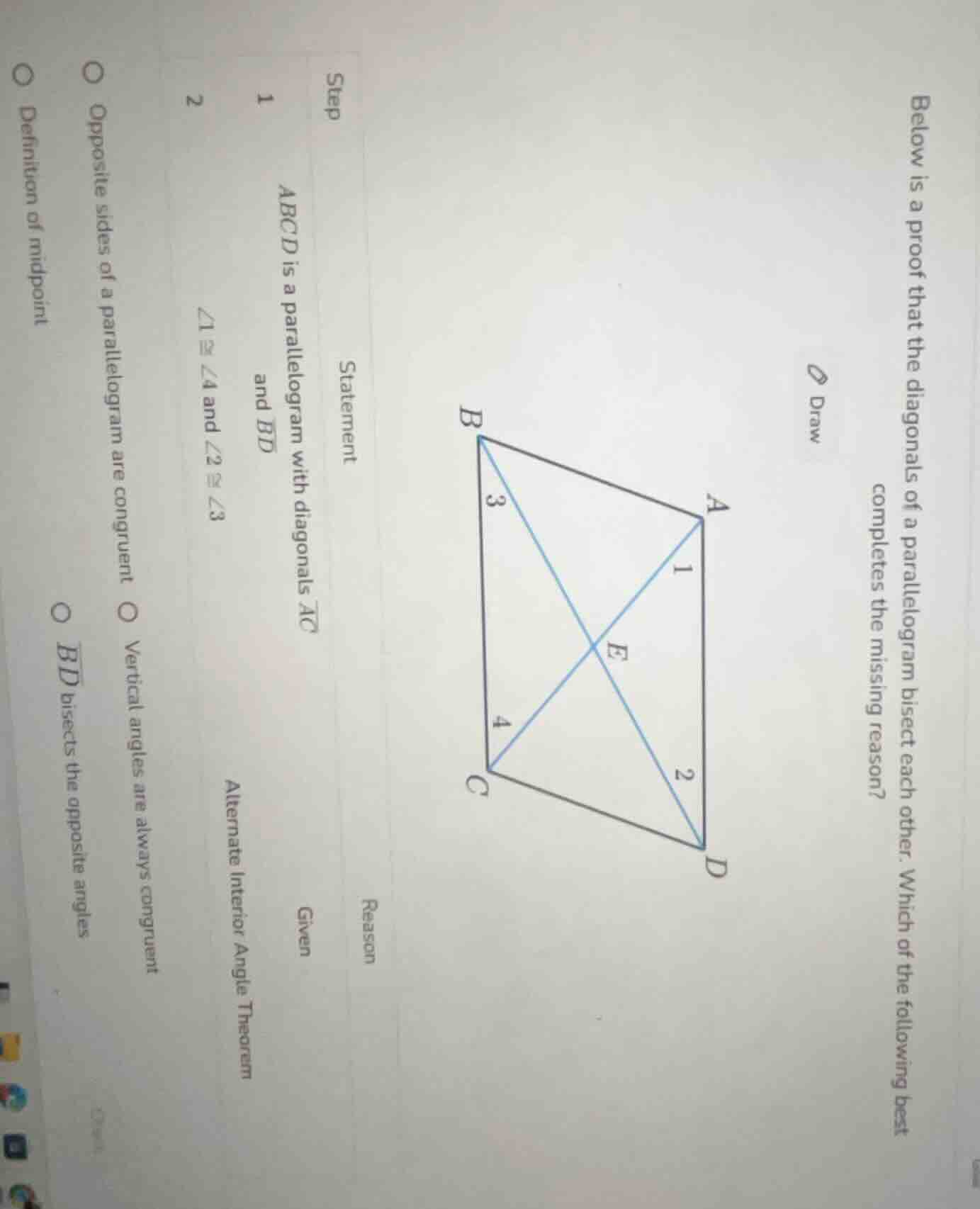
below is a proof that the diagonals of a parallelogram bisect each other. which of the following best completes the missing reason?drawstep | statement | reason1 | $abcd$ is a parallelogram with diagonals $overline{ac}$ and $overline{bd}$ | given2 | $angle 1 cong angle 4$ and $angle 2 cong angle 3$ | alternate interior angle theorem$\bigcirc$ opposite sides of a parallelogram are congruent$\bigcirc$ vertical angles are always congruent$\bigcirc$ definition of midpoint$\bigcirc$ $overline{bd}$ bisects the opposite angles
In a parallelogram, opposite sides are parallel. For $\angle 1$ and $\angle 4$, they are formed by transversal $\overline{AC}$ cutting parallel sides $\overline{AB}$ and $\overline{CD}$, so they are alternate interior angles. Similarly, $\angle 2$ and $\angle 3$ are alternate interior angles formed by transversal $\overline{BD}$ cutting parallel sides $\overline{AD}$ and $\overline{BC}$. The Alternate Interior Angle Theorem states that such angles are congruent, which matches the statement in Step 2.

Snap & solve any problem in the app
Get step-by-step solutions on Sovi AI
Photo-based solutions with guided steps
Explore more problems and detailed explanations
Alternate Interior Angle Theorem