QUESTION IMAGE
Question
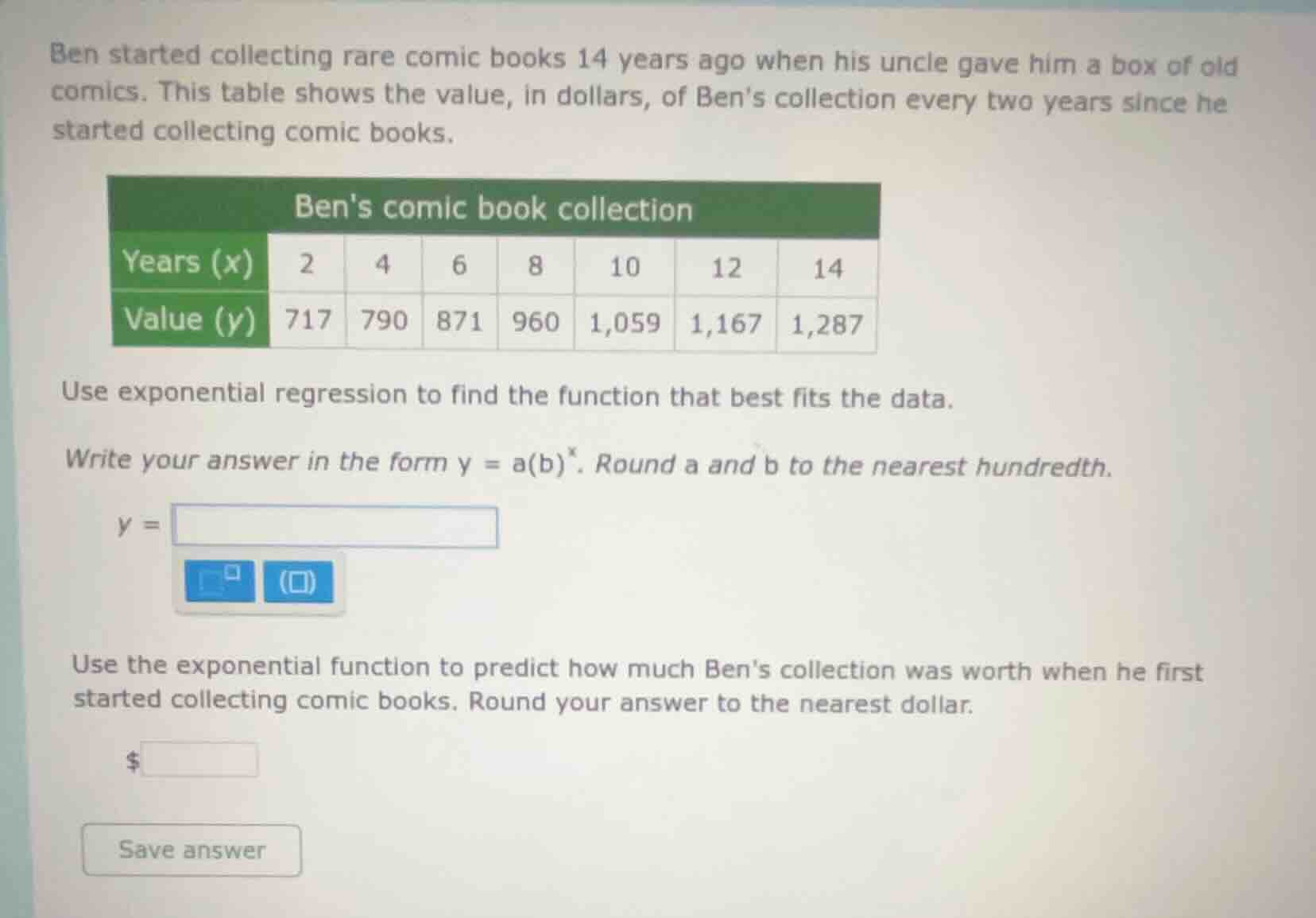
ben started collecting rare comic books 14 years ago when his uncle gave him a box of old comics. this table shows the value, in dollars, of ben’s collection every two years since he started collecting comic books. bens comic book collection years (x) 2 4 6 8 10 12 14 value (y) 717 790 871 960 1,059 1,167 1,287 use exponential regression to find the function that best fits the data. write your answer in the form $y = a(b)^x$. round a and b to the nearest hundredth. $y = $ use the exponential function to predict how much ben’s collection was worth when he first started collecting comic books. round your answer to the nearest dollar. $
Step1: Recall exponential regression form
The target form is $y = a(b)^x$, which can be linearized by taking the natural log of both sides: $\ln(y) = \ln(a) + x\ln(b)$, where we let $Y=\ln(y)$, $A=\ln(a)$, $B=\ln(b)$, so $Y = A + Bx$.
Step2: Calculate $\ln(y)$ for each data point
| $x$ | $y$ | $\ln(y)$ |
|---|---|---|
| 4 | 790 | $\ln(790)\approx6.673$ |
| 6 | 871 | $\ln(871)\approx6.771$ |
| 8 | 960 | $\ln(960)\approx6.867$ |
| 10 | 1059 | $\ln(1059)\approx6.964$ |
| 12 | 1167 | $\ln(1167)\approx7.062$ |
| 14 | 1287 | $\ln(1287)\approx7.159$ |
Step3: Compute linear regression for $Y$ and $x$
First, calculate necessary sums:
- $n=7$
- $\sum x = 2+4+6+8+10+12+14=56$
- $\sum Y = 6.575+6.673+6.771+6.867+6.964+7.062+7.159\approx48.071$
- $\sum xY = (2*6.575)+(4*6.673)+(6*6.771)+(8*6.867)+(10*6.964)+(12*7.062)+(14*7.159)\approx390.232$
- $\sum x^2 = 2^2+4^2+6^2+8^2+10^2+12^2+14^2=560$
Calculate slope $B$:
Calculate intercept $A$:
Step4: Solve for $a$ and $b$
$b = e^B \approx e^{0.0506} \approx 1.05$
$a = e^A \approx e^{6.462} \approx 643.00$
So the exponential function is $y = 643.00(1.05)^x$
Step5: Predict initial value ($x=0$)
Substitute $x=0$ into the function: $y = 643.00(1.05)^0 = 643.00*1 = 643$

Snap & solve any problem in the app
Get step-by-step solutions on Sovi AI
Photo-based solutions with guided steps
Explore more problems and detailed explanations
$y = 643.00(1.05)^x$
$\$643$