QUESTION IMAGE
Question
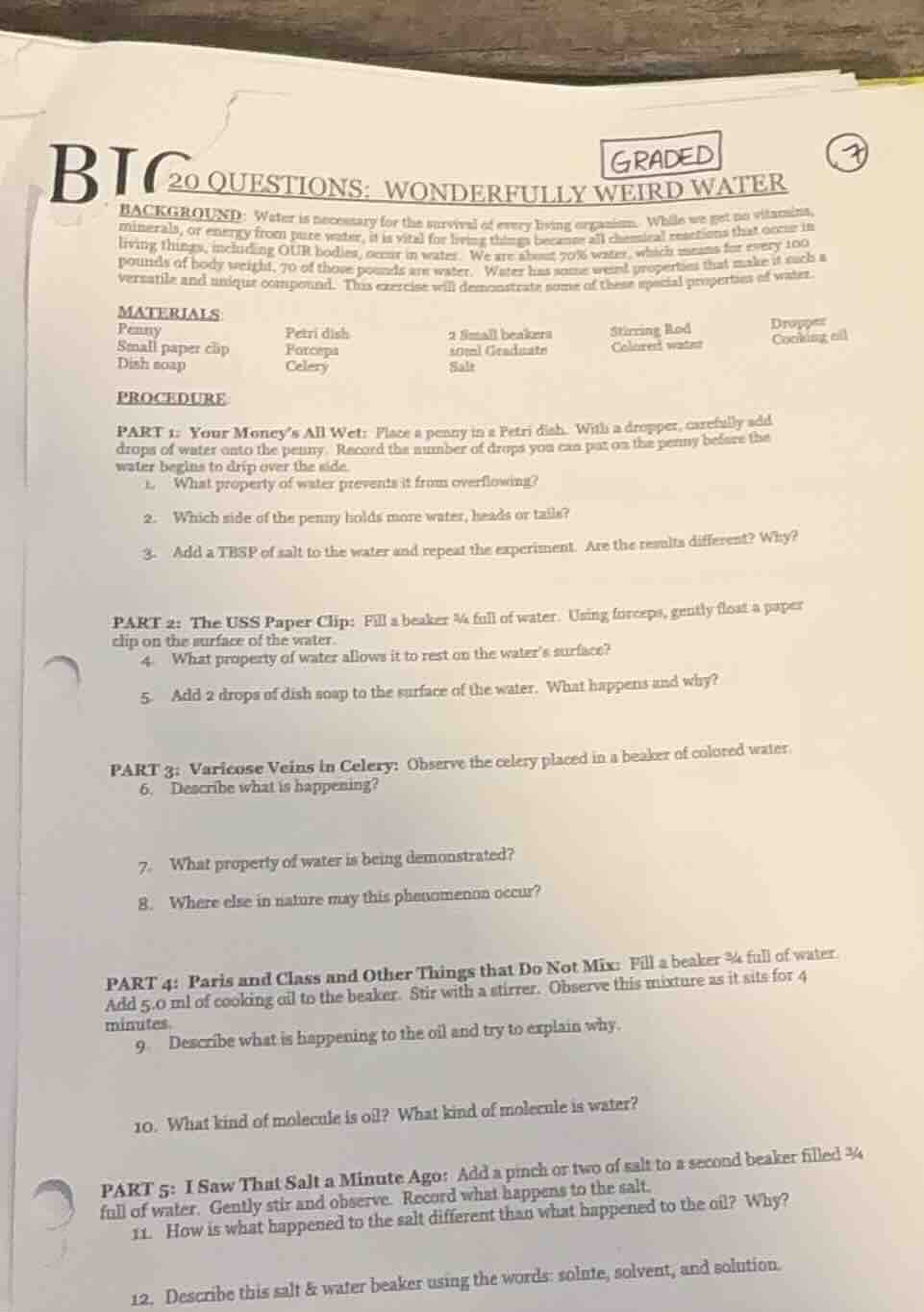
big 20 questions: wonderfully weird water
background: water is necessary for the survival of every living organism. while we get no vitamins, minerals, or energy from pure water, it is vital for living things because all chemical reactions that occur in living things, including our bodies, occur in water. we are about 70% water, which means for every 100 pounds of body weight, 70 of those pounds are water. water has some weird properties that make it such a versatile and unique compound. this exercise will demonstrate some of these special properties of water.
materials
penny
petri dish
2 small beakers
stirring rod
dropper
small paper clip
forceps
iodine (graduated)
colored water
cooking oil
dish soap
celery
salt
procedure
part 1: your money’s all wet: place a penny in a petri dish. with a dropper, carefully add drops of water onto the penny. record the number of drops you can put on the penny before the water begins to drip over the side.
- what property of water prevents it from overflowing?
- which side of the penny holds more water, heads or tails?
- add a tbsp of salt to the water and repeat the experiment. are the results different? why?
part 2: the uss paper clip: fill a beaker ¾ full of water. using forceps, gently float a paper clip on the surface of the water.
- what property of water allows it to rest on the water’s surface?
- add 2 drops of dish soap to the surface of the water. what happens and why?
part 3: varicose veins in celery: observe the celery placed in a beaker of colored water.
- describe what is happening?
- what property of water is being demonstrated?
- where else in nature may this phenomenon occur?
part 4: paris and class and other things that do not mix: fill a beaker ¾ full of water. add 5.0 ml of cooking oil to the beaker. stir with a stirrer. observe this mixture as it sits for 4 minutes.
- describe what is happening to the oil and try to explain why.
- what kind of molecule is oil? what kind of molecule is water?
part 5: i saw that salt a minute ago: add a pinch or two of salt to a second beaker filled ¾ full of water. gently stir and observe. record what happens to the salt.
- how is what happened to the salt different than what happened to the oil? why?
- describe this salt & water beaker using the words: solute, solvent, and solution.
- Question 1: Water forms a curved surface (meniscus) and resists overflow due to cohesive forces between water molecules creating surface tension, which holds the water together above the penny's edge.
- Question 2: Both sides hold nearly the same amount; any minor difference is due to surface texture, not an inherent difference between heads/tails.
- Question 3: Fewer drops fit on the penny. Salt dissolves and disrupts the hydrogen bonds that create water's surface tension, weakening it.
- Question 4: Surface tension, created by cohesive forces between water molecules, forms a "skin" strong enough to support the paper clip's small weight.
- Question 5: The paper clip sinks. Dish soap is a surfactant that breaks water's surface tension by interfering with cohesive hydrogen bonds.
- Question 6: The blue colored water moves upward through the thin tubes (xylem) inside the celery stalk, turning the stalk and leaves blue.
- Question 7: Capillary action, which combines adhesion (water sticking to celery tube walls) and cohesion (water sticking to itself) to pull water upward.
- Question 8: This occurs when water moves up plant roots and stems to reach leaves, or when water rises in a thin glass tube placed in water.
- Question 9: The oil floats on top of the water and forms a separate layer, even after stirring. Oil is nonpolar, water is polar, and polar and nonpolar substances do not mix (like dissolves like principle).
- Question 10: Oil is a nonpolar molecule; water is a polar molecule.
- Question 11: Salt dissolves completely in water, while oil forms a separate layer. Salt is polar, so it interacts with polar water molecules and dissolves; oil is nonpolar and cannot interact with polar water.
- Question 12: The salt is the solute (substance being dissolved), the water is the solvent (substance doing the dissolving), and the mixture of dissolved salt in water is the solution.

Snap & solve any problem in the app
Get step-by-step solutions on Sovi AI
Photo-based solutions with guided steps
Explore more problems and detailed explanations
- Surface tension
- Both hold nearly the same amount; minor differences are from surface texture, not heads/tails itself.
- Yes, fewer drops fit. Salt weakens water's surface tension by disrupting hydrogen bonds.
- Surface tension
- The paper clip sinks. Dish soap breaks water's surface tension.
- Colored water moves up the celery stalk, turning it blue.
- Capillary action (adhesion + cohesion)
- Water moving up plant roots/stems, or rising in thin glass tubes.
- Oil floats in a separate layer on water. Oil is nonpolar, water is polar—they do not mix.
- Oil: nonpolar molecule; Water: polar molecule
- Salt dissolves in water, while oil forms a separate layer. Salt is polar (matches water's polarity), oil is nonpolar (does not match).
- Salt = solute, water = solvent, dissolved salt-water mixture = solution