QUESTION IMAGE
Question
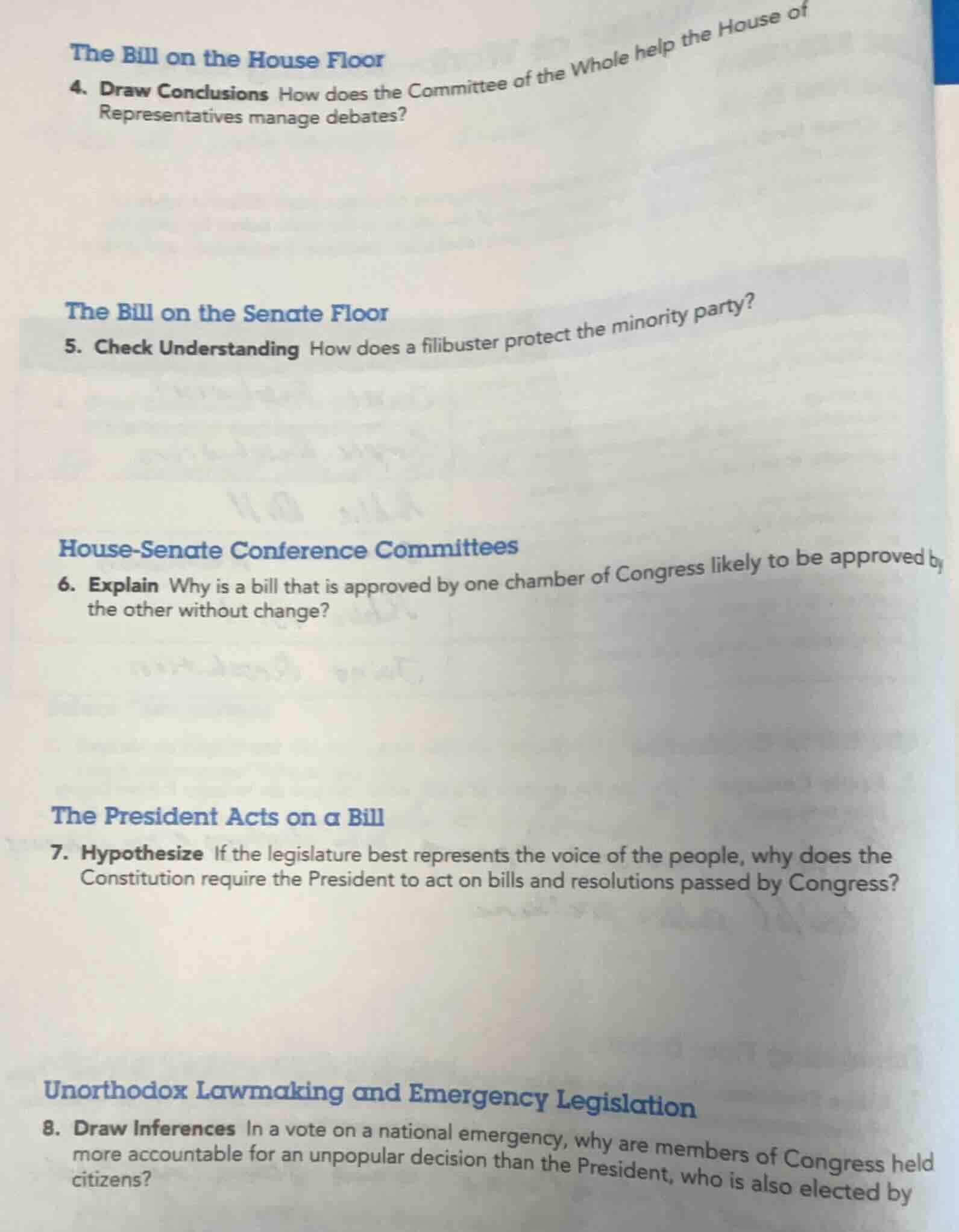
the bill on the house floor
- draw conclusions how does the committee of the whole help the house of representatives manage debates?
the bill on the senate floor
- check understanding how does a filibuster protect the minority party?
house - senate conference committees
- explain why is a bill that is approved by one chamber of congress likely to be approved by the other without change?
the president acts on a bill
- hypothesize if the legislature best represents the voice of the people, why does the constitution require the president to act on bills and resolutions passed by congress?
unorthodox lawmaking and emergency legislation
- draw inferences in a vote on a national emergency, why are members of congress held more accountable for an unpopular decision than the president, who is also elected by citizens?
Brief Explanations
- The Committee of the Whole simplifies House debate rules: it allows for a quorum of just 100 members (instead of the full House majority), permits more flexible discussion and amendment processes, and streamlines the consideration of bills by operating with less formal rules than the full House, making debate management more efficient.
- A filibuster lets Senate minority party members extend debate indefinitely on a bill. To end it, a supermajority of 60 votes is required. This gives the minority the power to block or delay legislation they oppose, ensuring their voices are heard and preventing the majority from ramming through bills without bipartisan input.
- Bills approved by one chamber are often passed unchanged by the other because they are typically crafted with input from both parties and undergo extensive committee review to align with broad congressional priorities. Additionally, members often avoid revising bills from the other chamber to prevent lengthy conference negotiations and maintain legislative efficiency, especially for non-controversial legislation.
- This is a core part of the separation of powers and checks and balances in the U.S. system. The President's role ensures a check on legislative overreach, ensures bills align with executive branch priorities and administrative feasibility, and provides a final layer of accountability by requiring a branch of government elected nationally (not just by districts/ states) to sign off on laws.
- Congress members are held more accountable because they represent smaller, geographically defined constituencies, so an unpopular emergency vote directly risks their re-election by angering local voters. The President, as a national figure, can frame the decision around broader national interests, and their larger, diverse national base may be more forgiving, plus they serve a 4-year term (vs. 2 for House members) which distances them from immediate electoral consequences.

Snap & solve any problem in the app
Get step-by-step solutions on Sovi AI
Photo-based solutions with guided steps
Explore more problems and detailed explanations
- It streamlines debate with relaxed rules, smaller quorum, and flexible amendment processes to manage House discussions efficiently.
- It lets minorities extend debate, requiring a 60-vote supermajority to end, blocking/delaying unwanted majority legislation.
- Bills are often bipartisan, committee-vetted, and members avoid revisions to skip lengthy negotiations and maintain efficiency.
- It enforces separation of powers/checks and balances, checks legislative overreach, ensures administrative feasibility, and adds national accountability.
- Congress members represent small local constituencies with short terms, making them more vulnerable to local backlash, while the President has a national base and longer term to frame the decision broadly.