QUESTION IMAGE
Question
bio 1016
meiosis worksheet
name: lilian batiste
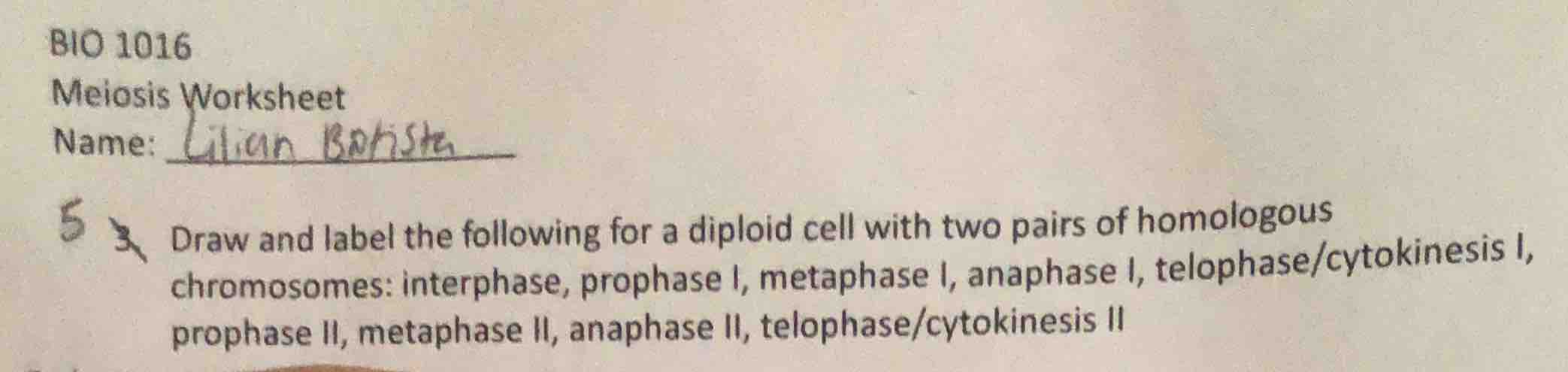
- draw and label the following for a diploid cell with two pairs of homologous chromosomes: interphase, prophase i, metaphase i, anaphase i, telophase/cytokinesis i, prophase ii, metaphase ii, anaphase ii, telophase/cytokinesis ii
Brief Explanations
Each stage is described with key features for a diploid cell (2n=4, 2 homologous chromosome pairs):
- Interphase: Cell grows, DNA replicates; chromosomes are uncondensed chromatin, nuclear envelope intact, centrioles duplicate.
- Prophase I: Chromosomes condense, homologous pairs synapse (form tetrads), crossing over occurs, nuclear envelope breaks down, spindle fibers form.
- Metaphase I: Tetrads align at the cell's equatorial plate, spindle fibers attach to centromeres of homologous chromosomes.
- Anaphase I: Homologous chromosome pairs separate and move to opposite poles; sister chromatids remain attached.
- Telophase/Cytokinesis I: Chromosomes arrive at poles, nuclear envelopes reform, cytokinesis splits cell into two haploid daughter cells (each with 2 chromosomes, sister chromatids still paired).
- Prophase II: Nuclear envelope breaks down, spindle fibers reform, chromosomes condense (no homologous pairs present now).
- Metaphase II: Chromosomes align single-file at the equatorial plate of each daughter cell, spindle fibers attach to sister chromatid centromeres.
- Anaphase II: Sister chromatids separate and move to opposite poles of each cell.
- Telophase/Cytokinesis II: Chromosomes decondense, nuclear envelopes reform, cytokinesis splits each cell, resulting in 4 genetically distinct haploid daughter cells (each with 1 chromosome from each original homologous pair).

Snap & solve any problem in the app
Get step-by-step solutions on Sovi AI
Photo-based solutions with guided steps
Explore more problems and detailed explanations
Visual Guide (Text Description for Drawing):
- Interphase:
- Draw a large oval (cell membrane). Inside, draw a round nucleus with a nucleolus. Sketch loose, thread-like chromatin strands (representing 4 replicated chromosomes, 2 homologous pairs). Label: Cell Membrane, Nucleus, Nucleolus, Chromatin.
- Prophase I:
- Draw the cell oval, no nuclear envelope. Draw 2 paired sets of X-shaped chromosomes (tetrads; each X is a replicated chromosome, paired with its homolog). Add spindle fibers from centrioles at cell poles. Label: Homologous Chromosome Pair (Tetrad), Spindle Fibers, Centrioles, Cell Membrane.
- Metaphase I:
- Draw the cell oval, spindle fibers extending from poles. Position the 2 tetrads lined up along the center (equator) of the cell. Label: Equatorial Plate, Homologous Chromosome Pair, Spindle Fibers, Centrioles.
- Anaphase I:
- Draw the cell oval, spindle fibers shortening. Pull one chromosome from each homologous pair to opposite cell poles (each chromosome is still an X shape, sister chromatids attached). Label: Separated Homologous Chromosomes, Spindle Fibers, Cell Membrane.
- Telophase/Cytokinesis I:
- Draw two separate small ovals (forming daughter cells). In each, draw a nucleus around the 2 chromosomes at each pole. A cleavage furrow (or cell plate in plants) divides the original cell. Label: Daughter Cells, Nucleus, Cleavage Furrow, Chromosomes.
- Prophase II:
- Draw two small cell ovals. In each, draw 2 X-shaped chromosomes (no pairs), spindle fibers forming from centrioles, no nuclear envelope. Label: Chromosomes, Spindle Fibers, Centrioles, Cell Membrane.
- Metaphase II:
- Draw two small cell ovals. In each, line the 2 X-shaped chromosomes single-file along the cell's equator, spindle fibers attached to centromeres. Label: Equatorial Plate, Chromosomes, Spindle Fibers.
- Anaphase II:
- Draw two small cell ovals. In each, pull sister chromatids (now individual rod-shaped chromosomes) to opposite poles via shortening spindle fibers. Label: Separated Sister Chromatids, Spindle Fibers, Cell Membrane.
- Telophase/Cytokinesis II:
- Draw four small ovals (final daughter cells). In each, draw a nucleus around the 2 single rod-shaped chromosomes, with a cleavage furrow completing division. Label: Genetically Unique Haploid Daughter Cells, Nucleus, Chromosomes, Cleavage Furrow.