QUESTION IMAGE
Question
biography activity
world war i and the russian revolution
archduke francis ferdinand (1863–1914)
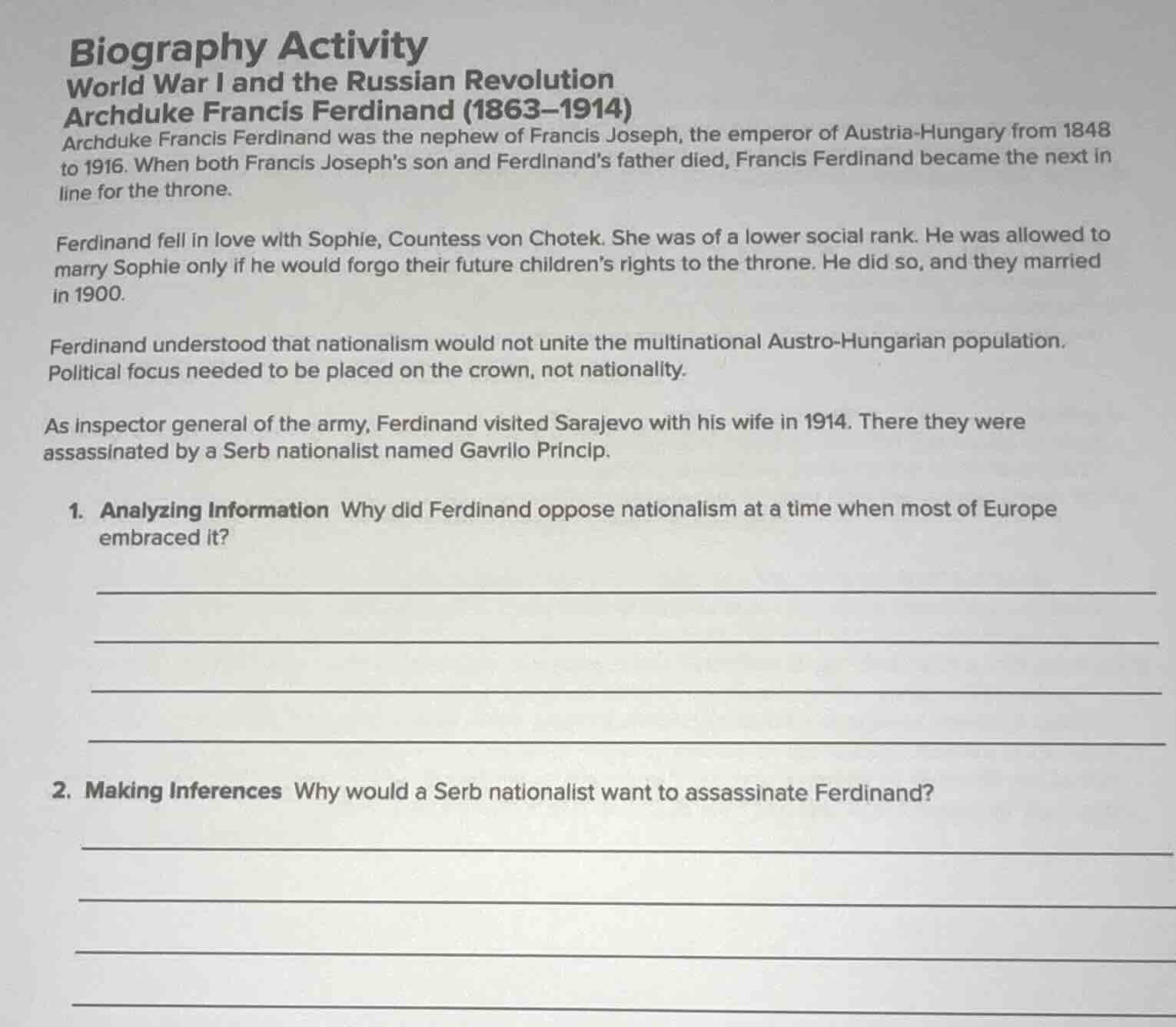
archduke francis ferdinand was the nephew of francis joseph, the emperor of austria - hungary from 1848 to 1916. when both francis josephs son and ferdinands father died, francis ferdinand became the next in line for the throne.
ferdinand fell in love with sophie, countess von chotek. she was of a lower social rank. he was allowed to marry sophie only if he would forgo their future childrens rights to the throne. he did so, and they married in 1900.
ferdinand understood that nationalism would not unite the multinational austro - hungarian population. political focus needed to be placed on the crown, not nationality.
as inspector general of the army, ferdinand visited sarajevo with his wife in 1914. there they were assassinated by a serb nationalist named gavrilo princip.
- analyzing information why did ferdinand oppose nationalism at a time when most of europe embraced it?
- making inferences why would a serb nationalist want to assassinate ferdinand?
Question 1
Ferdinand opposed nationalism because Austria - Hungary was multinational. He believed nationalism couldn't unite its diverse population. Instead, he thought the political focus should be on the crown (monarchy) rather than nationality, as nationalism based on a single nation - state idea would disrupt the multi - ethnic Austro - Hungarian empire.
A Serb nationalist would want to assassinate Ferdinand because Serbia (and Serb nationalists) aimed for Slavic regions within Austria - Hungary (like Bosnia where Sarajevo is) to be part of Serbia. Ferdinand, as a key figure of Austria - Hungary, represented the empire's control over these regions. Assassinating him was a way to strike against Austrian - Hungarian rule and advance Serbian nationalist goals of uniting all Serbs (and Slavic peoples in Austro - Hungarian territory) into a single Serbian state.

Snap & solve any problem in the app
Get step-by-step solutions on Sovi AI
Photo-based solutions with guided steps
Explore more problems and detailed explanations
Ferdinand opposed nationalism as Austria - Hungary was multinational. He believed nationalism couldn't unite its diverse population and political focus should be on the crown, not nationality.