QUESTION IMAGE
Question
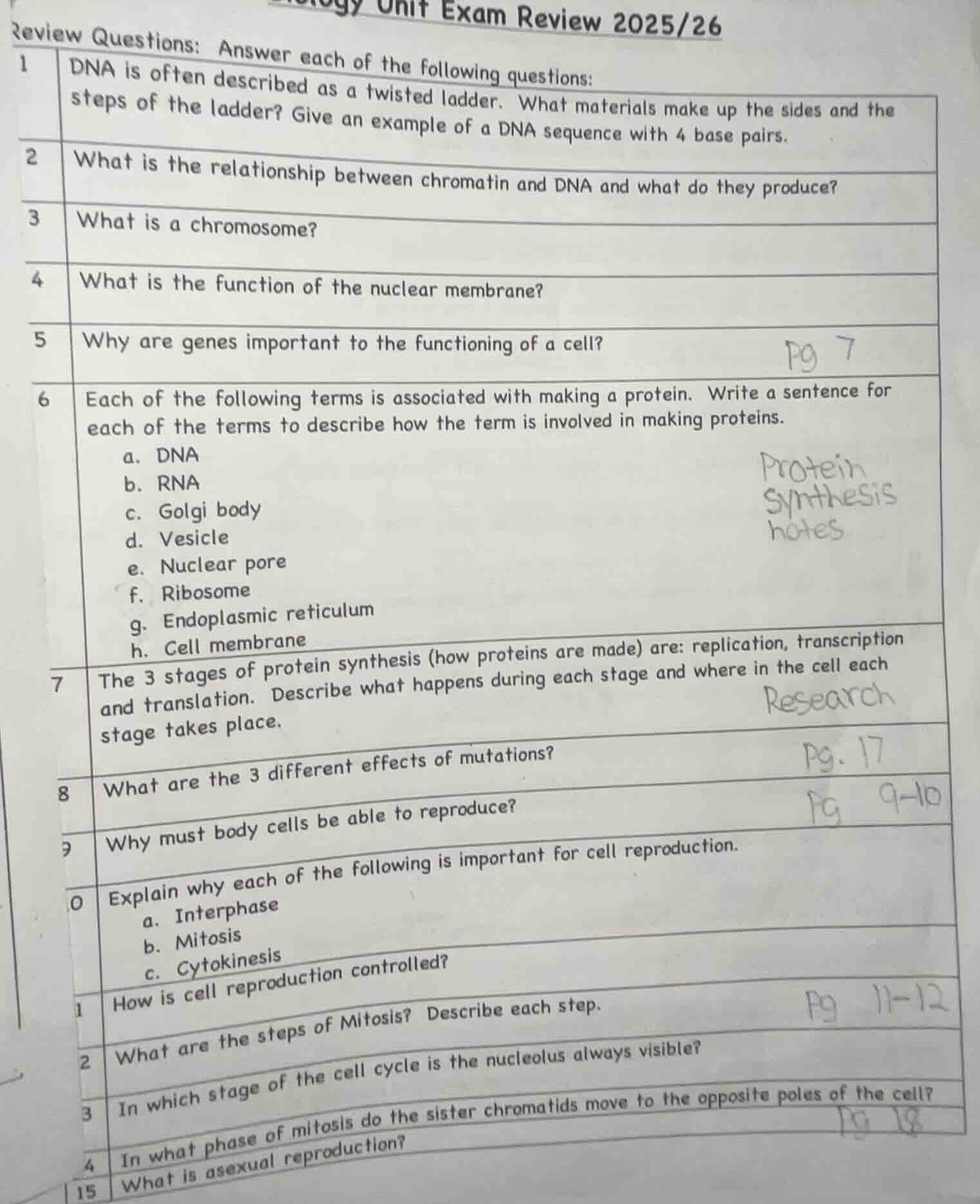
biology unit exam review 2025/26
review questions: answer each of the following questions:
1 dna is often described as a twisted ladder. what materials make up the sides and the steps of the ladder? give an example of a dna sequence with 4 base pairs.
2 what is the relationship between chromatin and dna and what do they produce?
3 what is a chromosome?
4 what is the function of the nuclear membrane?
5 why are genes important to the functioning of a cell?
6 each of the following terms is associated with making a protein. write a sentence for each of the terms to describe how the term is involved in making proteins.
a. dna
b. rna
c. golgi body
d. vesicle
e. nuclear pore
f. ribosome
g. endoplasmic reticulum
h. cell membrane
7 the 3 stages of protein synthesis (how proteins are made) are: replication, transcription and translation. describe what happens during each stage and where in the cell each stage takes place.
8 what are the 3 different effects of mutations?
9 why must body cells be able to reproduce?
10 explain why each of the following is important for cell reproduction.
a. interphase
b. mitosis
c. cytokinesis
11 how is cell reproduction controlled?
12 what are the steps of mitosis? describe each step.
13 in which stage of the cell cycle is the nucleolus always visible?
14 in what phase of mitosis do the sister chromatids move to the opposite poles of the cell?
15 what is asexual reproduction?
To answer these biology - related questions, we'll go through each one:
Question 1
- Sides of the DNA ladder: The sides of the DNA double helix (the twisted ladder) are made up of alternating sugar (deoxyribose) and phosphate molecules.
- Steps of the ladder: The steps are made up of pairs of nitrogenous bases (adenine - thymine and guanine - cytosine).
- Example of a DNA sequence with 4 base pairs: A possible sequence is
ATGC(where A pairs with T, T pairs with A, G pairs with C, and C pairs with G). So the double - stranded sequence would be:
ATGC
TACG
Question 2
- Relationship between chromatin and DNA: Chromatin is a complex of DNA and proteins (histones). DNA is wrapped around histone proteins to form chromatin.
- What they produce: When the cell is about to divide, chromatin condenses and coils to form chromosomes.
Question 3
A chromosome is a thread - like structure found in the nucleus of a cell. It is made up of DNA that is tightly coiled around histone proteins. Chromosomes carry genetic information in the form of genes and are visible during cell division when they condense.
Question 4
The nuclear membrane (also called the nuclear envelope) has several functions:
- It acts as a barrier, separating the genetic material (DNA in the nucleus) from the cytoplasm.
- It controls the movement of substances between the nucleus and the cytoplasm. It has nuclear pores that allow the passage of molecules such as RNA, proteins, and other small molecules.
Question 5
Genes are important to the functioning of a cell because:
- Genes are segments of DNA that contain the instructions for making proteins.
- Proteins are essential for the structure, function, and regulation of the cell. For example, enzymes (a type of protein) catalyze chemical reactions in the cell, structural proteins provide support to the cell, and regulatory proteins control cell processes like cell division and metabolism.
Question 6
- a. DNA: DNA contains the genetic code (the sequence of nucleotides) that holds the instructions for making proteins. During transcription, the information in a gene (a segment of DNA) is used to make a complementary RNA molecule.
- b. RNA: Specifically, messenger RNA (mRNA) carries the genetic information from DNA in the nucleus to the ribosomes in the cytoplasm. Transfer RNA (tRNA) brings the correct amino acids to the ribosome during translation, and ribosomal RNA (rRNA) is a component of the ribosome, the site of protein synthesis.
- c. Golgi body: After proteins are synthesized in the rough endoplasmic reticulum, they are transported to the Golgi body. The Golgi body modifies, sorts, and packages proteins. It can add sugar molecules to proteins (glycosylation) and then package the proteins into vesicles for transport to their final destinations (either within the cell or for secretion outside the cell).
- d. Vesicle: Vesicles are small membrane - bound sacs. They transport proteins from the Golgi body to other parts of the cell or to the cell membrane for secretion. For example, a vesicle containing a secreted protein will fuse with the cell membrane and release the protein outside the cell.
- e. Nuclear pore: Nuclear pores are channels in the nuclear membrane. They allow mRNA (which is made in the nucleus from DNA) to leave the nucleus and enter the cytoplasm, where it can be used in protein synthesis at the ribosomes.
- f. Ribosome: Ribosomes are the sites of protein synthesis. During translation, ribosomes read the mRNA sequence and, with the help o…

Snap & solve any problem in the app
Get step-by-step solutions on Sovi AI
Photo-based solutions with guided steps
Explore more problems and detailed explanations
To answer these biology - related questions, we'll go through each one:
Question 1
- Sides of the DNA ladder: The sides of the DNA double helix (the twisted ladder) are made up of alternating sugar (deoxyribose) and phosphate molecules.
- Steps of the ladder: The steps are made up of pairs of nitrogenous bases (adenine - thymine and guanine - cytosine).
- Example of a DNA sequence with 4 base pairs: A possible sequence is
ATGC(where A pairs with T, T pairs with A, G pairs with C, and C pairs with G). So the double - stranded sequence would be:
ATGC
TACG
Question 2
- Relationship between chromatin and DNA: Chromatin is a complex of DNA and proteins (histones). DNA is wrapped around histone proteins to form chromatin.
- What they produce: When the cell is about to divide, chromatin condenses and coils to form chromosomes.
Question 3
A chromosome is a thread - like structure found in the nucleus of a cell. It is made up of DNA that is tightly coiled around histone proteins. Chromosomes carry genetic information in the form of genes and are visible during cell division when they condense.
Question 4
The nuclear membrane (also called the nuclear envelope) has several functions:
- It acts as a barrier, separating the genetic material (DNA in the nucleus) from the cytoplasm.
- It controls the movement of substances between the nucleus and the cytoplasm. It has nuclear pores that allow the passage of molecules such as RNA, proteins, and other small molecules.
Question 5
Genes are important to the functioning of a cell because:
- Genes are segments of DNA that contain the instructions for making proteins.
- Proteins are essential for the structure, function, and regulation of the cell. For example, enzymes (a type of protein) catalyze chemical reactions in the cell, structural proteins provide support to the cell, and regulatory proteins control cell processes like cell division and metabolism.
Question 6
- a. DNA: DNA contains the genetic code (the sequence of nucleotides) that holds the instructions for making proteins. During transcription, the information in a gene (a segment of DNA) is used to make a complementary RNA molecule.
- b. RNA: Specifically, messenger RNA (mRNA) carries the genetic information from DNA in the nucleus to the ribosomes in the cytoplasm. Transfer RNA (tRNA) brings the correct amino acids to the ribosome during translation, and ribosomal RNA (rRNA) is a component of the ribosome, the site of protein synthesis.
- c. Golgi body: After proteins are synthesized in the rough endoplasmic reticulum, they are transported to the Golgi body. The Golgi body modifies, sorts, and packages proteins. It can add sugar molecules to proteins (glycosylation) and then package the proteins into vesicles for transport to their final destinations (either within the cell or for secretion outside the cell).
- d. Vesicle: Vesicles are small membrane - bound sacs. They transport proteins from the Golgi body to other parts of the cell or to the cell membrane for secretion. For example, a vesicle containing a secreted protein will fuse with the cell membrane and release the protein outside the cell.
- e. Nuclear pore: Nuclear pores are channels in the nuclear membrane. They allow mRNA (which is made in the nucleus from DNA) to leave the nucleus and enter the cytoplasm, where it can be used in protein synthesis at the ribosomes.
- f. Ribosome: Ribosomes are the sites of protein synthesis. During translation, ribosomes read the mRNA sequence and, with the help of tRNA, assemble amino acids into a polypeptide chain (a protein).
- g. Endoplasmic reticulum (ER): The rough ER has ribosomes attached to its surface. Ribosomes on the rough ER synthesize proteins, and the ER then helps in the folding and modification of these proteins. The smooth ER is involved in lipid synthesis and also plays a role in detoxification, but in terms of protein synthesis, the rough ER is the main site for the synthesis of proteins that are destined for secretion or for use in the cell membrane.
- h. Cell membrane: The cell membrane is made up of proteins (along with lipids and carbohydrates). Some of these proteins are synthesized and then inserted into the cell membrane. These membrane proteins can act as receptors (for signaling molecules), transporters (for moving substances in and out of the cell), or enzymes. Also, proteins that are secreted from the cell (like hormones) are released from the cell through the cell membrane.
Question 7
- Replication:
- What happens: DNA replication is the process by which a cell makes an identical copy of its DNA. The double - helix structure of DNA is unwound by an enzyme called helicase. Then, DNA polymerase enzymes add complementary nucleotides to each of the original DNA strands, following the base - pairing rules (A - T, G - C).
- Where it takes place: In the nucleus of a eukaryotic cell.
- Transcription:
- What happens: Transcription is the process of making an RNA copy of a gene's DNA sequence. RNA polymerase binds to a specific region of the DNA (the promoter) and synthesizes a complementary RNA molecule (usually mRNA) using one of the DNA strands as a template.
- Where it takes place: In the nucleus.
- Translation:
- What happens: Translation is the process of converting the mRNA sequence into a protein. The mRNA is transported from the nucleus to the cytoplasm, where it binds to a ribosome. tRNA molecules, which carry specific amino acids, bind to the mRNA at the ribosome according to the codon - anticodon pairing (each codon on mRNA is complementary to an anticodon on tRNA). The ribosome then links the amino acids together to form a polypeptide chain (protein).
- Where it takes place: In the cytoplasm, at the ribosomes (either free - floating in the cytoplasm or attached to the rough endoplasmic reticulum).
Question 8
The three different effects of mutations are:
- Neutral mutations: These mutations have no effect on the organism's fitness. This can happen if the mutation occurs in a non - coding region of DNA or if it results in a change in the amino acid sequence of a protein that does not affect the protein's function. For example, a mutation that changes one amino acid in a large protein to another amino acid with similar chemical properties may not change the protein's structure or function.
- Beneficial mutations: These mutations increase the organism's fitness. For example, a mutation in a bacterial gene that makes the bacteria resistant to an antibiotic is a beneficial mutation as it allows the bacteria to survive in the presence of the antibiotic.
- Harmful (deleterious) mutations: These mutations decrease the organism's fitness. For example, a mutation that causes a genetic disorder like sickle - cell anemia (in humans) is a harmful mutation. In sickle - cell anemia, a mutation in the gene for hemoglobin causes the red blood cells to have a sickle shape, which can lead to problems with blood flow and oxygen delivery.
Question 9
Body cells must be able to reproduce (through cell division, mainly mitosis) for several reasons:
- Growth: As an organism grows, more cells are needed. For example, a human embryo grows into a fetus and then into an adult, and this growth is due to the division of body cells.
- Repair: If the body is injured (e.g., a cut in the skin), body cells need to divide to replace the damaged cells. Skin cells divide to close the wound, and muscle cells and other tissue cells also divide to repair damaged tissues.
- Replacement: Some cells in the body have a limited lifespan. For example, red blood cells have a lifespan of about 120 days, and new red blood cells are produced from stem cells in the bone marrow through cell division.
Question 10
- a. Interphase: Interphase is important for cell reproduction because:
- It is the period of the cell cycle when the cell is not dividing. During interphase, the cell grows (G1 phase), replicates its DNA (S phase), and prepares for cell division (G2 phase). The growth phase (G1) allows the cell to increase in size and synthesize proteins and organelles needed for division. The S phase ensures that the genetic material is duplicated so that each daughter cell will have a complete set of chromosomes. The G2 phase is a period of further growth and preparation, including the synthesis of proteins needed for mitosis.
- b. Mitosis: Mitosis is important because it is the process of nuclear division that results in the formation of two daughter nuclei, each with the same number and type of chromosomes as the parent nucleus. This ensures that the genetic information is accurately passed on to the daughter cells, maintaining the genetic stability of the organism.
- c. Cytokinesis: Cytokinesis is the process of dividing the cytoplasm of the cell after mitosis. It results in the formation of two separate daughter cells, each with its own nucleus and a complete set of organelles. Without cytokinesis, the cell would not be physically divided into two functional cells.
Question 11
Cell reproduction (cell division) is controlled by a complex system of regulatory proteins and checkpoints:
- Checkpoints: There are checkpoints at different stages of the cell cycle (G1, G2, and during mitosis). For example, at the G1 checkpoint, the cell checks if it has enough nutrients, if the DNA is undamaged, and if there is a signal to divide. At the G2 checkpoint, the cell checks if DNA replication has been completed correctly and if the cell is large enough to divide. During mitosis, there are checkpoints to ensure that the chromosomes are properly aligned and attached to the spindle fibers before they are pulled apart.
- Regulatory proteins: Proteins such as cyclins and cyclin - dependent kinases (CDKs) play a key role. Cyclins are proteins whose levels fluctuate during the cell cycle. They bind to CDKs, activating them. The activated CDKs then phosphorylate other proteins, which triggers the cell to move from one phase of the cell cycle to the next. Tumor suppressor genes (e.g., p53) also play a role in cell cycle control. The p53 protein can stop the cell cycle at the G1 checkpoint if DNA damage is detected, allowing time for the DNA to be repaired or triggering apoptosis (cell death) if the damage is too severe.
Question 12
The steps of mitosis are:
- Prophase:
- The chromatin condenses into visible chromosomes. Each chromosome consists of two sister chromatids held together by a centromere.
- The nuclear envelope breaks down.
- The spindle apparatus (made of microtubules) begins to form. The centrioles (in animal cells) move to opposite poles of the cell.
- Metaphase:
- The chromosomes line up along the equator (the metaphase plate) of the cell.
- The spindle fibers attach to the centromeres of the chromosomes.
- Anaphase:
- The centromeres split, and the sister chromatids are pulled apart by the spindle fibers.
- The separated chromatids (now called daughter chromosomes) move to opposite poles of the cell.
- Telophase:
- The daughter chromosomes reach the opposite poles of the cell.
- A new nuclear envelope forms around each set of daughter chromosomes.
- The chromosomes begin to uncoil back into chromatin.
Question 13
The nucleolus is always visible during interphase. During interphase, the cell is not dividing, and the nucleolus is involved in the production of ribosomal RNA (rRNA) and the assembly of ribosomes. During mitosis, the nucleolus disappears early in prophase as the nuclear envelope breaks down and the chromatin condenses, and it reappears in telophase as the new nuclear envelopes form around the daughter nuclei.
Question 14
During anaphase of mitosis, the sister chromatids move to the opposite poles of the cell. The spindle fibers attached to the centromeres of the chromosomes shorten, pulling the sister chromatids apart and towards the opposite ends of the cell.
Question 15
Asexual reproduction is a type of reproduction that involves only one parent. The offspring produced are genetically identical (or nearly identical) to the parent. Examples of asexual reproduction include:
- Binary fission: In bacteria, the cell divides into two equal - sized daughter cells.
- Budding: In yeast or hydra, a small outgrowth (bud) forms on the parent organism. The bud grows and eventually detaches from the parent to become a new, independent organism.
- Fragmentation: In some organisms like flatworms or starfish, the organism breaks into pieces, and each piece can grow into a new organism.