QUESTION IMAGE
Question
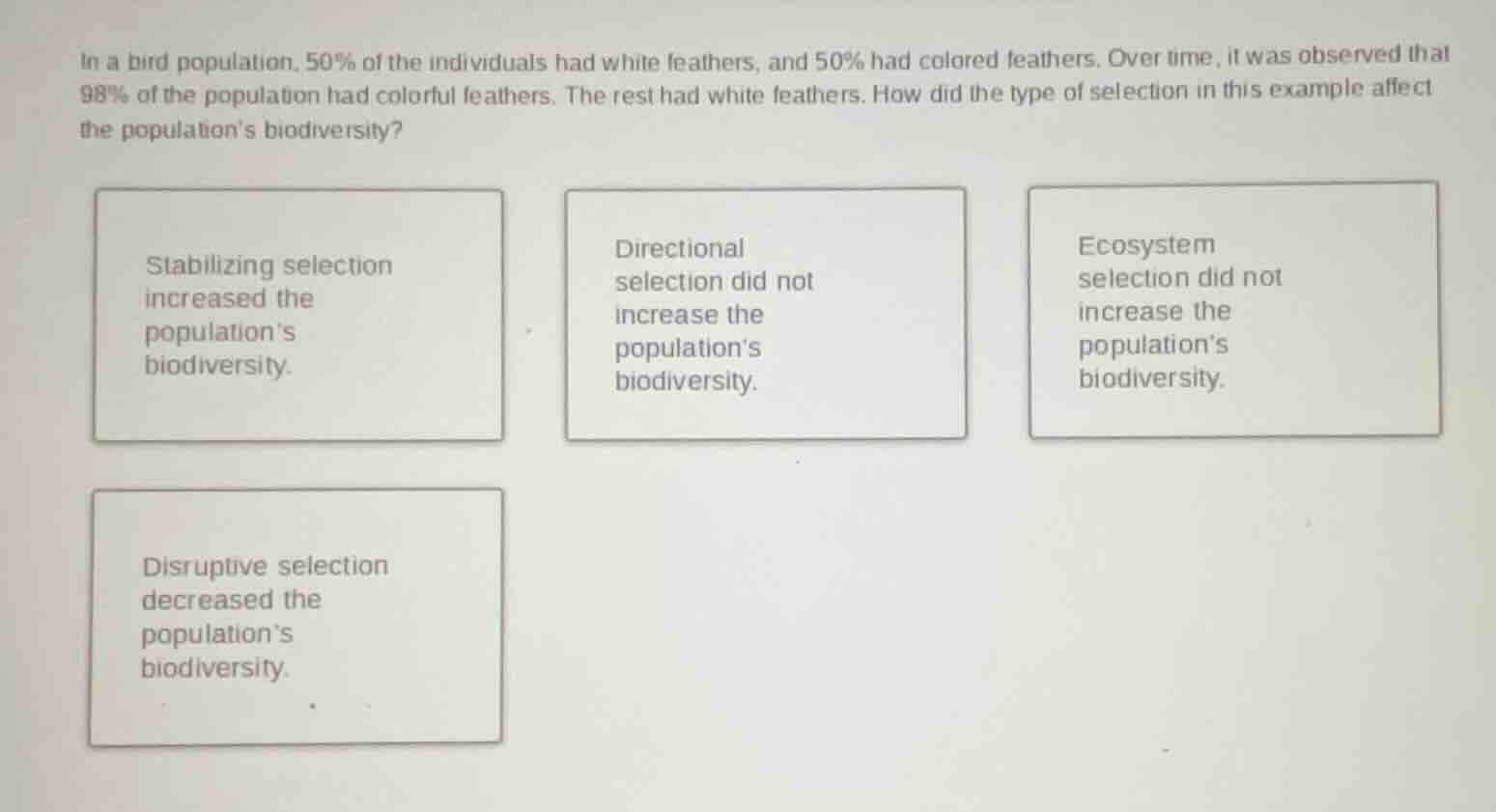
in a bird population, 50% of the individuals had white feathers, and 50% had colored feathers. over time, it was observed that 98% of the population had colorful feathers. the rest had white feathers. how did the type of selection in this example affect the population’s biodiversity? stabilizing selection increased the population’s biodiversity. directional selection did not increase the population’s biodiversity. ecosystem selection did not increase the population’s biodiversity. disruptive selection decreased the population’s biodiversity.
- First, analyze the selection type: The bird population shifted from 50% white and 50% colored to 98% colored (one extreme phenotype becoming more common), which is directional selection.
- Then, consider biodiversity: Directional selection favors one phenotype, reducing variation (biodiversity) as the other phenotype (white) becomes rare. The option "Directional selection did not increase the population’s biodiversity" matches because directional selection typically decreases or doesn't increase biodiversity by favoring one trait. Other options: Stabilizing selection favors intermediate traits (not the case here), "ecosystem selection" is not a standard selection type, and disruptive selection increases biodiversity (opposite of what happened).

Snap & solve any problem in the app
Get step-by-step solutions on Sovi AI
Photo-based solutions with guided steps
Explore more problems and detailed explanations
B. Directional selection did not increase the population’s biodiversity.