QUESTION IMAGE
Question
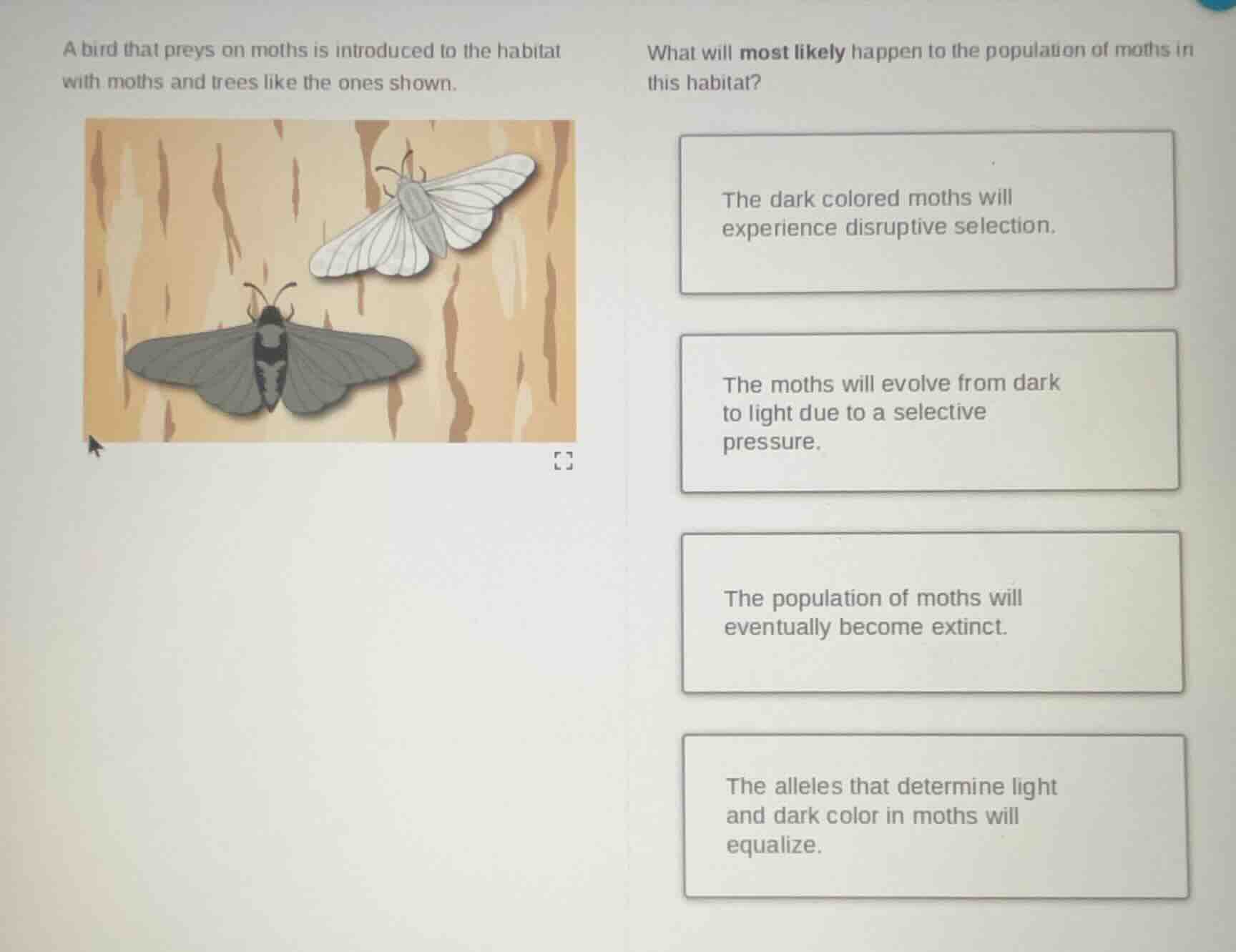
a bird that preys on moths is introduced to the habitat with moths and trees like the ones shown. what will most likely happen to the population of moths in this habitat? the dark colored moths will experience disruptive selection. the moths will evolve from dark to light due to a selective pressure. the population of moths will eventually become extinct. the alleles that determine light and dark color in moths will equalize.
Brief Explanations
- Analyze the first option: Disruptive selection splits a population into two extremes. But here, the tree bark is light - colored. Dark - colored moths are more visible to the new predator (birds), while light - colored moths are camouflaged. So disruptive selection is not the main process here.
- Analyze the second option: The tree bark is light - colored. Birds (the new predator) will be more likely to see and eat the dark - colored moths. This creates a selective pressure. Over time, the moths will evolve to have more light - colored individuals because light - colored moths have a survival advantage (they are camouflaged from the birds). So this option is correct.
- Analyze the third option: The moths are not likely to become extinct. There are light - colored moths that are camouflaged and can survive and reproduce. So this option is incorrect.
- Analyze the fourth option: The selective pressure (birds preying on dark - colored moths) will favor the light - colored moths. So the alleles for light color will become more common, not equalize. So this option is incorrect.

Snap & solve any problem in the app
Get step-by-step solutions on Sovi AI
Photo-based solutions with guided steps
Explore more problems and detailed explanations
The moths will evolve from dark to light due to a selective pressure.