QUESTION IMAGE
Question
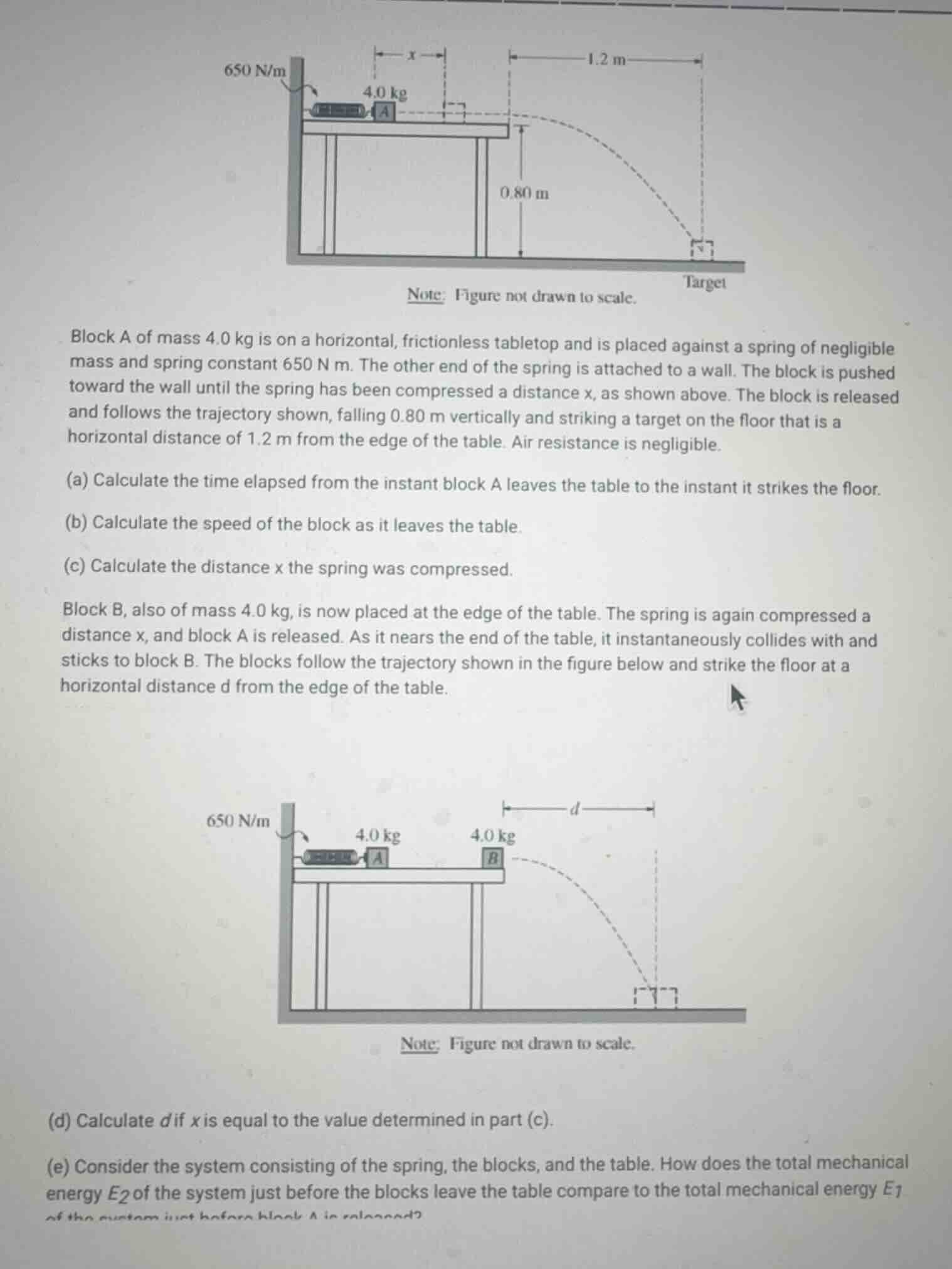
block a of mass 4.0 kg is on a horizontal, frictionless tabletop and is placed against a spring of negligible mass and spring constant 650 n m. the other end of the spring is attached to a wall. the block is pushed toward the wall until the spring has been compressed a distance x, as shown above. the block is released and follows the trajectory shown, falling 0.80 m vertically and striking a target on the floor that is a horizontal distance of 1.2 m from the edge of the table. air resistance is negligible.
(a) calculate the time elapsed from the instant block a leaves the table to the instant it strikes the floor.
(b) calculate the speed of the block as it leaves the table.
(c) calculate the distance x the spring was compressed.
block b, also of mass 4.0 kg, is now placed at the edge of the table. the spring is again compressed a distance x, and block a is released. as it nears the end of the table, it instantaneously collides with and sticks to block b. the blocks follow the trajectory shown in the figure below and strike the floor at a horizontal distance d from the edge of the table.
(d) calculate d if x is equal to the value determined in part (c).
(e) consider the system consisting of the spring, the blocks, and the table. how does the total mechanical energy e₂ of the system just before the blocks leave the table compare to the total mechanical energy e₁ of the system just before block a is released?
Step1: Find fall time (vertical motion)
Use $y = \frac{1}{2}gt^2$, solve for $t$.
$t = \sqrt{\frac{2y}{g}} = \sqrt{\frac{2\times0.80\ \text{m}}{9.8\ \text{m/s}^2}}$
Step2: Calculate horizontal launch speed
Use $v = \frac{d_x}{t}$.
$v = \frac{1.2\ \text{m}}{\sqrt{\frac{1.6}{9.8}}\ \text{s}}$
Step3: Find spring compression (energy conservation)
Set $\frac{1}{2}kx^2 = \frac{1}{2}mv^2$, solve for $x$.
$x = \sqrt{\frac{mv^2}{k}}$
Step4: Find post-collision speed (momentum conservation)
$m_Av_A = (m_A+m_B)v_f$, solve for $v_f$.
$v_f = \frac{4.0\ \text{kg} \times v}{4.0\ \text{kg}+4.0\ \text{kg}}$
Step5: Calculate horizontal distance $d$
Use $d = v_f \times t$, $t$ from Step1.
$d = v_f \times \sqrt{\frac{1.6}{9.8}}\ \text{s}$
Step6: Compare mechanical energies
Inelastic collision dissipates energy as heat/sound, so $E_2 < E_1$.

Snap & solve any problem in the app
Get step-by-step solutions on Sovi AI
Photo-based solutions with guided steps
Explore more problems and detailed explanations
(a) $t = \sqrt{\frac{2\times0.80}{9.8}} \approx 0.40\ \text{s}$
(b) $v = \frac{1.2}{0.40} = 3.0\ \text{m/s}$
(c) $x = \sqrt{\frac{4.0\times(3.0)^2}{650}} \approx 0.237\ \text{m}$
(d) $v_f = \frac{4.0\times3.0}{8.0} = 1.5\ \text{m/s}$, $d = 1.5\times0.40 = 0.60\ \text{m}$
(e) The total mechanical energy $E_2$ just before the blocks leave the table is less than the total mechanical energy $E_1$ just before block A is released. The inelastic collision between blocks A and B converts some mechanical energy into non-mechanical forms (e.g., thermal energy, sound), reducing the system's mechanical energy.