QUESTION IMAGE
Question
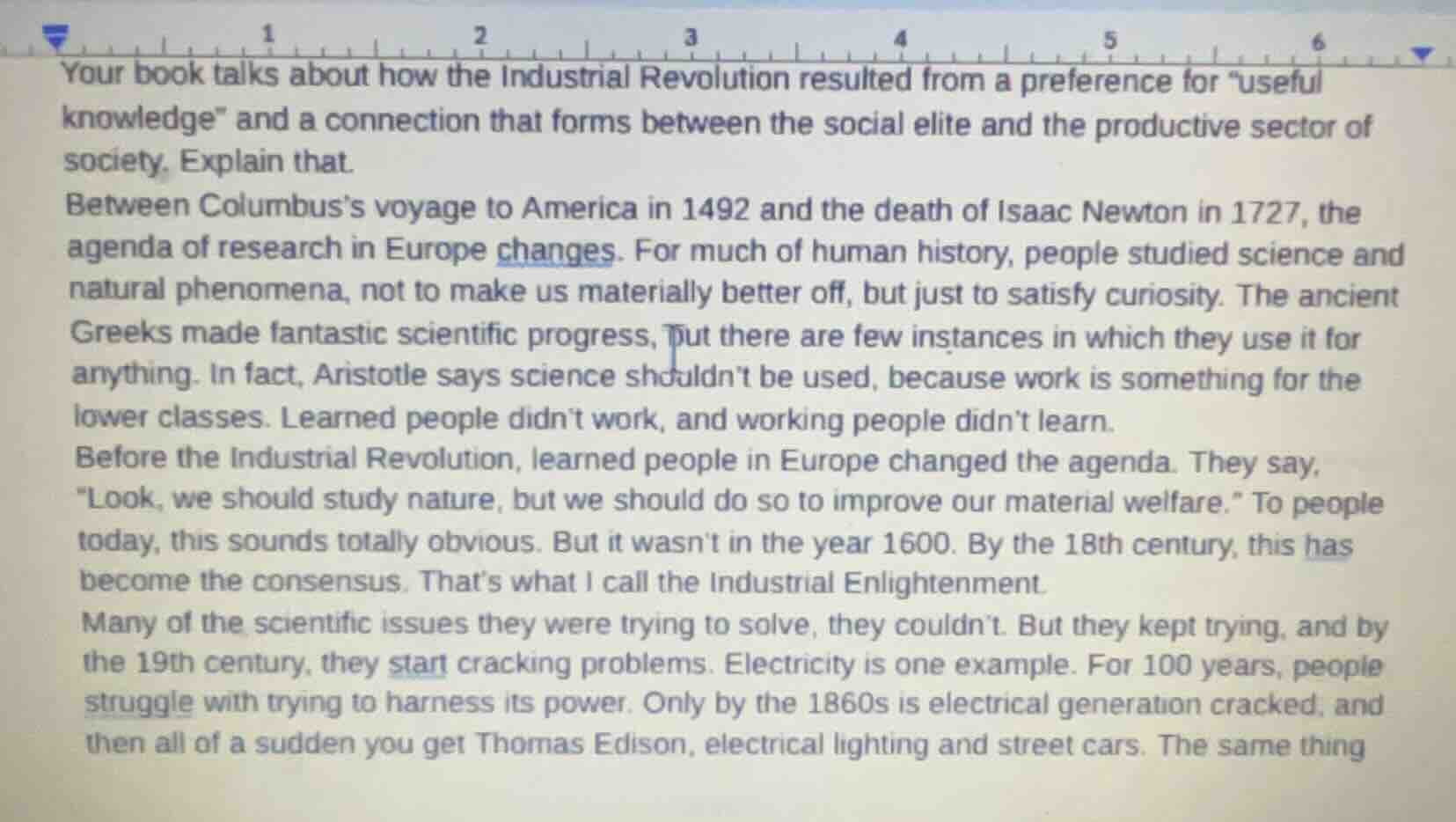
your book talks about how the industrial revolution resulted from a preference for “useful knowledge” and a connection that forms between the social elite and the productive sector of society. explain that. between columbus’s voyage to america in 1492 and the death of isaac newton in 1727, the agenda of research in europe changes. for much of human history, people studied science and natural phenomena, not to make us materially better off, but just to satisfy curiosity. the ancient greeks made fantastic scientific progress, but there are few instances in which they use it for anything. in fact, aristotle says science shouldn’t be used, because work is something for the lower classes. learned people didn’t work, and working people didn’t learn. before the industrial revolution, learned people in europe changed the agenda. they say, “look, we should study nature, but we should do so to improve our material welfare.” to people today, this sounds totally obvious. but it wasn’t in the year 1600. by the 18th century, this has become the consensus. that’s what i call the industrial enlightenment. many of the scientific issues they were trying to solve, they couldn’t. but they kept trying, and by the 19th century, they start cracking problems. electricity is one example. for 100 years, people struggle with trying to harness its power. only by the 1860s is electrical generation cracked, and then all of a sudden you get thomas edison, electrical lighting and street cars. the same thing
- Shift to "Useful Knowledge": Before the Industrial Revolution, European scholars moved from studying science purely for curiosity (like the ancient Greeks, who saw applied work as lower-class) to a new focus: researching natural phenomena explicitly to improve material welfare. This shift, called the Industrial Enlightenment, became the dominant consensus by the 18th century, prioritizing "useful" knowledge that could drive practical, tangible improvements.
- Elite-Productive Sector Connection: This new agenda created a link between the educated social elite (who developed the scientific ideas) and the productive, working sector of society. The elite's research aimed to solve real-world industrial problems, and over time (by the 19th century), this collaboration led to breakthroughs like harnessing electricity. These advances then enabled innovations such as electrical lighting and streetcars, which powered the Industrial Revolution by translating theoretical, useful knowledge into large-scale, practical industrial applications.

Snap & solve any problem in the app
Get step-by-step solutions on Sovi AI
Photo-based solutions with guided steps
Explore more problems and detailed explanations
The Industrial Revolution emerged from two key developments:
- A shift in intellectual focus to "useful knowledge": European scholars moved from studying science solely for curiosity to prioritizing research that directly improved material welfare, a consensus called the Industrial Enlightenment by the 18th century. This rejected the ancient Greek view that applied work was for lower classes.
- A new connection between elites and the productive sector: The educated elite's problem-solving research targeted industrial needs. By the 19th century, this collaboration led to breakthroughs (like harnessing electricity) that translated into practical industrial innovations, driving the Industrial Revolution forward.