QUESTION IMAGE
Question
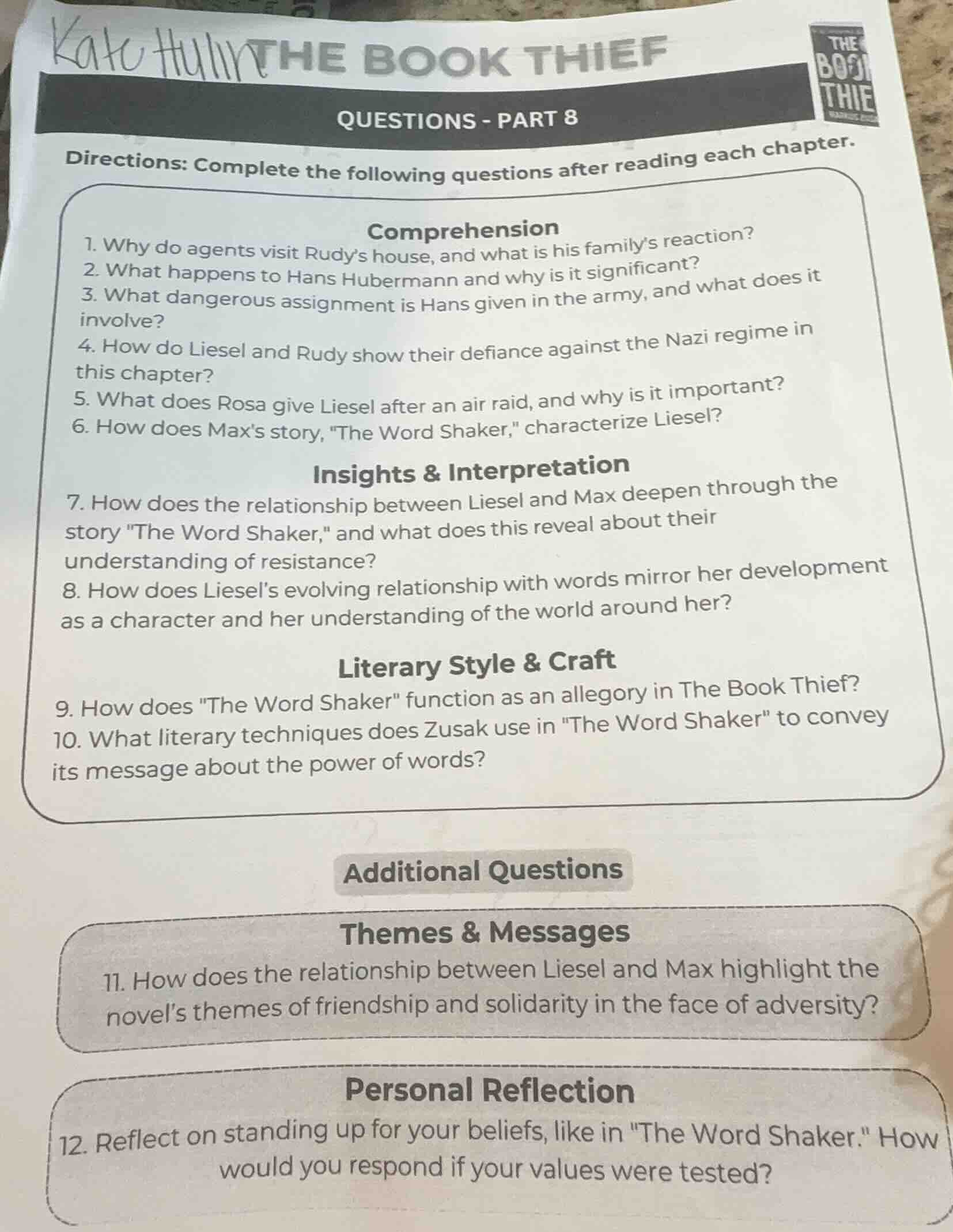
the book thief
questions - part 8
directions: complete the following questions after reading each chapter.
comprehension
- why do agents visit rudy’s house, and what is his family’s reaction?
- what happens to hans hubermann and why is it significant?
- what dangerous assignment is hans given in the army, and what does it involve?
- how do liesel and rudy show their defiance against the nazi regime in this chapter?
- what does rosa give liesel after an air raid, and why is it important?
- how does max’s story, \the word shaker,\ characterize liesel?
insights & interpretation
- how does the relationship between liesel and max deepen through the story \the word shaker,\ and what does this reveal about their understanding of resistance?
- how does liesel’s evolving relationship with words mirror her development as a character and her understanding of the world around her?
literary style & craft
- how does \the word shaker\ function as an allegory in the book thief?
- what literary techniques does zusak use in \the word shaker\ to convey its message about the power of words?
additional questions
themes & messages
- how does the relationship between liesel and max highlight the novel’s themes of friendship and solidarity in the face of adversity?
personal reflection
- reflect on standing up for your beliefs, like in \the word shaker.\ how would you respond if your values were tested?
To answer these questions, we analyze each based on the text of The Book Thief (Part 8):
Question 1: Agents visit Rudy’s house…
- Reason: Agents suspect Rudy may have stolen a coat (or due to his “Hitler Youth” defiance, like imitating Jesse Owens).
- Family reaction: Rudy’s parents (especially his father) are angry/frightened, fearing punishment for Rudy’s rebellious behavior (e.g., skipping Hitler Youth or petty theft).
Question 2: What happens to Hans Hubermann…
- Hans is punished for helping a Jewish man (giving bread) during a march. He is drafted into the army (a dangerous assignment) as retribution for defying Nazi ideology.
- Significance: It shows the Nazi regime’s cruelty toward those who show compassion, and Hans’ moral courage (he prioritizes humanity over conformity).
Question 3: Hans’ dangerous army assignment…
Hans is assigned to a Luftdichter (air raid clean-up) unit. This involves recovering bodies and debris after Allied bombings—risky work with little protection, intended to punish his earlier act of kindness.
Question 4: Liesel and Rudy’s defiance…
They steal books (or engage in small acts of rebellion, like Liesel reading/hiding books, Rudy refusing to fully embrace Hitler Youth). For example, they might steal from the mayor’s library or resist Nazi propaganda, showing their rejection of the regime’s ideology.
Question 5: Rosa gives Liesel…
Rosa gives Liesel a letter (or a memento, like a book) after an air raid. It’s important as a symbol of care, connection, or a reminder of loved ones (e.g., a letter from Liesel’s mother, reinforcing their bond).
Question 6: “The Word Shaker” characterizes Liesel…
Max’s story casts Liesel as a “Word Shaker” who uses words to resist. She is brave, compassionate, and uses literature to challenge the Nazi’s “word tree” (propaganda). The story highlights her growth as a defender of humanity through language.
Question 7: Liesel and Max’s relationship (via “The Word Shaker”)…
The story deepens their bond: Max writes it for Liesel, and she embraces its message of using words for good. Their understanding of resistance is collaborative—Max (Jewish, hiding) and Liesel (Aryan, learning) unite against oppression through storytelling, showing resistance as a shared, creative act.
Question 8: Liesel’s relationship with words…
Liesel starts as a struggling reader, then uses words to connect (with Max, Hans, Rudy) and resist (via books/stories). Her evolution mirrors her growth from a vulnerable child to a courageous defender of humanity, understanding words as both tools of oppression (Nazi propaganda) and liberation (her own storytelling).
Question 9: “The Word Shaker” as an allegory…
It allegorizes Nazi propaganda (the “word tree” that poisons minds) and resistance (Liesel as the Word Shaker who plants a new tree of kindness/truth). The story critiques totalitarianism and celebrates the power of empathy and literature to overcome hate.
Question 10: Literary techniques in “The Word Shaker”…
Zusak uses personification (words as seeds, trees), metaphor (Nazi propaganda as a toxic tree), and symbolism (Liesel’s tree as hope). These techniques illustrate how words can be weapons of hate or tools of love, emphasizing their transformative power.
Question 11: Liesel and Max’s relationship (themes of friendship/solidarity)…
Their bond (Liesel, a German girl; Max, a Jewish fugitive) defies Nazi racial ideology. They support each other (Max writes for Liesel, Liesel protects him), showing friendship as a form of…

Snap & solve any problem in the app
Get step-by-step solutions on Sovi AI
Photo-based solutions with guided steps
Explore more problems and detailed explanations
To answer these questions, we analyze each based on the text of The Book Thief (Part 8):
Question 1: Agents visit Rudy’s house…
- Reason: Agents suspect Rudy may have stolen a coat (or due to his “Hitler Youth” defiance, like imitating Jesse Owens).
- Family reaction: Rudy’s parents (especially his father) are angry/frightened, fearing punishment for Rudy’s rebellious behavior (e.g., skipping Hitler Youth or petty theft).
Question 2: What happens to Hans Hubermann…
- Hans is punished for helping a Jewish man (giving bread) during a march. He is drafted into the army (a dangerous assignment) as retribution for defying Nazi ideology.
- Significance: It shows the Nazi regime’s cruelty toward those who show compassion, and Hans’ moral courage (he prioritizes humanity over conformity).
Question 3: Hans’ dangerous army assignment…
Hans is assigned to a Luftdichter (air raid clean-up) unit. This involves recovering bodies and debris after Allied bombings—risky work with little protection, intended to punish his earlier act of kindness.
Question 4: Liesel and Rudy’s defiance…
They steal books (or engage in small acts of rebellion, like Liesel reading/hiding books, Rudy refusing to fully embrace Hitler Youth). For example, they might steal from the mayor’s library or resist Nazi propaganda, showing their rejection of the regime’s ideology.
Question 5: Rosa gives Liesel…
Rosa gives Liesel a letter (or a memento, like a book) after an air raid. It’s important as a symbol of care, connection, or a reminder of loved ones (e.g., a letter from Liesel’s mother, reinforcing their bond).
Question 6: “The Word Shaker” characterizes Liesel…
Max’s story casts Liesel as a “Word Shaker” who uses words to resist. She is brave, compassionate, and uses literature to challenge the Nazi’s “word tree” (propaganda). The story highlights her growth as a defender of humanity through language.
Question 7: Liesel and Max’s relationship (via “The Word Shaker”)…
The story deepens their bond: Max writes it for Liesel, and she embraces its message of using words for good. Their understanding of resistance is collaborative—Max (Jewish, hiding) and Liesel (Aryan, learning) unite against oppression through storytelling, showing resistance as a shared, creative act.
Question 8: Liesel’s relationship with words…
Liesel starts as a struggling reader, then uses words to connect (with Max, Hans, Rudy) and resist (via books/stories). Her evolution mirrors her growth from a vulnerable child to a courageous defender of humanity, understanding words as both tools of oppression (Nazi propaganda) and liberation (her own storytelling).
Question 9: “The Word Shaker” as an allegory…
It allegorizes Nazi propaganda (the “word tree” that poisons minds) and resistance (Liesel as the Word Shaker who plants a new tree of kindness/truth). The story critiques totalitarianism and celebrates the power of empathy and literature to overcome hate.
Question 10: Literary techniques in “The Word Shaker”…
Zusak uses personification (words as seeds, trees), metaphor (Nazi propaganda as a toxic tree), and symbolism (Liesel’s tree as hope). These techniques illustrate how words can be weapons of hate or tools of love, emphasizing their transformative power.
Question 11: Liesel and Max’s relationship (themes of friendship/solidarity)…
Their bond (Liesel, a German girl; Max, a Jewish fugitive) defies Nazi racial ideology. They support each other (Max writes for Liesel, Liesel protects him), showing friendship as a form of resistance. Their solidarity highlights humanity’s ability to connect across divides in adversity.
Question 12: Personal reflection on standing up for beliefs…
Inspired by “The Word Shaker,” one might respond with courage: prioritize empathy, speak out against injustice, and use one’s voice (like Liesel) to defend values. Even small acts (sharing a story, helping others) can resist oppression, mirroring Liesel and Max’s collaborative resistance.
These answers draw from the novel’s plot, themes, and character development in Part 8.