QUESTION IMAGE
Question
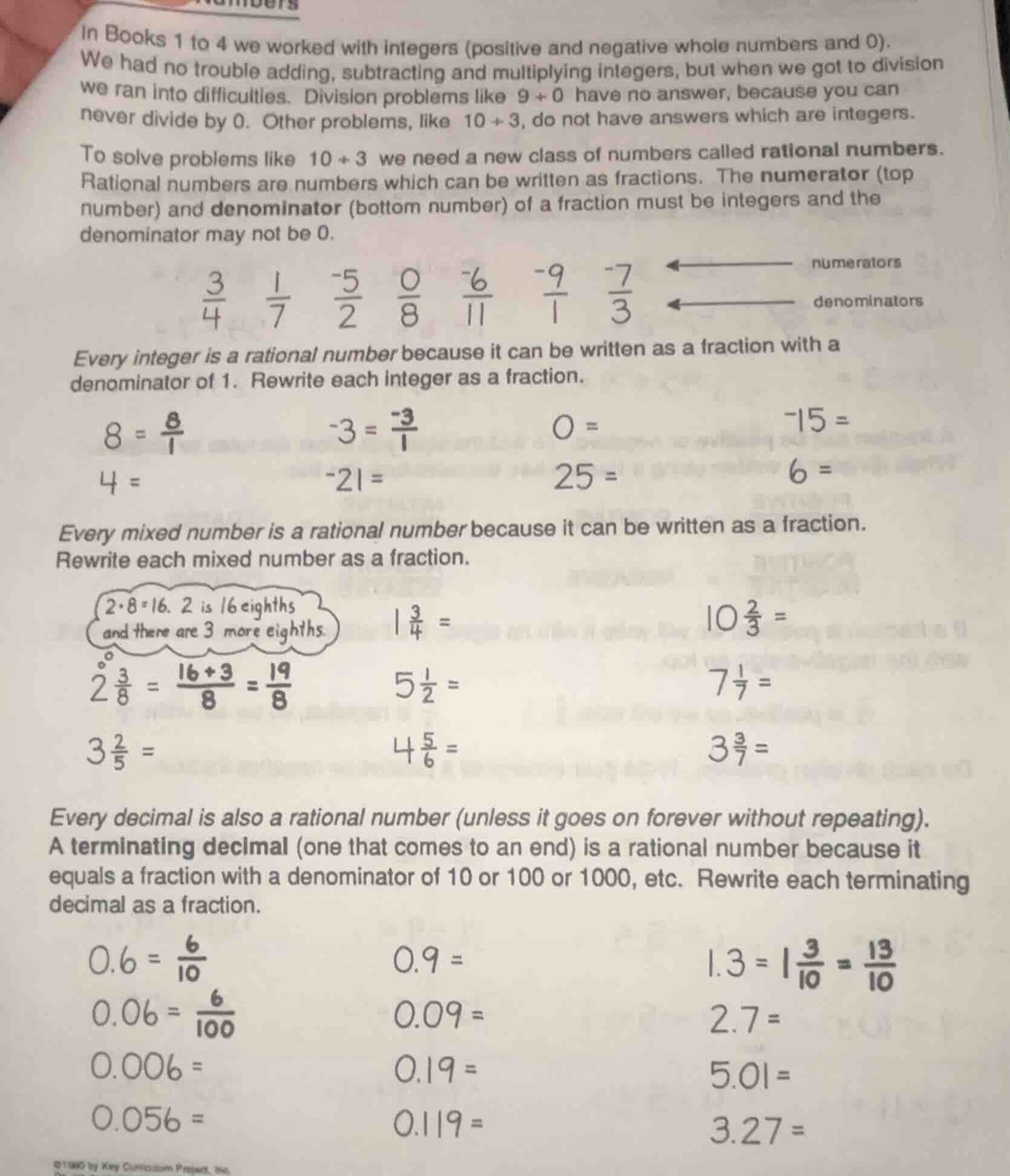
in books 1 to 4 we worked with integers (positive and negative whole numbers and 0).we had no trouble adding, subtracting and multiplying integers, but when we got to division we ran into difficulties. division problems like $9 \div 0$ have no answer, because you can never divide by 0. other problems, like $10 \div 3$, do not have answers which are integers.to solve problems like $10 \div 3$ we need a new class of numbers called rational numbers.rational numbers are numbers which can be written as fractions. the numerator (top number) and denominator (bottom number) of a fraction must be integers and the denominator may not be 0.$\frac{3}{4}$ $\frac{1}{7}$ $\frac{-5}{2}$ $\frac{0}{8}$ $\frac{-6}{11}$ $\frac{-9}{1}$ $\frac{-7}{3}LXB0-3 = \frac{-3}{1}LXB1-15 =LXB2-21 =LXB36 =$every mixed number is a rational number because it can be written as a fraction.rewrite each mixed number as a fraction.$2 \cdot 8 = 16$. 2 is 16 eighths and there are 3 more eighths.$2\frac{3}{8} = \frac{16+3}{8} = \frac{19}{8}LXB410\frac{2}{3} =LXB57\frac{1}{7} =LXB64\frac{5}{6} =LXB70.9 =LXB80.06 = \frac{6}{100}LXB92.7 =LXB100.19 =LXB110.056 =LXB123.27 =$
Step1: Rewrite integers as fractions
Integers become fractions with denominator 1.
$0 = \frac{0}{1}$, $-15 = \frac{-15}{1}$, $4 = \frac{4}{1}$, $-21 = \frac{-21}{1}$, $25 = \frac{25}{1}$, $6 = \frac{6}{1}$
Step2: Convert mixed numbers to fractions
Multiply whole number by denominator, add numerator, keep denominator.
$1\frac{3}{4} = \frac{1\times4 + 3}{4} = \frac{7}{4}$
$10\frac{2}{3} = \frac{10\times3 + 2}{3} = \frac{32}{3}$
$5\frac{1}{2} = \frac{5\times2 + 1}{2} = \frac{11}{2}$
$7\frac{1}{7} = \frac{7\times7 + 1}{7} = \frac{50}{7}$
$3\frac{2}{5} = \frac{3\times5 + 2}{5} = \frac{17}{5}$
$4\frac{5}{6} = \frac{4\times6 + 5}{6} = \frac{29}{6}$
$3\frac{3}{7} = \frac{3\times7 + 3}{7} = \frac{24}{7}$
Step3: Convert decimals to fractions
Use denominator 10, 100, 1000 based on decimal places.
$0.9 = \frac{9}{10}$
$2.7 = 2\frac{7}{10} = \frac{27}{10}$
$0.09 = \frac{9}{100}$
$5.01 = 5\frac{1}{100} = \frac{501}{100}$
$0.006 = \frac{6}{1000}$
$3.27 = 3\frac{27}{100} = \frac{327}{100}$
$0.056 = \frac{56}{1000}$
$0.19 = \frac{19}{100}$
$0.119 = \frac{119}{1000}$

Snap & solve any problem in the app
Get step-by-step solutions on Sovi AI
Photo-based solutions with guided steps
Explore more problems and detailed explanations
Integer to Fraction:
$0 = \frac{0}{1}$
$-15 = \frac{-15}{1}$
$4 = \frac{4}{1}$
$-21 = \frac{-21}{1}$
$25 = \frac{25}{1}$
$6 = \frac{6}{1}$
Mixed Number to Fraction:
$1\frac{3}{4} = \frac{7}{4}$
$10\frac{2}{3} = \frac{32}{3}$
$5\frac{1}{2} = \frac{11}{2}$
$7\frac{1}{7} = \frac{50}{7}$
$3\frac{2}{5} = \frac{17}{5}$
$4\frac{5}{6} = \frac{29}{6}$
$3\frac{3}{7} = \frac{24}{7}$
Decimal to Fraction:
$0.9 = \frac{9}{10}$
$2.7 = \frac{27}{10}$
$0.09 = \frac{9}{100}$
$5.01 = \frac{501}{100}$
$0.006 = \frac{6}{1000}$
$3.27 = \frac{327}{100}$
$0.056 = \frac{56}{1000}$
$0.19 = \frac{19}{100}$
$0.119 = \frac{119}{1000}$