QUESTION IMAGE
Question
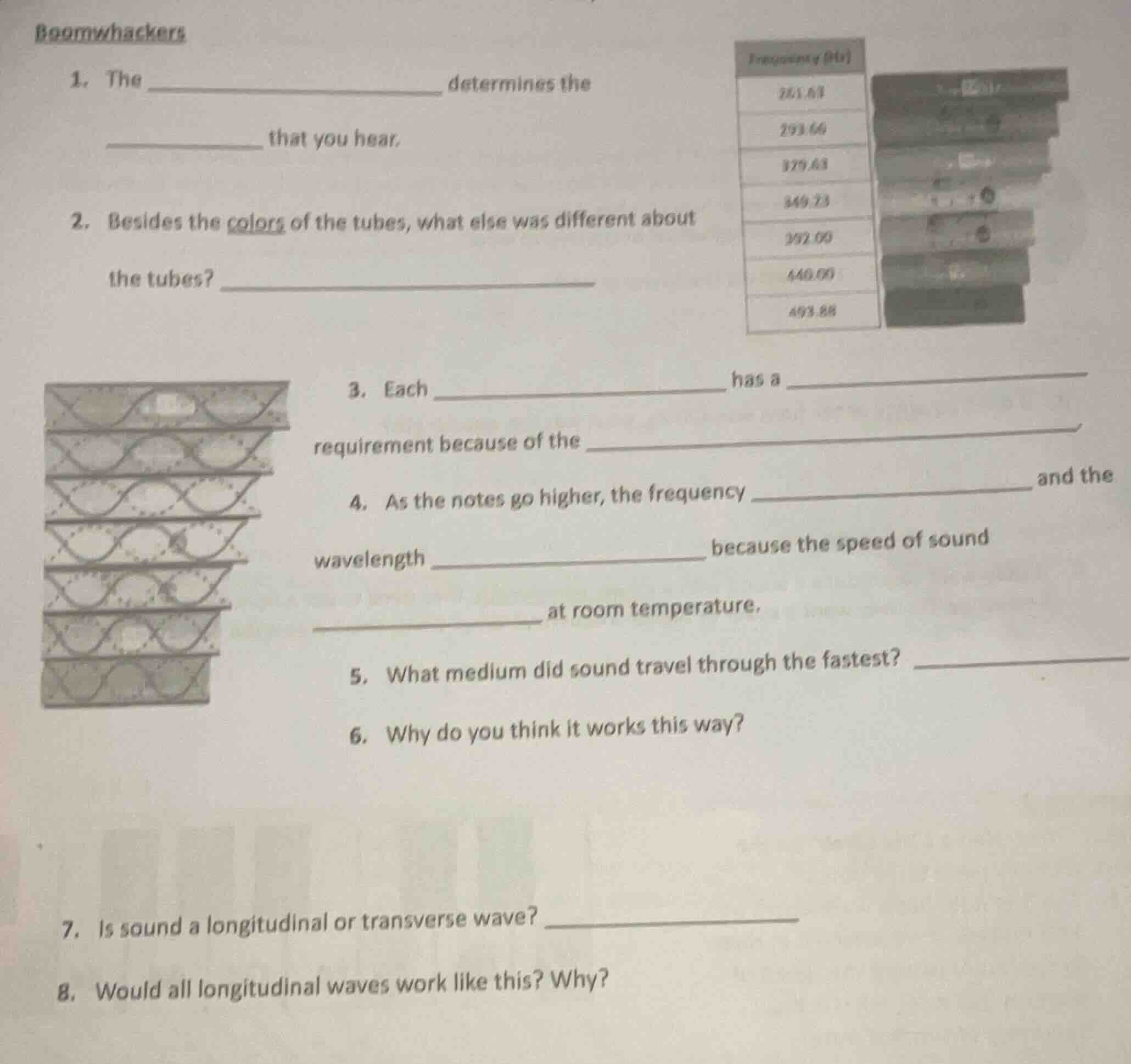
boomwhackers1. the _______________________ determines the_____________ that you hear.2. besides the colors of the tubes, what else was different aboutthe tubes? _____________________3. each _____________________ has a _____________________requirement because of the _____________________4. as the notes go higher, the frequency _____________________ and thewavelength _____________________ because the speed of sound_____________________ at room temperature.5. what medium did sound travel through the fastest? _____________________6. why do you think it works this way?7. is sound a longitudinal or transverse wave? _______________________8. would all longitudinal waves work like this? why?
- Relates to sound wave properties: frequency dictates perceived pitch.
- Observes Boomwhacker physical traits: length varies with pitch/frequency.
- Tubes have specific length needs for resonant frequency.
- Uses wave speed formula $v = f\lambda$; at constant speed, higher frequency means shorter wavelength.
- Sound travels fastest in solids due to particle density.
- Closer particles in solids transfer sound energy quicker.
- Sound waves oscillate parallel to their direction of travel.
- All longitudinal waves rely on particle compression/rarefaction, so they share this medium-dependent speed trait.

Snap & solve any problem in the app
Get step-by-step solutions on Sovi AI
Photo-based solutions with guided steps
Explore more problems and detailed explanations
- frequency; pitch
- Their lengths (or their resonant frequencies)
- tube; length; resonant frequency
- increases; decreases; is constant
- Solid (the plastic tube itself)
- The particles in a solid are packed much closer together than in liquids or gases, so they can transfer the sound wave's energy more rapidly from one particle to the next.
- Longitudinal wave
- Yes, all longitudinal waves work this way. This is because longitudinal waves propagate through the compression and rarefaction of the medium's particles, and the distance between particles (which is smallest in solids, then liquids, then gases) directly affects how quickly this energy can be transferred.