QUESTION IMAGE
Question
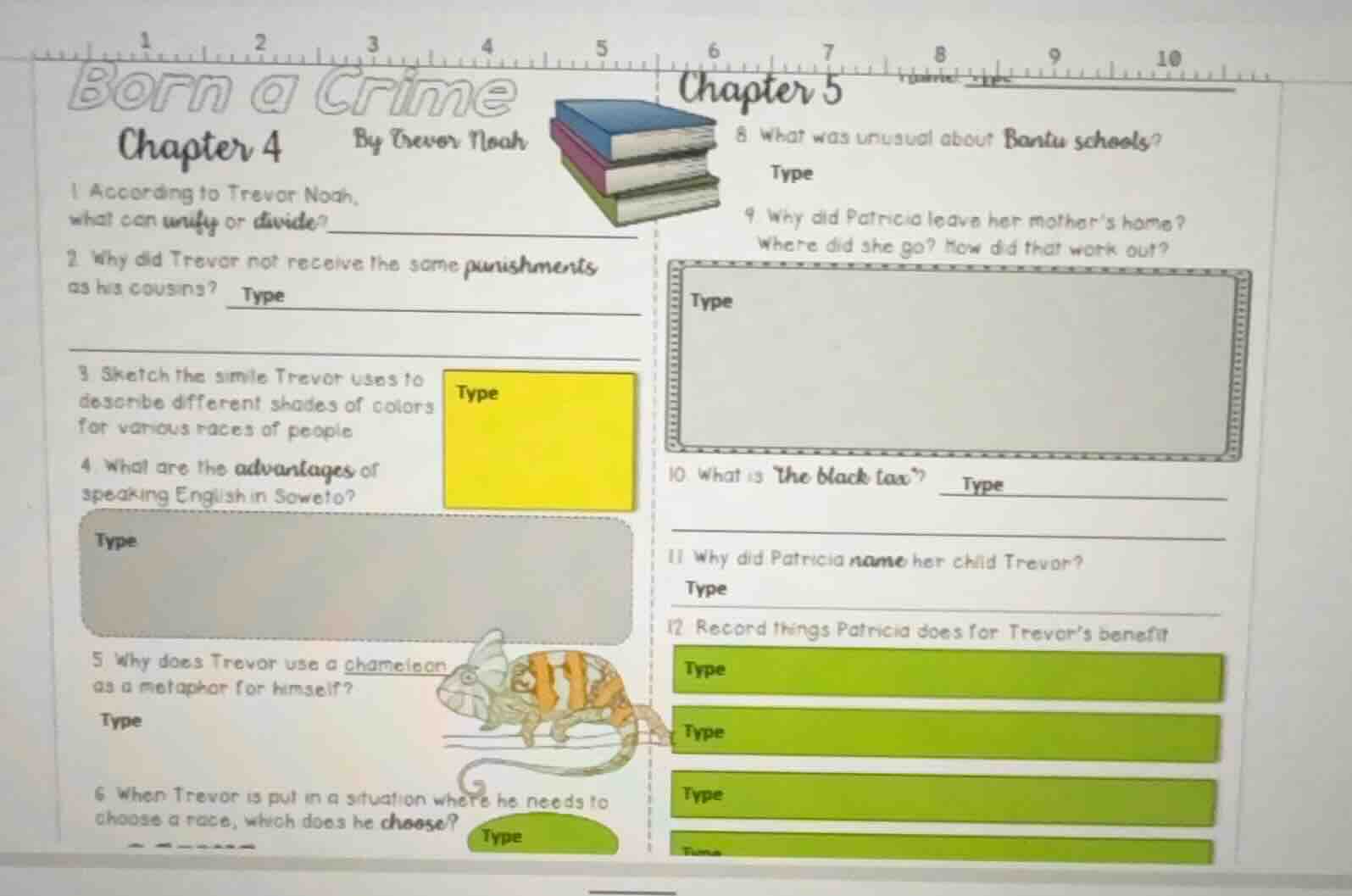
born a crime
chapter 4
by trevor noah
1 according to trevor noah,
what can unify or divide?
2 why did trevor not receive the same punishments
as his cousins? type
3 sketch the simile trevor uses to
describe different shades of colors
for various races of people
4 what are the advantages of
speaking english in soweto?
5 why does trevor use a chameleon
as a metaphor for himself?
type
6 when trevor is put in a situation where he needs to
choose a race, which does he choose?
chapter 5
8 what was unusual about bantu schools?
type
9 why did patricia leave her mother’s home?
where did she go? how did that work out?
10 what is \the black tax\? type
11 why did patricia name her child trevor?
type
12 record things patricia does for trevor’s benefit
All answers are based on content from Trevor Noah's Born a Crime: Stories from a South African Childhood.
- Trevor notes that language can both unify people (by creating shared understanding) and divide them (by creating barriers between groups who don't share a language).
- Trevor was mixed-race (Black mother, White father), so his grandmother treated him differently—she feared punishing him would lead to trouble with the apartheid authorities, who enforced strict racial hierarchies.
- Trevor uses the simile of mixing milk (White people), coffee (Black people), and different amounts of sugar to describe the spectrum of mixed-race skin tones (e.g., more sugar = lighter mixed skin).
- Speaking English in Soweto let Trevor stand out positively, access better opportunities (like jobs or connections with white South Africans), and navigate spaces across racial lines more easily.
- Trevor uses a chameleon metaphor because, as a mixed-race child under apartheid, he could "blend in" with different racial groups (Black, White, mixed) depending on the situation, adapting to survive and belong.
- When forced to choose a race, Trevor chooses to identify as Black, as he was raised in a Black community and that is where he felt the most belonging.
- Bantu schools were underfunded, segregated, and designed to teach Black South Africans only basic, menial skills—they were not meant to provide a high-quality, equal education to white schools, as part of apartheid's racial oppression.
- Patricia left her mother's home to escape an abusive, controlling relationship with her partner (Trevor's stepfather, Abel) and to create a safer, more independent life for herself and Trevor. She moved to a different area of Soweto, which gave her more freedom but also brought new financial and social challenges.
- "The Black tax" is the expectation that successful Black South Africans must financially support their extended family members, often for life, as a way to repay the community for helping them succeed under systemic oppression.
- Patricia named Trevor "Trevor" because it was a neutral, English name that would not immediately mark him as Black or White under apartheid, which could help him avoid some racial discrimination and give him more flexibility in navigating segregated spaces.
- Patricia did many things for Trevor's benefit:
- She worked multiple jobs to provide for him and give him access to education and opportunities most Black children in Soweto did not have.
- She taught him to speak multiple languages to help him navigate different racial and social spaces.
- She encouraged his curiosity and independence, even when it went against strict apartheid rules.
- She protected him from violence and discrimination, often putting herself at risk to keep him safe.

Snap & solve any problem in the app
Get step-by-step solutions on Sovi AI
Photo-based solutions with guided steps
Explore more problems and detailed explanations
- Language
- He was mixed-race; apartheid rules made his grandmother hesitant to punish him the same way as his Black cousins.
- (Sketch idea: A cup of coffee with varying amounts of sugar, labeled to match different skin tones/racial identities)
- It let him cross racial lines, access better opportunities, and stand out positively.
- As a mixed-race child, he could adapt and "blend in" with different racial groups to survive and belong.
- He chooses to identify as Black, his community of upbringing.
- They were segregated, underfunded, and designed to teach only menial skills (not equal education to white schools).
- She escaped an abusive relationship; she moved to another part of Soweto, gaining freedom but facing new financial struggles.
- The expectation that successful Black South Africans financially support their extended family for life.
- It was a neutral English name that would help him avoid immediate racial targeting under apartheid.
12.
- Worked multiple jobs to fund his education and opportunities
- Taught him multiple languages to navigate segregated spaces
- Encouraged his curiosity and independence despite apartheid rules
- Protected him from violence and discrimination, often at her own risk