QUESTION IMAGE
Question
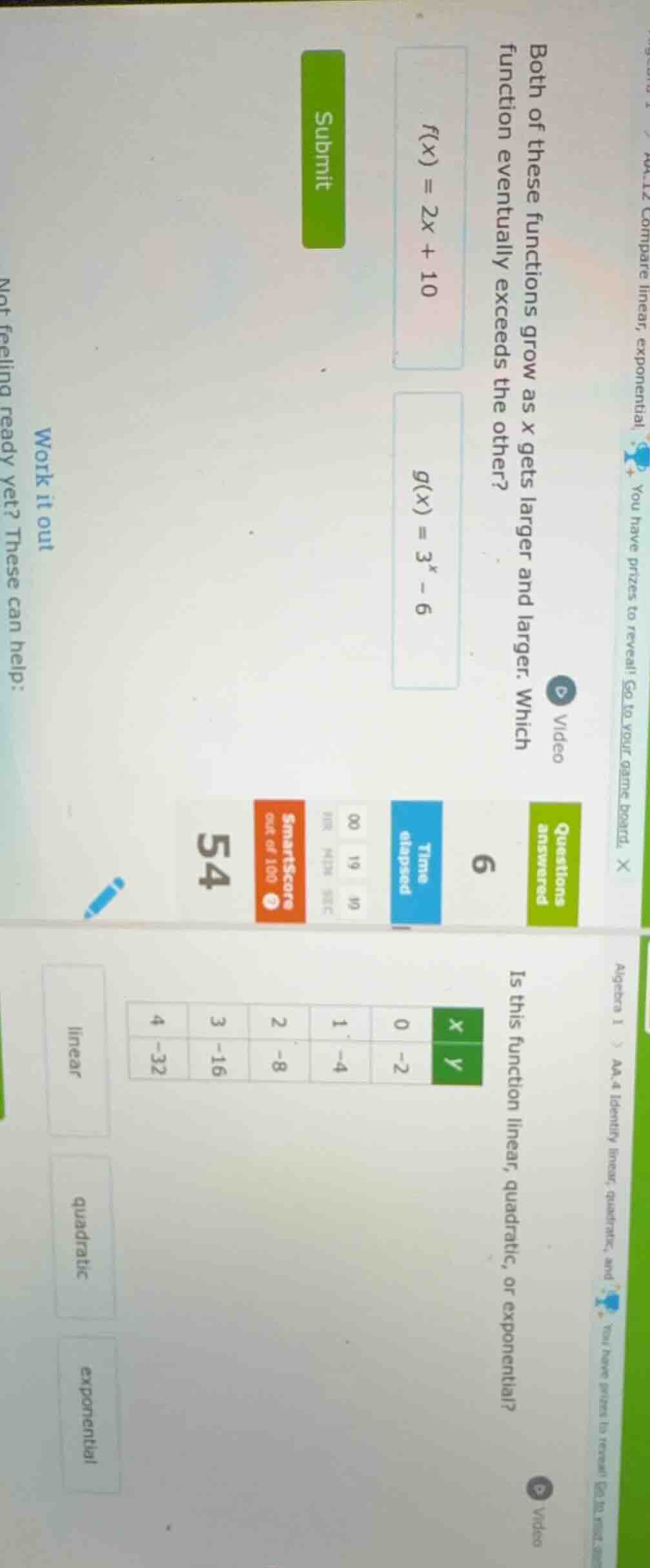
- both of these functions grow as x gets larger and larger. which function eventually exceeds the other? $f(x) = 2x + 10$ $g(x) = 3^{x} - 6$ submit
- is this function linear, quadratic, or exponential?
| x | y | ---- | ---- | 0 | -2 | 1 | -4 | 2 | -8 | 3 | -16 | 4 | -32 | linearquadraticexponential |
First Question (Function Growth Comparison)
Step1: Test small x values
Calculate $f(x)$ and $g(x)$ for small $x$:
- $x=0$: $f(0)=2(0)+10=10$, $g(0)=3^0-6=1-6=-5$
- $x=3$: $f(3)=2(3)+10=16$, $g(3)=3^3-6=27-6=21$
- $x=4$: $f(4)=2(4)+10=18$, $g(4)=3^4-6=81-6=75$
Step2: Analyze long-term growth
Linear function $f(x)$ has constant slope $2$; exponential function $g(x)=3^x-6$ has growth rate that accelerates as $x$ increases. Exponential functions always outpace linear functions as $x\to\infty$.
Step1: Check linearity (constant slope)
Slope between $(0,-2)$ and $(1,-4)$: $\frac{-4-(-2)}{1-0}=-2$
Slope between $(1,-4)$ and $(2,-8)$: $\frac{-8-(-4)}{2-1}=-4$
Slopes are not constant, so not linear.
Step2: Check exponential (constant ratio)
Ratio of $y$-values for $x$ increasing by 1:
$\frac{-4}{-2}=2$, $\frac{-8}{-4}=2$, $\frac{-16}{-8}=2$, $\frac{-32}{-16}=2$
There is a constant multiplicative ratio of 2.

Snap & solve any problem in the app
Get step-by-step solutions on Sovi AI
Photo-based solutions with guided steps
Explore more problems and detailed explanations
The function $g(x)=3^x - 6$ eventually exceeds $f(x)=2x + 10$.
---