QUESTION IMAGE
Question
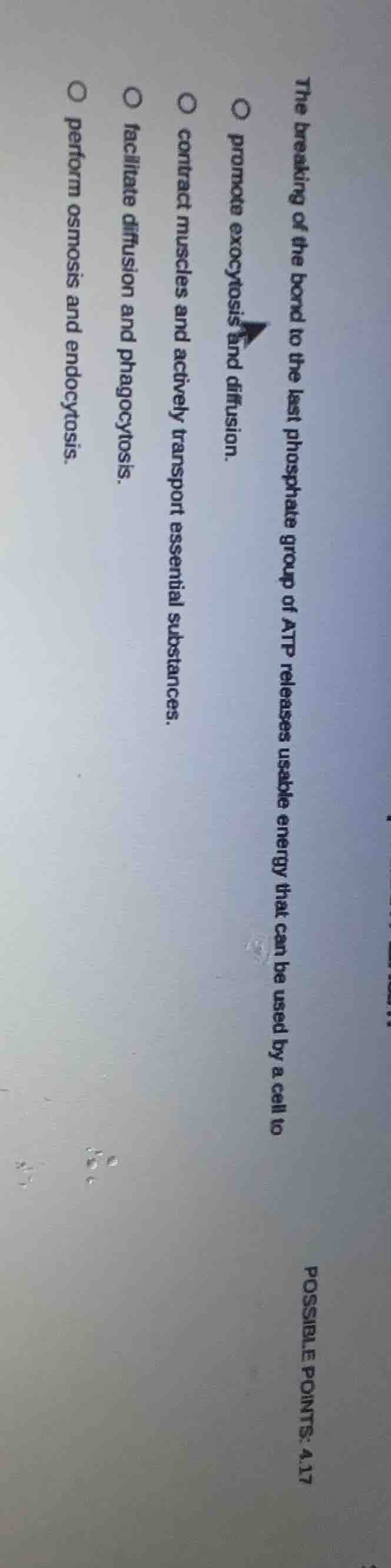
the breaking of the bond to the last phosphate group of atp releases usable energy that can be used by a cell to
promote exocytosis and diffusion.
contract muscles and actively transport essential substances.
facilitate diffusion and phagocytosis.
perform osmosis and endocytosis.
Brief Explanations
To solve this, we analyze each option:
- Option 1: Exocytosis is active transport (needing energy), diffusion is passive (no energy). ATP - derived energy isn't for promoting both as diffusion doesn't need it. Eliminate.
- Option 2: Muscle contraction and active transport of essential substances both require energy. When ATP loses its last phosphate, it releases energy. Muscle contraction (like in muscle cells) and active transport (moving substances against concentration gradient) use this energy. This fits.
- Option 3: Diffusion is passive (no energy), phagocytosis is active (needs energy). But ATP's energy isn't mainly to "facilitate" diffusion (which happens spontaneously). Eliminate.
- Option 4: Osmosis (passive, no energy) and endocytosis (active, needs energy). ATP's energy isn't for performing osmosis. Eliminate.

Snap & solve any problem in the app
Get step-by-step solutions on Sovi AI
Photo-based solutions with guided steps
Explore more problems and detailed explanations
The correct option is the one with "contract muscles and actively transport essential substances." (The option with text: "contract muscles and actively transport essential substances.")