QUESTION IMAGE
Question
bridge to college mathematics student manual
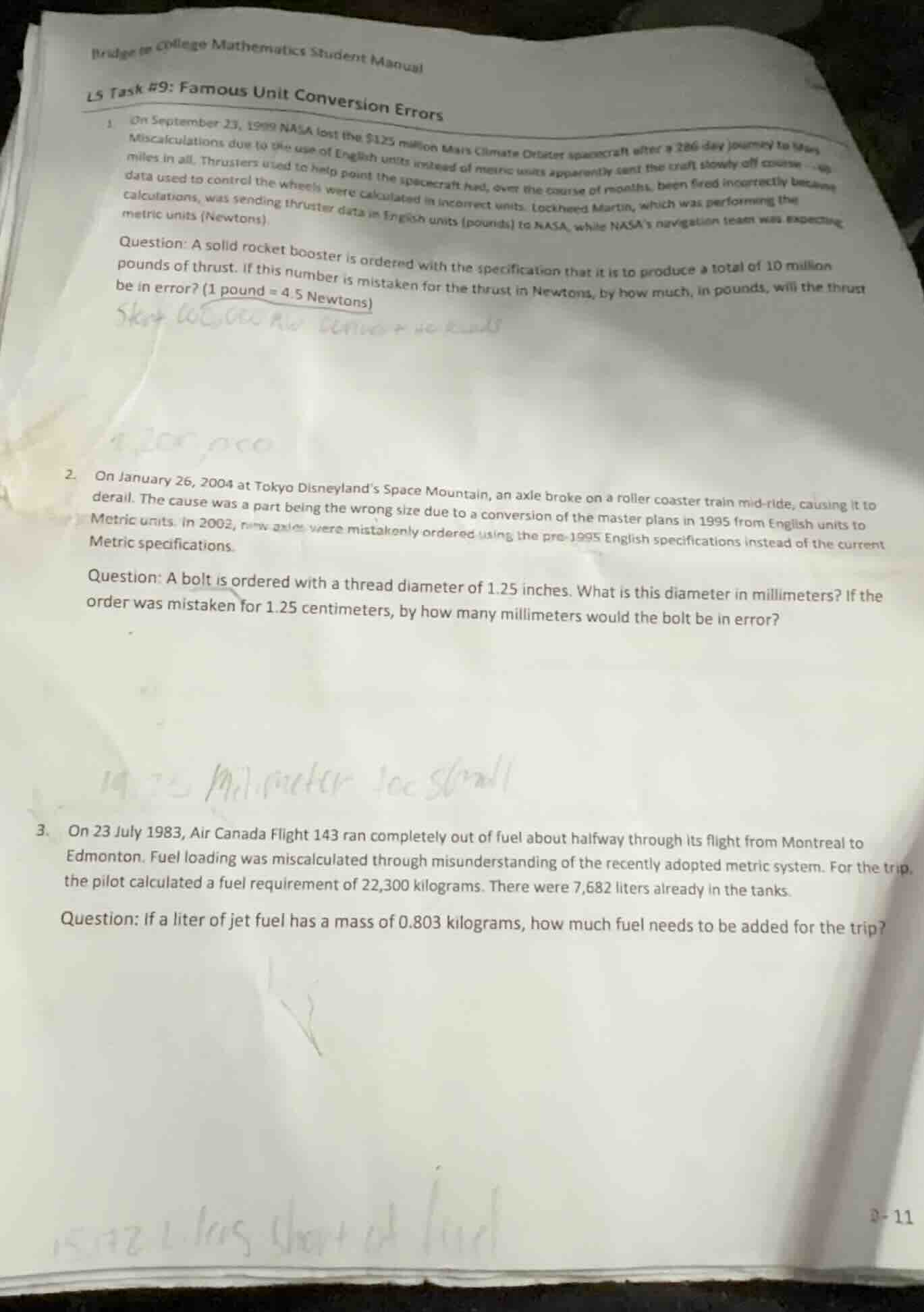
ls task #9: famous unit conversion errors
- on september 23, 1999 nasa lost the $125 million mars climate orbiter spacecraft after a 286 - day journey to mars. miscalculations due to the use of english units instead of metric units apparently sent the craft slowly off course — 40 miles in all. thrusters used to help point the spacecraft had, over the course of months, been fired incorrectly because data used to control the wheels were calculated in incorrect units. lockheed martin, which was performing the calculations, was sending thruster data in english units (pounds) to nasa, while nasa’s navigation team was expecting metric units (newtons).
question: a solid rocket booster is ordered with the specification that it is to produce a total of 10 million pounds of thrust. if this number is mistaken for the thrust in newtons, by how much, in pounds, will the thrust be in error? (1 pound = 4.5 newtons)
- on january 26, 2004 at tokyo disneyland’s space mountain, an axle broke on a roller coaster train mid - ride, causing it to derail. the cause was a part being the wrong size due to a conversion of the master plans in 1995 from english units to metric units. in 2002, new axles were mistakenly ordered using the pre - 1995 english specifications instead of the current metric specifications.
question: a bolt is ordered with a thread diameter of 1.25 inches. what is this diameter in millimeters? if the order was mistaken for 1.25 centimeters, by how many millimeters would the bolt be in error?
- on 23 july 1983, air canada flight 143 ran completely out of fuel about halfway through its flight from montreal to edmonton. fuel loading was miscalculated through misunderstanding of the recently adopted metric system. for the trip, the pilot calculated a fuel requirement of 22,300 kilograms. there were 7,682 liters already in the tanks.
question: if a liter of jet fuel has a mass of 0.803 kilograms, how much fuel needs to be added for the trip?
Step1: Convert Newtons to pounds
First, convert the mistaken 10 million Newtons to pounds using the conversion factor $1 \text{ pound} = 4.5 \text{ Newtons}$.
$\text{Thrust in pounds (mistaken)} = \frac{10,000,000}{4.5} \approx 2,222,222.22$
Step2: Calculate thrust error
Subtract the mistaken thrust (in pounds) from the specified thrust (10 million pounds) to find the error.
$\text{Error} = 10,000,000 - 2,222,222.22 = 7,777,777.78$
---
Step1: Convert inches to millimeters
Use $1 \text{ inch} = 25.4 \text{ mm}$ to convert 1.25 inches.
$1.25 \times 25.4 = 31.75 \text{ mm}$
Step2: Convert cm to millimeters
Use $1 \text{ cm} = 10 \text{ mm}$ to convert 1.25 cm.
$1.25 \times 10 = 12.5 \text{ mm}$
Step3: Calculate diameter error
Subtract the mistaken diameter from the correct diameter.
$\text{Error} = 31.75 - 12.5 = 19.25 \text{ mm}$
---
Step1: Calculate existing fuel mass
Multiply existing fuel volume by mass per liter.
$7,682 \times 0.803 = 6,168.646 \text{ kg}$
Step2: Calculate required fuel to add
Subtract existing fuel mass from total required mass.
$\text{Fuel to add} = 22,300 - 6,168.646 = 16,131.354 \text{ kg}$

Snap & solve any problem in the app
Get step-by-step solutions on Sovi AI
Photo-based solutions with guided steps
Explore more problems and detailed explanations
- The thrust will be in error by 7,777,777.78 pounds.
- The correct diameter is 31.75 millimeters; the bolt will be in error by 19.25 millimeters.
- 16,131.35 kilograms of fuel needs to be added.