QUESTION IMAGE
Question
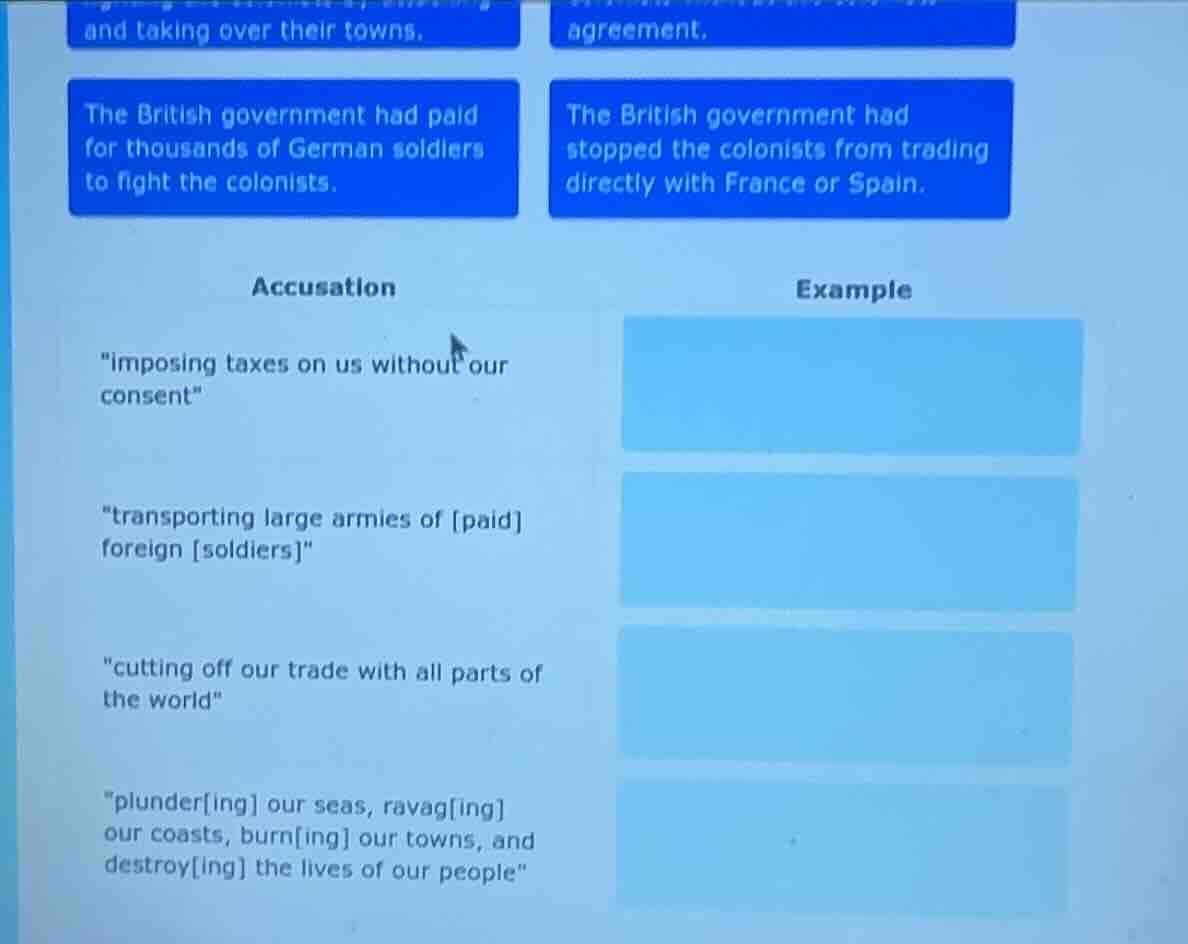
the british government had paid for thousands of german soldiers to fight the colonists. the british government had stopped the colonists from trading directly with france or spain. accusation example \imposing taxes on us without our consent\ \transporting large armies of paid foreign soldiers\ \cutting off our trade with all parts of the world\ \plundering our seas, ravaging our coasts, burning our towns, and destroying the lives of our people\
To solve this, we match each accusation with the appropriate example by analyzing the content:
1. “Imposing taxes on us without our consent”
No direct example from the given blue boxes relates to taxation, but if we assume other context (though not provided here), typically this would relate to tax-related actions. However, from the given blue boxes, none fit perfectly, but maybe a missing one. But with the given, let's use the provided blue boxes:
2. “transporting large armies of [paid] foreign [soldiers]”
The blue box: “The British government had paid for thousands of German soldiers to fight the colonists.” matches this, as it's about paying foreign soldiers to fight.
3. “cutting off our trade with all parts of the world”
The blue box: “The British government had stopped the colonists from trading directly with France or Spain.” relates (though “all parts” is broader, this is a trade restriction).
4. “plunder[ing] our seas, ravag[ing] our coasts, burn[ing] our towns, and destroy[ing] the lives of our people”
The blue box: “and taking over their towns” (assuming a typo or partial, but the action of taking towns aligns with burning/destroying towns).
Filling the Table:
| Accusation | Example |
|---|---|
| "transporting large armies of [paid] foreign [soldiers]" | The British government had paid for thousands of German soldiers to fight the colonists. |
| "cutting off our trade with all parts of the world" | The British government had stopped the colonists from trading directly with France or Spain. |
| "plunder[ing] our seas, ravag[ing] our coasts, burn[ing] our towns, and destroy[ing] the lives of our people" | (Assuming the "and taking over their towns" box, as it relates to town destruction) |
If we strictly use the given blue boxes:
- For “transporting large armies of [paid] foreign [soldiers]”: The British government had paid for thousands of German soldiers to fight the colonists.
- For “cutting off our trade with all parts of the world”: The British government had stopped the colonists from trading directly with France or Spain.
- For “plunder[ing]...”: and taking over their towns (matches town destruction).
- For “Imposing taxes...”: No direct match in given boxes.
We analyze each accusation and match it to the example by identifying the core action (e.g., foreign soldiers paid, trade restriction, town destruction) in the blue boxes.

Snap & solve any problem in the app
Get step-by-step solutions on Sovi AI
Photo-based solutions with guided steps
Explore more problems and detailed explanations
| Accusation | Example |
|---|---|
| "transporting large armies of [paid] foreign [soldiers]" | The British government had paid for thousands of German soldiers to fight the colonists. |
| "cutting off our trade with all parts of the world" | The British government had stopped the colonists from trading directly with France or Spain. |
| "plunder[ing] our seas, ravag[ing] our coasts, burn[ing] our towns, and destroy[ing] the lives of our people" | and taking over their towns. |