QUESTION IMAGE
Question
a calculator is allowed on this question.
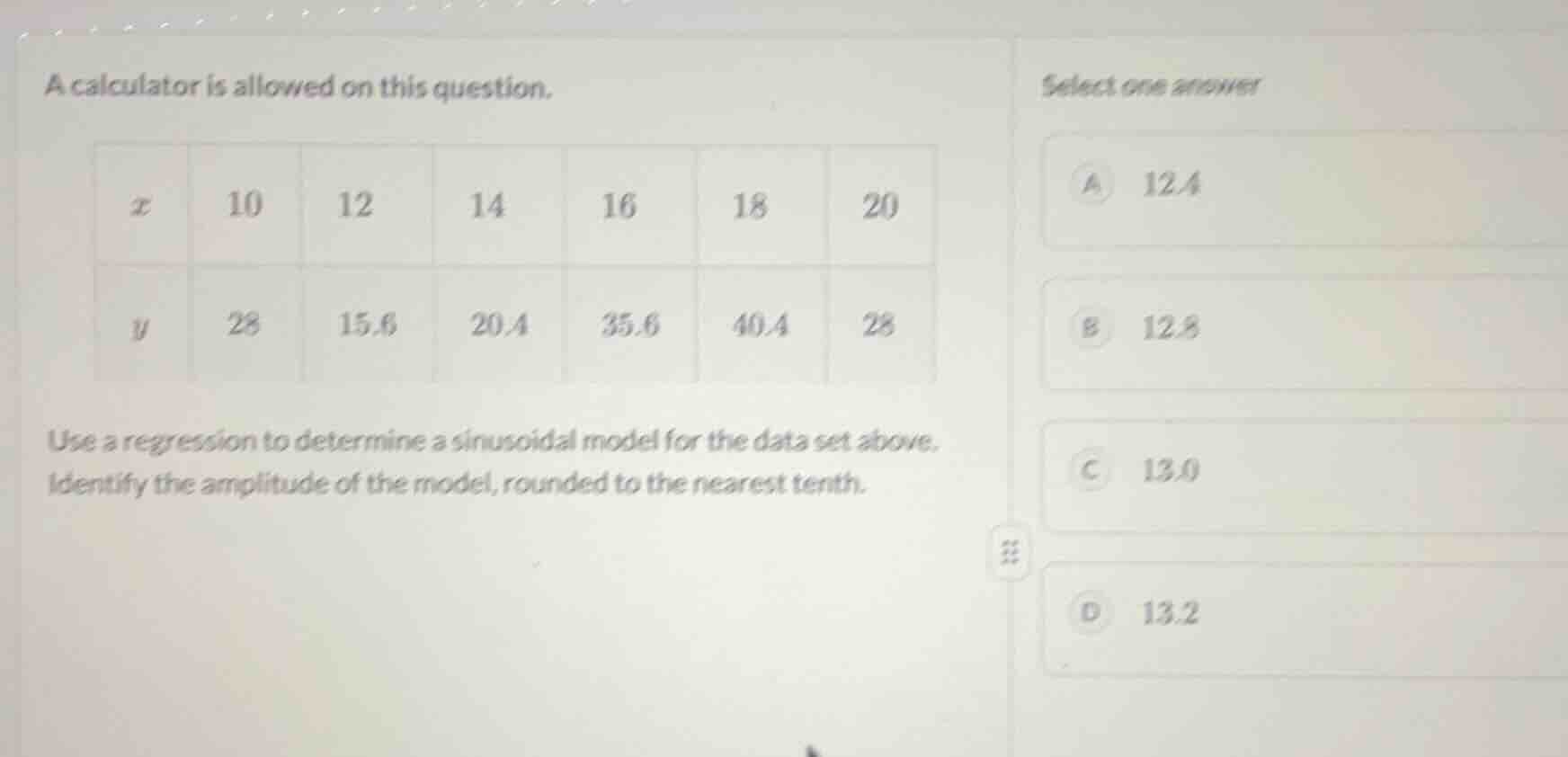
| x | 10 | 12 | 14 | 16 | 18 | 20 |
| y | 28 | 15.6 | 20.4 | 35.6 | 40.4 | 28 |
use a regression to determine a sinusoidal model for the data set above. identify the amplitude of the model, rounded to the nearest tenth.
select one answer
a 12.4
b 12.8
c 13.0
d 13.2
Step1: Recall Sinusoidal Model Form
A sinusoidal model is generally \( y = A\sin(B(x - C)) + D \) or \( y = A\cos(B(x - C)) + D \). The amplitude \( |A| \) is related to the maximum and minimum values of \( y \). First, find the maximum and minimum \( y \)-values.
From the data: \( y_{\text{min}} = 15.6 \), \( y_{\text{max}} = 40.4 \).
Step2: Calculate Amplitude
Amplitude \( A=\frac{y_{\text{max}} - y_{\text{min}}}{2} \).
Substitute values: \( A=\frac{40.4 - 15.6}{2}=\frac{24.8}{2} = 12.4 \)? Wait, no—wait, maybe using regression. Wait, let's check the data again. Wait, the \( y \)-values: 28, 15.6, 20.4, 35.6, 40.4, 28. Wait, maybe the midline \( D=\frac{y_{\text{max}}+y_{\text{min}}}{2} \), and amplitude is \( \frac{y_{\text{max}} - y_{\text{min}}}{2} \). Wait, but maybe the regression gives a better fit. Alternatively, let's use the formula for amplitude in sinusoidal regression. The general form for a sinusoid can also be \( y = A\sin(\omega x + \phi) + k \) or \( y = A\cos(\omega x + \phi) + k \). The amplitude is \( |A| \). Let's find the max and min of \( y \): max is 40.4, min is 15.6. Then amplitude is \( (40.4 - 15.6)/2 = 24.8/2 = 12.4 \)? But wait, the options include 12.4 (A), 12.8 (B), etc. Wait, maybe I made a mistake. Wait, let's check the data points again. Wait, 28 is repeated at x=10 and x=20, so the period might be 10 (from 10 to 20 is 10 units, so period \( T = 10 \)? Wait, no, x goes from 10 to 20, step 2. Wait, maybe the midline is the average of the maximum and minimum, but also considering the repeated 28. Wait, let's calculate the mean of all y-values: (28 + 15.6 + 20.4 + 35.6 + 40.4 + 28)/6 = (28*2 + 15.6 + 20.4 + 35.6 + 40.4)/6 = (56 + 15.6 + 20.4 + 35.6 + 40.4)/6 = (56 + 112)/6 = 168/6 = 28. Oh! The midline \( D = 28 \). Then the maximum deviation from the midline: max y - D = 40.4 - 28 = 12.4; min y - D = 15.6 - 28 = -12.4. So the amplitude is 12.4? Wait, that's exactly option A. Wait, because the midline is 28 (since 28 is the average of the max and min? Wait, no, the mean of all y is 28. So the amplitude is the maximum distance from the midline (28) to a y-value. So 40.4 - 28 = 12.4, 28 - 15.6 = 12.4. So the amplitude is 12.4.

Snap & solve any problem in the app
Get step-by-step solutions on Sovi AI
Photo-based solutions with guided steps
Explore more problems and detailed explanations
A. 12.4