QUESTION IMAGE
Question
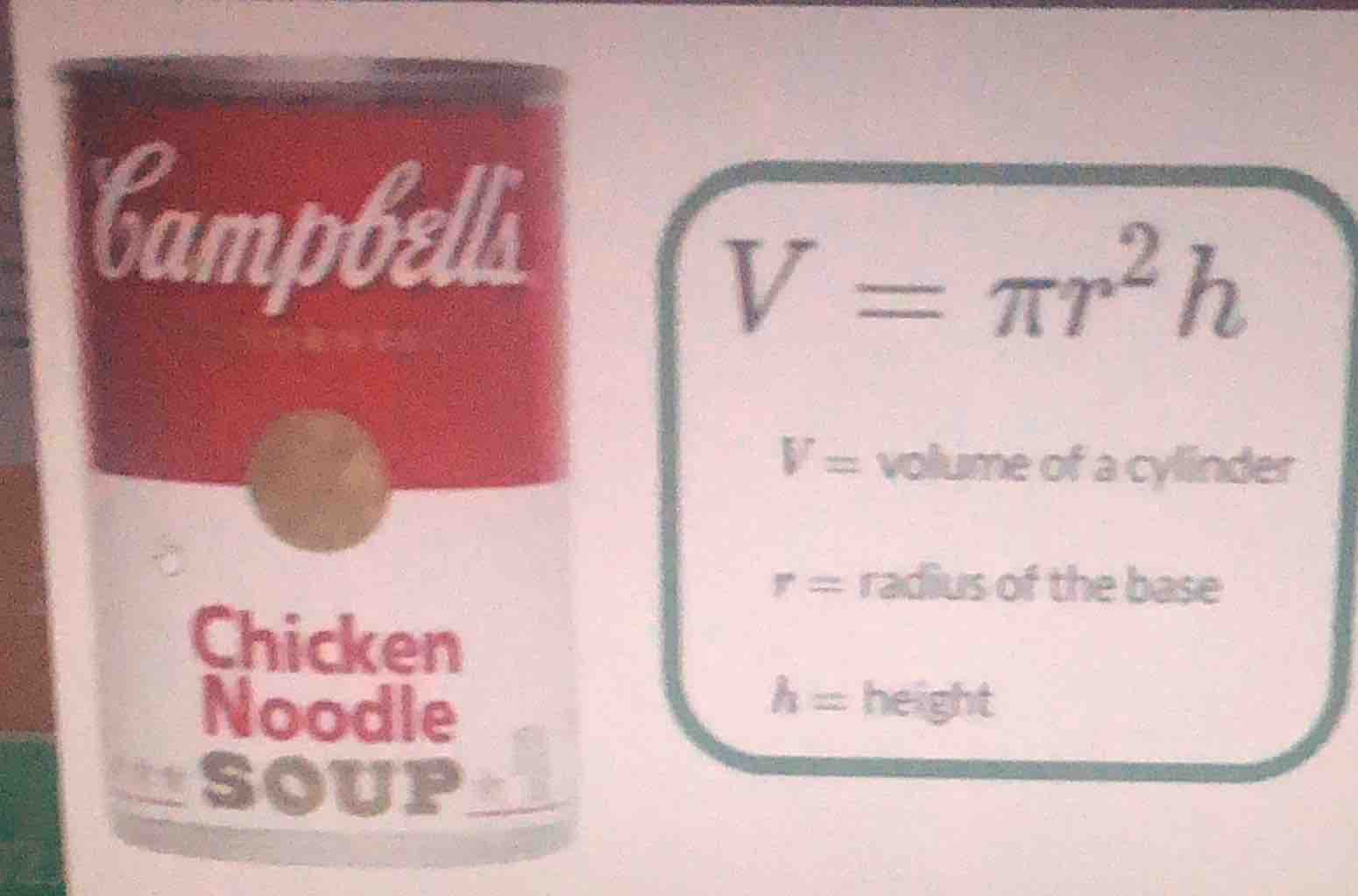
campbells chicken noodle soup; $v = pi r^2 h$; $v = $ volume of a cylinder; $r = $ radius of the base; $h = $ height
Since the problem (presumably about calculating the volume of the soup can, a cylinder) isn't fully stated (no values for \( r \) and \( h \) are given), we can't perform the calculation. But if we assume we have the radius \( r \) and height \( h \) of the can:
Step1: Identify the formula
The formula for the volume \( V \) of a cylinder is given as \( V = \pi r^2 h \), where \( r \) is the radius of the base and \( h \) is the height.
Step2: Substitute values
If we know the numerical values of \( r \) (in appropriate units, e.g., centimeters) and \( h \) (in the same units), we substitute them into the formula. For example, if \( r = 3 \, \text{cm} \) and \( h = 10 \, \text{cm} \), then:
\( V = \pi \times (3)^2 \times 10 = \pi \times 9 \times 10 = 90\pi \approx 282.74 \, \text{cubic centimeters} \) (this is just an example with made - up values; actual values from the can would be used).
Since the problem as presented doesn't have the necessary values for \( r \) and \( h \) to compute the volume, we can't give a final numerical answer without that information. If you provide the radius and height of the soup can, we can calculate the volume using the formula \( V=\pi r^{2}h \).

Snap & solve any problem in the app
Get step-by-step solutions on Sovi AI
Photo-based solutions with guided steps
Explore more problems and detailed explanations
Step1: Identify the formula
The formula for the volume \( V \) of a cylinder is given as \( V = \pi r^2 h \), where \( r \) is the radius of the base and \( h \) is the height.
Step2: Substitute values
If we know the numerical values of \( r \) (in appropriate units, e.g., centimeters) and \( h \) (in the same units), we substitute them into the formula. For example, if \( r = 3 \, \text{cm} \) and \( h = 10 \, \text{cm} \), then:
\( V = \pi \times (3)^2 \times 10 = \pi \times 9 \times 10 = 90\pi \approx 282.74 \, \text{cubic centimeters} \) (this is just an example with made - up values; actual values from the can would be used).
Since the problem as presented doesn't have the necessary values for \( r \) and \( h \) to compute the volume, we can't give a final numerical answer without that information. If you provide the radius and height of the soup can, we can calculate the volume using the formula \( V=\pi r^{2}h \).